Nehemiah 12
Translation for Translators · Tap a verse to see its cross-references.
A list of the priests and Levites who returned
1Many priests and other descendants of Levi returned ◄from Babylonia/to Jerusalem► with Zerubbabel and Jeshua. They included
Seraiah, Jeremiah, Ezra,
2Amariah, Malluch, Hattush,
3Shecaniah, Rehum, Meremoth,
4Iddo, Ginnethon, Abijah,
5Mijamin, Moadiah, Bilgah,
6Shemaiah, Joiarib, Jedaiah,
7Sallu, Amok, Hilkiah, and Jedaiah.
All those men were leaders of the priests during the time that Jeshua was the Supreme Priest.
8Some of the other descendants of Levi who returned were Jeshua, Binnui, Kadmiel, Sherebiah, Judah, and Mattaniah. They were in charge of singing songs to thank God. 9Bakbukiah, Unni, and other descendants of Levi formed a choir that stood opposite the other group and sang in reply to them.
A list of descendants of Jeshua the Supreme Priest
10Jeshua who was the Supreme Priest was the father of Joiakim, who was the father of Eliashib, who was the father of Joiada, 11who was the father of Jonathan, who was the father of Jaddua.
Leaders of the clans of priests
12When Joiakim was the Supreme Priest, these were the leaders of the clans of priests:
Meraiah, from the clan of Seraiah;
Hananiah, from the clan of Jeremiah;
13Meshullam, from the clan of Ezra;
Jehohanan, from the clan of Amariah;
14Jonathan, from the clan of Malluch;
Joseph, from the clan of Shecaniah;
15Adna, from the clan of Harim;
Helkai, from the clan of Meremoth/Maraioth;
16Zechariah, from the clan of Iddo;
Meshullam, from the clan of Ginnethon;
17Zicri, from the clan of Abijah.
There was also a leader from the clan of Miniamin;
Piltai, from the clan of Moadiah;
18Shammua, from the clan of Bilgah;
Jehonathan, from the clan of Shemaiah;
19Mattenai, from the clan of Joiarib;
Uzzi, from the clan of Jedaiah;
20Kallai, from the clan of Sallu/Sallai;
Eber, from the clan of Amok;
21Hashabiah, from the clan of Hilkiah;
and Nethanel, from the clan of Jedaiah.
Duties of priests and Levites
22During the years that Eliashib, Joiada, Johanan, and Jaddua were Supreme Priests, they ◄wrote/kept a list of► the names of the clans who were descendants of Levi. When Darius was the king of Persia, they stopped writing that list. 23They wrote the names of the leaders of the clans who were descendants of Levi in the Book of Events in Israel, but they stopped writing those names when Eliashib’s grandson Johanan was the Supreme Priest.
24These are the leaders of the clans who are descendants of Levi: Hashabiah, Sherebiah, Jeshua, Binnui, Kadmiel and others who were divided into two groups. The two groups faced each other, one group replying to the other, during the time that they praised and thanked God. They did that just as King David, the man who served God well, had instructed. 25These singers included Mattaniah, Bakbukiah, and Obadiah.
The men who guarded the storerooms close to the gates of the temple were Meshullam, Talmon, and Akkub. 26They did that work during the time that Joiakim, who was the son of Jeshua and the grandson of Jehozadak, was the Supreme Priest, and I was the governor, and Ezra was the priest who knew the Jewish laws very well.
Nehemiah dedicated the wall
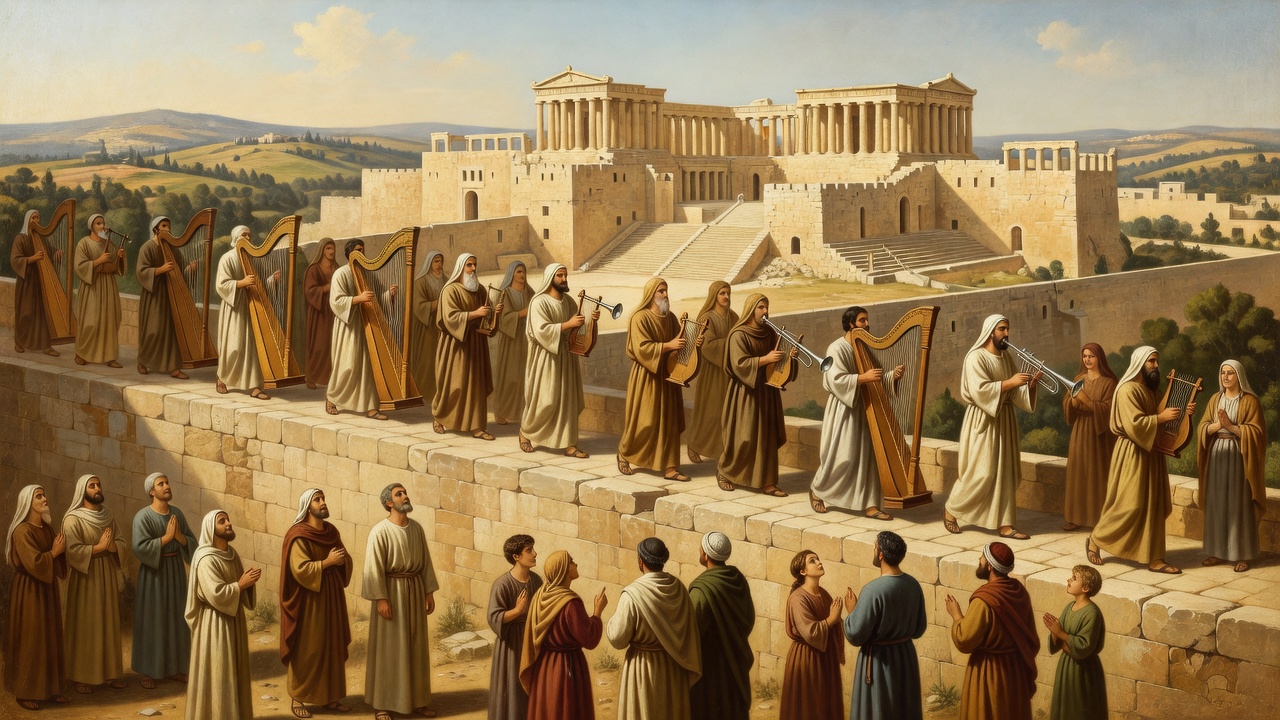
27When we dedicated the wall around Jerusalem, we summoned the descendants of Levi who help the priests from the nearby places where they were living. We asked them to join with us to celebrate when we dedicated the wall. We wanted them to sing songs to thank Yahweh and make music by playing cymbals and harps and other stringed instruments. 28We summoned the descendants of Levi who habitually sang together. They came to Jerusalem from nearby areas where they had settled, and from places around Netophah town southeast of Jerusalem, 29and from three places northeast of Jerusalem—Beth Gilgal city and the areas around Geba and Azmaveth. Those singers had built villages to live in near Jerusalem.
30When they came to Jerusalem, the priests and other descendants of Levi who help the priests performed rituals to cause themselves to be acceptable to God, and then they performed similar rituals to purify the other people, the gates, and the wall. 31Then I gathered together the leaders of Judah on top of the wall, and I appointed them to lead two large groups to march around the city on top of the wall, thanking God. As they faced the city, one group walked to the right toward the Dung Gate. 32Behind their leaders marched Hoshaiah and half of the leaders of Judah. 33Behind them marched a group of priests who were blowing trumpets. They were Azariah, Ezra, Meshullam, Judah, Benjamin, Shemaiah, and Jeremiah. Next came Zechariah, the son of Jonathan, the son of Shemaiah, the son of Mattaniah, the son of Micaiah, the son of Zaccur, a descendant of Asaph. 36Behind them marched other members of Zechariah’s clan: Shemaiah, Azarel, Milalai, Gilalai, Maai, Nethanel, Judah, and Hanani. They all were playing the same kinds of musical instruments that King David had played many years previously. Ezra, the man who knew the Jewish laws very well, marched in front of this group. 37When they reached the Fountain Gate, they went up the steps to David’s City, past his palace, and then to the wall at the Water Gate, on the east side of the city.
38The other group of those who were thanking Yahweh marched to the left on top of the wall. I followed them with half of the people. We marched past the Tower of the Ovens to the Broad Wall. 39From there we marched past Ephraim Gate, Jeshanah Gate, the Fish Gate, the Tower of Hananel, the Tower of the Hundred Soldiers, to the Sheep Gate. We finished marching near the gate into the temple. 40Both the groups reached the temple while they were thanking God. They stood in their places there. The leaders who were with me also stood with me in our places.
41My group included these priests who were all blowing trumpets: Eliakim, Maaseiah, Miniamin, Micaiah, Elioenai, Zechariah, Hananiah, 42another Maaseiah, Shemaiah, Eleazar, Uzzi, Jehohanan, Malchijah, Elam, and Ezer. The singers, whose leader was Jezrahiah, sang loudly. 43After we went outside the temple, we offered many sacrifices. We men all rejoiced because God had caused us to be very happy. The women and the children also rejoiced. People far away could hear the noise that we made there in Jerusalem.
Preparations for worship in the temple
44On that day, men were appointed {they appointed men} to be in charge of the storerooms where they kept the money that people contributed for the temple. They also kept there the other things that the people contributed— the tithes and the first part of the grain and fruit that was harvested each year. Those men collected those things from the fields/farms near the cities, and took them to Jerusalem and gave them to the priests and the other descendants of Levi, as Moses had said in his laws that they should do. All the Israeli people were happy about the work that the priests and the descendants of Levi did, 45because they performed the rituals to purify things, and the other rituals that God had commanded. The musicians in the temple also did their work as King David and his son Solomon had declared that they should do. 46Ever since the time that David had been the king and Asaph had been his chief musician, the musicians had led the people while they sang songs to praise and thank God. 47During the years that Zerubbabel and I governed the Israeli people, they all contributed the food that the singers and temple gatekeepers needed each day. They gave ◄a tithe/10%► of their crops to the descendants of Levi who helped the priests, and those descendants of Levi gave ◄a tithe/10%► of that to the priests, who were descendants of Aaron the first Supreme Priest.
Did you know?
Dedication of the Wall and Priestly Registers
- For the dedication of Jerusalem's rebuilt wall, Levites and singers were brought from surrounding settlements where they had built villages, including Beth-gilgal and the fields of Geba and Azmaveth. Musical worship was organized in alternating groups using instruments patterned after the instructions of King David.Sources: the Bible text itself · Beth-gilgal · Geba · Azmaveth
- The dedication ceremony featured two large thanksgiving choirs marching directly along the top of the newly repaired city walls in opposite directions. One procession was led by Ezra the scribe toward the Dung Gate, while Nehemiah followed the second group, until both choirs met at the house of God.Sources: the Bible text itself · Dung Gate · Gate of the Fountain
- The chapter preserves ancestral records of priests and Levites spanning from the first return under Zerubbabel and the high priest Jeshua through several generations into the Persian period. These records documented the lineage of high priests and family heads responsible for temple services and gatekeeping.Sources: the Bible text itself · Zerubbabel · Joshua · Eliashib
Notes written with AI assistance from open sources (Theographic Bible Metadata, CC BY-SA 4.0; Easton’s Bible Dictionary, public domain) and reviewed before publishing.
Places in this chapter
- Jerusalem · 31.777, 35.234 · verses 27, 28, 29, 43
- Dung Gate · Today: in Jerusalem · 31.777, 35.234 · verse 31
- City of David · 31.774, 35.236 · verse 37
- Fountain Gate · Today: in Jerusalem · 31.777, 35.234 · verse 37
- Water Gate · Today: in Jerusalem · 31.777, 35.234 · verse 37
- Broad Wall · 31.776, 35.232 · verse 38
- Tower of the Ovens · Today: in Jerusalem · 31.777, 35.234 · verse 38
- Ephraim Gate · Today: in Jerusalem · 31.777, 35.234 · verse 39
- Fish Gate · Today: in Jerusalem · 31.777, 35.234 · verse 39
- Gate of the Guard · Today: in Jerusalem · 31.777, 35.234 · verse 39
- Gate of Yeshanah · Today: in Jerusalem · 31.777, 35.234 · verse 39
- Sheep Gate · Today: in Jerusalem · 31.777, 35.234 · verse 39
- Tower of Hananel · Today: Antonia Fortress · 31.780, 35.234 · verse 39
- Tower of the Hundred · Today: within 500 m of the Antonia Fortress · 31.780, 35.234 · verse 39
Only places identified with high confidence are shown (90% or more according to the scholarly sources compiled by OpenBible). Period map: DARE (Digital Atlas of the Roman Empire), CC BY 4.0; modern map: © OpenStreetMap contributors; places: OpenBible.info (CC BY 4.0).
Credits and license for this translation
Translation for Translators
A Bible Translation for Bible Translators which makes implied information explicit in the text as an aid to the translator who may need that information to correctly translate into a particular language.
Copyright © 2008-2017 Ellis W. Deibler, Jr.
Language: English
Dialect: American
This translation is made available to you under the terms of the
Creative Commons Attribution Share-Alike license 4.0.
You have permission to share and redistribute this Bible translation in any format and to make reasonable revisions and adaptations of this translation, provided that:
You include the above copyright and source information.
If you make any changes to the text, you must indicate that you did so in a way that makes it clear that the original licensor is not necessarily endorsing your changes.
If you redistribute this text, you must distribute your contributions under the same license as the original.
Pictures included with Scriptures and other documents on this site are licensed just for use with those Scriptures and documents.
For other uses, please contact the respective copyright owners.
Note that in addition to the rules above, revising and adapting God's Word involves a great responsibility to be true to God's Word. See Revelation 22:18-19.
2026-10-02
Source: http://ebible.org/eng-t4t/ · eBible.org