Leviticus 6
Translation for Translators · Tap a verse to see its cross-references.
1Yahweh also said to Moses/me, 2“If any one of you you sins against me by deceiving someone—if you refuse to return what someone has lent you, or if you steal something of his, or if you find something and claim that you do not have it, 3you are guilty. You must return to its owner what you have stolen or what someone has lent you and you have not returned, or what you found that someone else had lost, 4or whatever you lied about. 5You must not only return anything like that to its owner, but you must also pay to the owner one-fifth of its value. 6You must also bring to the Supreme Priest a ram to be an offering to me in order that you will no longer be guilty. The ram that you bring must be one that has no defects, one that has the value that has been officially determined. 7Then he will offer that ram to be a sacrifice that will cause you to no longer be guilty, and you will be forgiven for the wrong things that you did.”
Other instructions concerning the burnt offerings
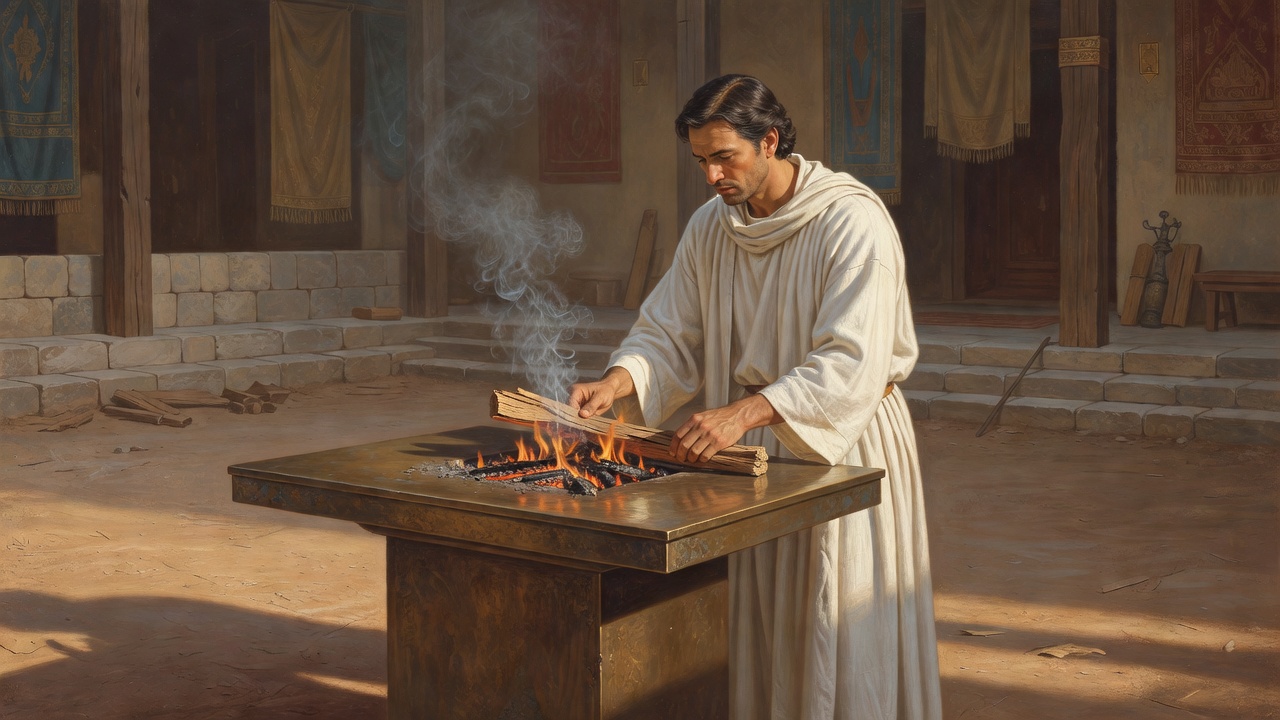
8Yahweh also said to Moses/me, 9“Tell this to Aaron and his sons: These are the regulations concerning the offerings that will be completely burned on the altar: The offering must remain on the altar all during the night, and the fire on the altar must always be kept burning. 10The next morning the priest must put on his linen under-clothes and linen outer clothes. Then he must remove the ashes of the offering from the fire and put them beside the altar. 11Then he must take off those clothes and put on other clothes, and take the ashes outside the camp, to a place that is acceptable to me. 12The fire on the altar must always be kept burning; the priest must not allow it to ◄go out/quit burning►. Each morning the priest must put more firewood on the fire. Then he must arrange more offerings on the fire, and burn on the altar the fat of the offerings to be burned to maintain fellowship with me. 13The fire on the altar must be kept burning continually; the priest must not allow it to go out.”
Other instructions concerning the grain offerings
14“These are the regulations concerning the offerings made from grain: Aaron’s sons must bring them to me in front of the altar. 15The priest must take a handful of fine flour mixed with olive oil and incense and burn that on the altar. That handful will signify that the whole offering truly belongs to me. And the aroma while it burns will be pleasing to me. 16Aaron and his sons may eat the remaining part of the grain offering. But they must eat it in a holy place, in the courtyard of the Sacred Tent. 17It must not have yeast mixed with it. Like the offerings for sin and the offerings to cause people to no longer be guilty of sin, that offering is very holy. 18Any male descendants of Aaron are permitted to eat it, because it is forever their regular share of the offerings given to me and burned in the fire on the altar. Anyone else who touches those offerings made from grain will be punished by God.”
19Yahweh also said to Moses/me, 20“Tell Aaron and his sons that this is the offering that they must bring to Yahweh on the day that any of them ◄is ordained/becomes a priest►: That person must bring two quarts/liters of fine flour as an offering made from grain. He must bring half of it in the morning and half of it in the evening. 21He must mix it well with olive oil and bake it in a shallow pan. He must then break it into small pieces to be burned on the altar. And the aroma while it burns will be pleasing to Yahweh. 22I have commanded that the descendants of Aaron who are appointed in turn to become the Supreme Priests after Aaron dies are the ones who must prepare those things. These offerings must be completely burned on the altar to be sacrifices to me, Yahweh. 23Every offering that a priest gives that is made from grain must be completely burned; none of it is to be eaten.”
Other instructions concerning the sin offering
24Yahweh also said to Moses/me, 25“Tell Aaron and his sons: These are the regulations concerning the offerings that people must bring to me so that I will forgive the people for the sins they have committed: 26The animals must be slaughtered in my presence in the same place that the animals that are to be completely burned on the altar are slaughtered, in the courtyard in front of the Sacred Tent. 27Any other person who touches any of its meat will be punished by God. And if its blood is splattered on your clothes, you must wash the clothes in a holy place. 28If the meat is cooked in a clay pot, the pot must be broken afterwards. But if it is cooked in a bronze pot, the pot must be scoured afterwards and rinsed with water. 29Any male in a priest’s family may eat some of the cooked meat; that meat is very holy. 30But if the blood of those sin offerings is brought into the Sacred Tent to enable the people to be forgiven for having sinned, the meat of those animals must not be eaten. The meat must be completely burned.”
Did you know?
Priestly Duties and the Continuous Altar Fire
- For offenses involving robbery, extortion, or falsely swearing about lost property, the law required full restitution plus an additional fifth of the property's value paid to the rightful owner before the offender could present a ram for the guilt offering.Sources: the Bible text itself
- The priests were commanded to keep the fire on the altar burning continually day and night without ever letting it go out. Each morning, a priest wearing linen garments arranged fresh wood on the altar and removed the ashes to carry them outside the camp.Sources: the Bible text itself
- Because the sin offering was considered most holy, strict regulations governed the vessels used to prepare it: clay pots used for boiling its meat had to be broken, whereas bronze vessels could be scoured and rinsed with water.Sources: the Bible text itself
Notes written with AI assistance from open sources (Theographic Bible Metadata, CC BY-SA 4.0; Easton’s Bible Dictionary, public domain) and reviewed before publishing.
Credits and license for this translation
Translation for Translators
A Bible Translation for Bible Translators which makes implied information explicit in the text as an aid to the translator who may need that information to correctly translate into a particular language.
Copyright © 2008-2017 Ellis W. Deibler, Jr.
Language: English
Dialect: American
This translation is made available to you under the terms of the
Creative Commons Attribution Share-Alike license 4.0.
You have permission to share and redistribute this Bible translation in any format and to make reasonable revisions and adaptations of this translation, provided that:
You include the above copyright and source information.
If you make any changes to the text, you must indicate that you did so in a way that makes it clear that the original licensor is not necessarily endorsing your changes.
If you redistribute this text, you must distribute your contributions under the same license as the original.
Pictures included with Scriptures and other documents on this site are licensed just for use with those Scriptures and documents.
For other uses, please contact the respective copyright owners.
Note that in addition to the rules above, revising and adapting God's Word involves a great responsibility to be true to God's Word. See Revelation 22:18-19.
2026-10-02
Source: http://ebible.org/eng-t4t/ · eBible.org