Leviticus 15
Translation for Translators · Tap a verse to see its cross-references.
Discharges from bodies
1Yahweh also said to Moses/me and Aaron, 2“Tell this to the Israelis: When an infected discharge comes out of a man’s sexual organs [EUP], that fluid should not be touched. 3Whether that fluid is blocked or continues to drip, it causes him to be someone who should not be touched.
4“And any bed that such a man lies on should not be touched, and anything that he sits on should not be touched. 5Anyone who touches that person’s bed must wash his clothes and bathe, and no one should touch him until that evening. 6Anyone who sits on something that man has sat on must wash his clothes and bathe, and no one should touch him until that evening.
7“Anyone who touches such a man must wash his clothes and bathe, and no one should touch him until that evening.
8“If such a man spits on someone else, that person who is spit upon should not be touched. He must wash his clothes, and no one should touch him until that evening.
9“Everything that a man who has such a discharge of fluid sits on while he is riding a horse or a donkey should not be touched, 10and anyone who touches the seat or saddle that he was sitting on also should not be touched until that evening. And anyone who picks up the seat or saddle must wash his clothes and bathe, and no one should touch him until that evening. 11Anyone whom the man with such a discharge of fluid from his body touches without first rinsing his hands in water must wash his clothes and bathe, and no one should touch him until that evening.
12“If such a man touches a clay pot, that pot must be broken into pieces. Anything made from wood that he touches must be rinsed in water.
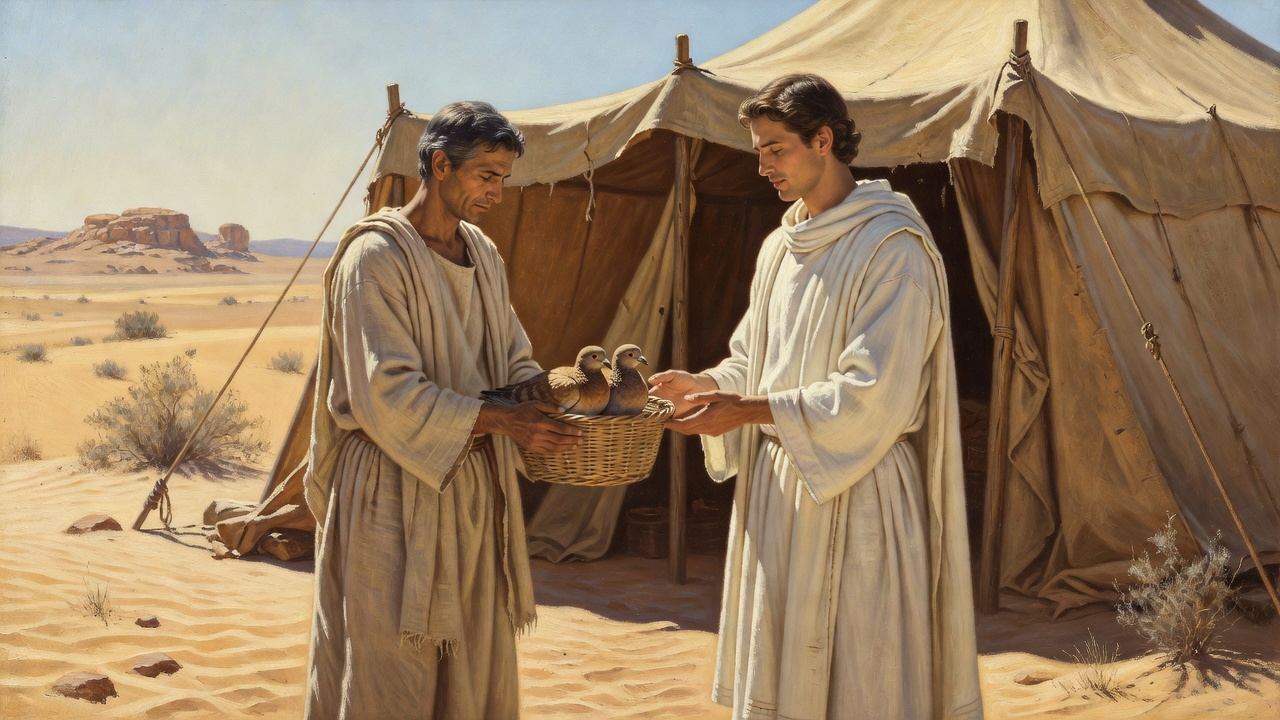
13“If such a man is healed from his flow of fluid, he must wait for seven days. Then he must wash his clothes and bathe in water from a spring. Then he will be able to be with others. 14On the eighth/next day, he must take two doves or two young pigeons and come in front of Yahweh at the entrance of the Sacred Tent, and give them to the priest. 15The priest will sacrifice them. One will be an offering for the man to become acceptable to God, and the other one will be completely burned on the altar. As a result of the priest doing that, the man will be forgiven for having sinned.
16“Then semen accidentally flows from a man’s sexual organs [EUP], he must bathe his whole body, and no one should touch him until that evening. 17Any clothing or leather that has semen on it must be washed, and no one should touch it until that evening. 18When a man has sex with a woman and some semen spills, both of them must bathe, and no one should touch them until that evening.
19“Then a woman has her monthly menstrual period, no one should touch her for seven days. If anyone touches her during that time, no one should touch the person who touched her until that evening. 20No one should touch anything that she lies on or sits on during that time. 21Anyone who touches her bed must wash his clothes and bathe, and no one should touch that person until that evening. 22Anyone who touches something that she has been sitting on, a bed or anything else, must wash his clothes, and no one should touch that person until that evening.
24“If a man has sex with a woman during that time and some of the menstrual blood touches him, no one should touch him for seven days, and no one should touch the bed that he lies on.
25“Then a woman has a vaginal discharge of blood for ◄many days/a long time►, which is not her monthly flow of blood, or if her flow of blood continues after her monthly flow ends, no one should touch her until it stops. 26And no one should touch the bed that she lies on or anything that she sits on while that flow of blood continues, just like during her monthly menstrual period. 27Anyone who touches those things should not touch anyone else; he must wash his clothes and bathe, and he should not touch anyone else until that evening.
28“After a woman’s monthly menstrual flow ends, she must wait seven days before she touches anyone. 29On the eighth/next day, she must take two doves or two pigeons to the priest at the entrance of the Sacred Tent. 30The priest will sacrifice one of them to be an offering to enable her to become acceptable to Yahweh again, and completely burn the other one on the altar. By doing that he will cause me, Yahweh, to forgive her for having sinned [DOU].
31“You must warn the Israeli people not to do things that ◄defile them/cause them to be unacceptable to me►. If they become ◄unacceptable to me/defiled►, they will cause my Sacred Tent which is among them to become an unacceptable place to worship me, and as a result they will die.”
32“Those are the regulations for a man who has a fluid that flows from his sexual organs or who should not be touched because some of his semen spills out while having sex with a woman, 33and for any woman during her monthly menstrual period, and for any man who has sex with a woman during her menstrual period.”
Did you know?
Laws on Bodily Discharges and Purification
- The purity laws in Leviticus 15 regulated both natural and abnormal bodily discharges in men and women, which rendered individuals ceremonially unclean. Objects touched by an afflicted person, such as beds, chairs, and saddles, transmitted uncleanness, requiring anyone who touched them to wash their clothes, bathe in water, and remain unclean until evening.Sources: the Bible text itself
- Purification from prolonged discharges required waiting seven days after healing, washing garments, and bathing in fresh water. On the eighth day, the person brought two turtledoves or two young pigeons to the priest at the entrance of the Tent of Meeting to offer one as a sin offering and the other as a burnt offering.Sources: the Bible text itself
- The explicit goal of these regulations was to keep the Israelites mindful of ritual boundaries, preventing them from defiling the tabernacle that stood in the midst of the camp.Sources: the Bible text itself
Notes written with AI assistance from open sources (Theographic Bible Metadata, CC BY-SA 4.0; Easton’s Bible Dictionary, public domain) and reviewed before publishing.
Credits and license for this translation
Translation for Translators
A Bible Translation for Bible Translators which makes implied information explicit in the text as an aid to the translator who may need that information to correctly translate into a particular language.
Copyright © 2008-2017 Ellis W. Deibler, Jr.
Language: English
Dialect: American
This translation is made available to you under the terms of the
Creative Commons Attribution Share-Alike license 4.0.
You have permission to share and redistribute this Bible translation in any format and to make reasonable revisions and adaptations of this translation, provided that:
You include the above copyright and source information.
If you make any changes to the text, you must indicate that you did so in a way that makes it clear that the original licensor is not necessarily endorsing your changes.
If you redistribute this text, you must distribute your contributions under the same license as the original.
Pictures included with Scriptures and other documents on this site are licensed just for use with those Scriptures and documents.
For other uses, please contact the respective copyright owners.
Note that in addition to the rules above, revising and adapting God's Word involves a great responsibility to be true to God's Word. See Revelation 22:18-19.
2026-10-02
Source: http://ebible.org/eng-t4t/ · eBible.org