Job 2
Translation for Translators · Tap a verse to see its cross-references.
Satan wanted to test Job again
1On another day, the angels came again and gathered together in front of Yahweh, and Satan came too. 2Yahweh asked Satan, “Where have you come from?” Satan replied, “I have come from the earth, where I have been traveling back and forth, seeing what is happening.”
3Yahweh asked Satan, “Have you ◄noticed/thought about► my faithful servant Job?
He is very godly/righteous [DOU], he greatly respects/reveres me, and he always avoids doing evil things. And he still acts in a very godly/righteous manner, even though you persuaded me to let you cause disastrous things to happen to him for no reason.”
4Satan replied to Yahweh, “He praises you only because you bless him [IDM]. People will give up everything they have to save their own lives. 5But if you harm his body [MTY], he will surely curse you openly [IDM]!”
6Yahweh replied to Satan, “◄All right/Okay►, you may do to him whatever you want to do, but do not cause him to die.”
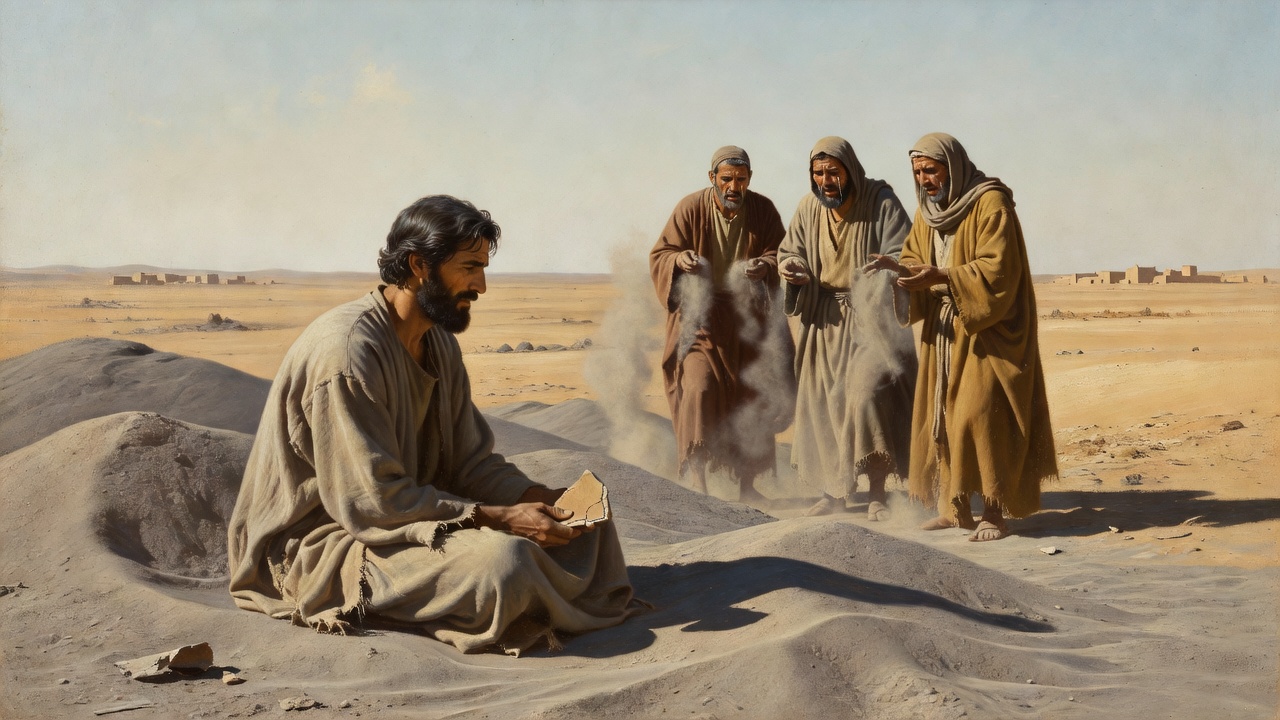
7So Satan left, and he caused Job to be afflicted with very painful boils, from the top of his head to the soles of his feet. 8Job took a piece of broken pottery and scraped the boils on his skin, and he sat in ashes as people did when they were mourning for those who had died.
9His wife said to him, “Are you still trying to ◄be loyal to/faithfully trust in► God? You should curse God, and then you will die.”
10But Job replied, “You talk like people who do not know God talk. ◄Should we accept only the good things that God does for us?/We should not accept only the good things that God does for us.► [RHQ] We should also accept bad things.” So in spite of all these things that happened to Job, he did not say anything against God.
Job’s three friends came to comfort him
11Among Job’s friends were Eliphaz from Teman town, Bildad from Shuah land and Zophar from Naamah land. When they heard about all the terrible things that had happened to Job, they left their home areas and went together to Job to console/comfort him [DOU]. 12When they saw Job from a distance, they almost did not recognize him. They wailed loudly, they tore their robes, and they threw dust over their heads to show how sorry they were because of what had happened to Job. 13Then they sat on the ground with Job for seven days. None of them said anything to Job, because they saw that he was suffering greatly, and they did not think that anything that they said would lessen his pain.
Did you know?
Job’s Affliction and the Arrival of His Friends
- In the Hebrew text of Job, the term translated as Satan appears with the definite article as the adversary or accuser. In this second heavenly council, the adversary argues that while Job endured the loss of his wealth and family, striking his physical flesh and bones would cause him to abandon his integrity.Sources: Satan · the Bible text itself
- Job’s companions—Eliphaz the Temanite, Bildad the Shuhite, and Zophar the Naamathite—came from distant regions associated with Arabia. Bildad's background is linked to Shuah, a son of Abraham by Keturah, while the ancient Greek Septuagint translation connects Zophar to the Mineans of southern Arabia.Sources: Bildad · Zophar · the Bible text itself
- Upon seeing Job's severe suffering, his three friends tore their garments, threw dust into the air over their heads, and sat with him on the ground in complete silence for seven days and seven nights. This shared vigil reflected ancient customs of deep mourning when sorrow was too profound for words.Sources: the Bible text itself
Notes written with AI assistance from open sources (Theographic Bible Metadata, CC BY-SA 4.0; Easton’s Bible Dictionary, public domain) and reviewed before publishing.
Credits and license for this translation
Translation for Translators
A Bible Translation for Bible Translators which makes implied information explicit in the text as an aid to the translator who may need that information to correctly translate into a particular language.
Copyright © 2008-2017 Ellis W. Deibler, Jr.
Language: English
Dialect: American
This translation is made available to you under the terms of the
Creative Commons Attribution Share-Alike license 4.0.
You have permission to share and redistribute this Bible translation in any format and to make reasonable revisions and adaptations of this translation, provided that:
You include the above copyright and source information.
If you make any changes to the text, you must indicate that you did so in a way that makes it clear that the original licensor is not necessarily endorsing your changes.
If you redistribute this text, you must distribute your contributions under the same license as the original.
Pictures included with Scriptures and other documents on this site are licensed just for use with those Scriptures and documents.
For other uses, please contact the respective copyright owners.
Note that in addition to the rules above, revising and adapting God's Word involves a great responsibility to be true to God's Word. See Revelation 22:18-19.
2026-10-02
Source: http://ebible.org/eng-t4t/ · eBible.org