Job 14
Translation for Translators · Tap a verse to see its cross-references.
Job prayed to God
1“We humans are very frail.
We live only a short time, and we experience a lot of trouble.
2We disappear quickly, like flowers that grow from the ground quickly and then wither and die [SIM].
We are like shadows that disappear when the sun stops shining.
3Yahweh, why do you keep watching me to see if I am doing something that is wrong [RHQ]?
Are you wanting to take me to court to judge me?
4People are sinners from the time when they are born;
who can cause them to be sinless? No one [RHQ]!
5You have decided how long our lives will be.
You have decided how many months we will live,
and we cannot live more months than the ◄limit/number of months► that you have decided.
6So please stop examining us, and allow us to be alone,
until/while we finish our time here on earth, like a man finishes his work at the end of the day.
Job said that we all die
7If someone cuts a tree down,
we hope that it will sprout again and grow new branches.
8Its roots in the ground may be very old,
and its stump may decay,
9but if some water falls on it,
it may bud/sprout and send up shoots like a young plant.
10But when we people lose all our strength and die,
we stop breathing and then we are gone forever.
11Just like water evaporates from the ocean,
or like a riverbed dries up,
12people lie down and die and do not get up again.
Until the heavens disappear,
people who die [EUP] do not wake up,
and no one can wake them up.
13“Yahweh, I wish that you would put me safely in the place of the dead and forget about me
until you are no longer angry with me.
I wish that you would decide how much time I would spend there,
and then remember that I am there.
14When we humans die, we will certainly not live again [RHQ].
If I knew that we would live again, I would wait patiently,
and I would wait for you to release me from my sufferings.
15You would call me, and I would answer.
You would be eager to see me, one of the creatures that you had made.
16You would take care of [MET] me,
instead of watching me to see if I would sin.
17It is as though the record of my sins would be sealed in a small bag,
and you would cover them up.
18“But, just like mountains crumble and rocks fall down from a cliff,
19and just like water slowly wears away the stones, and just like floods wash away soil,
you eventually destroy us; you do not allow us to continue to ◄hope/confidently expect► that we will keep on living.
20You always defeat us, and then we die [EUP].
You cause our faces to look ugly after we die,
and you send us away.
21When we die we do not know if our sons will grow up and do things that will cause them to be honored.
And if they become disgraced, we do not see that, either.
22We will feel our own pains; we will not feel anything else;
we will be sorry for ourselves, not for anyone else.”
Did you know?
The Frailty of Life and the Hope of Renewal
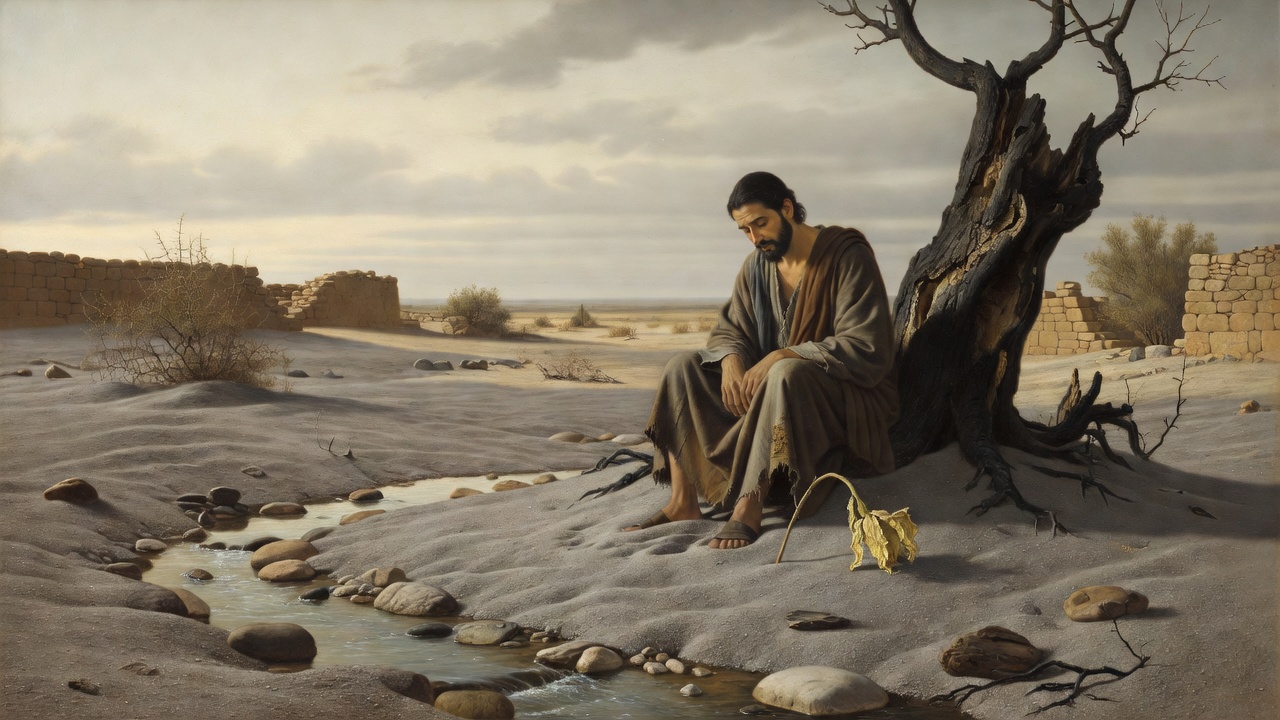
- In this speech, Job contrasts the fate of mortals with that of a tree. While a felled tree can sprout new shoots at the scent of water even after its stump seems dead, a human being dies, lies down, and does not rise again to life on earth.Sources: the Bible text itself
- Job contemplates Sheol as a potential hiding place where he might be sheltered until divine anger passes, imagining a longing in which God would seal his transgressions in a bag and call upon the work of His hands.Sources: the Bible text itself
- To capture the brevity and decay of human existence, the chapter draws upon natural metaphors of erosion and transience, comparing human life to a fleeting shadow, a withered flower, and rocks worn down by water.Sources: the Bible text itself
Notes written with AI assistance from open sources (Theographic Bible Metadata, CC BY-SA 4.0; Easton’s Bible Dictionary, public domain) and reviewed before publishing.
Credits and license for this translation
Translation for Translators
A Bible Translation for Bible Translators which makes implied information explicit in the text as an aid to the translator who may need that information to correctly translate into a particular language.
Copyright © 2008-2017 Ellis W. Deibler, Jr.
Language: English
Dialect: American
This translation is made available to you under the terms of the
Creative Commons Attribution Share-Alike license 4.0.
You have permission to share and redistribute this Bible translation in any format and to make reasonable revisions and adaptations of this translation, provided that:
You include the above copyright and source information.
If you make any changes to the text, you must indicate that you did so in a way that makes it clear that the original licensor is not necessarily endorsing your changes.
If you redistribute this text, you must distribute your contributions under the same license as the original.
Pictures included with Scriptures and other documents on this site are licensed just for use with those Scriptures and documents.
For other uses, please contact the respective copyright owners.
Note that in addition to the rules above, revising and adapting God's Word involves a great responsibility to be true to God's Word. See Revelation 22:18-19.
2026-10-02
Source: http://ebible.org/eng-t4t/ · eBible.org