Isaiah 27
Translation for Translators · Tap a verse to see its cross-references.
God’s future blessings on Israel
1At that time, Yahweh will punish Leviathan,
the swift-moving monster/dragon,
that coiling serpent that lives in the sea.
Yahweh will kill it with his sharp, huge, and powerful sword.
2At that time, Yahweh will say,
“You Israeli people, who are like [MET] a fruitful vineyard, must sing!
3I will protect you
like a farmer [MET] waters his crops carefully in order that they will grow well.
I will guard you day and night, in order that no one harms you.
4I am no longer angry with my people;
if any of your enemies try to injure you like briers and thorns injure people [MET],
I will attack them in battles;
I will get rid of them completely,
5unless they request me to protect them;
I strongly invite them to make peace with me [DOU]!”
6There will be a time when the ◄descendants of Jacob/Israeli people► will prosper like a plant that has good roots;
they will be like [MET] trees that bud and blossom and bear a lot of fruit;
what they do will bless all the people in the world.
7But now I ask, has Yahweh punished us Israelis
like he punished our enemies?
Has he punished us as much as he punished them?
8No, he has not done that,
but he punished us Israeli people and ◄exiled us/forced us to leave our country►;
we were taken away from our land
as though [SIM] we were struck by a windstorm from the east.
9Yahweh did that in order to punish us for our sins,
and remove our guilt.
As a result of our being exiled, all the altars to other gods in Israel will be demolished,
and we will be forgiven for the sins that we have committed.
There will be no more poles for worshiping the goddess Asherah, or altars for burning incense to other gods;
they will all be torn down.
10The cities that have strong walls around them will be empty;
like the desert, they will have no one living in them.
The houses will be abandoned,
and the streets will be full of weeds.
Calves will eat grass there and lie down there;
they will chew up all the leaves on the trees.
11The Israeli people are like [MET] dry branches on a tree;
women break them off and use them to make fires under their cooking pots.
Our Israeli people do not have any sense;
so Yahweh, who created them, will not act mercifully toward them
or be kind to them.
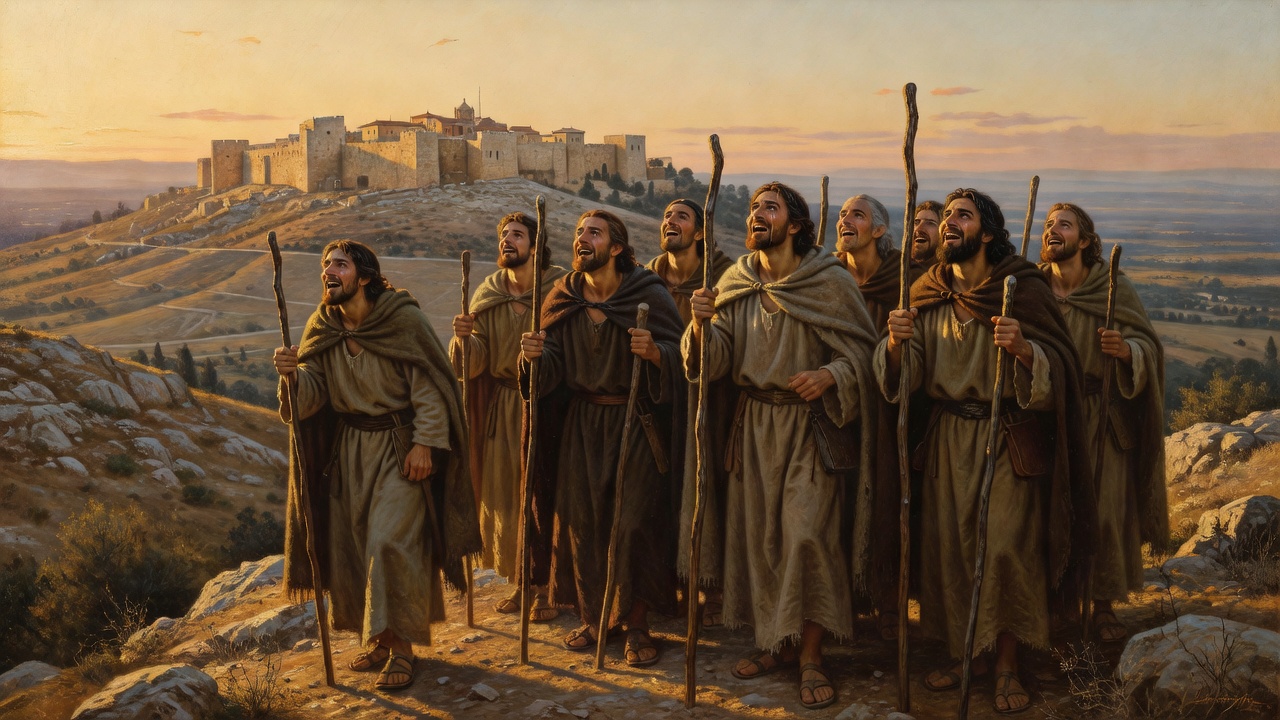
12However, there will be a time when Yahweh will gather them together again; he will separate them from the people who have conquered them, like people separate wheat from chaff. He will bring them back to Israel, one by one, from the land between the Euphrates River in the northeast and the brook at the border of Egypt in the southwest. 13At that time, a trumpet will be blown very loudly. And those who were exiled to Assyria and Egypt and who almost died there will return to Jerusalem, to worship Yahweh on Zion, his holy hill.
Did you know?
The Fruitful Vineyard and the Return of the Exiles
- In Isaiah 27, Israel is portrayed as a fruitful vineyard carefully guarded and continually watered by the Lord so that it will take root and fill the world with fruit. This picture of divine protection and flourishing stands in contrast to the earlier depiction of an unfruitful vineyard in the book.Sources: the Bible text itself
- The prophecy describes the gathering of Israelites between the flowing Euphrates River and the Brook of Egypt. In biblical tradition, these two geographical landmarks defined the expansive borders of the land promised to Abraham's descendants.Sources: the Bible text itself · Euphrates · Brook of Egypt
- The sounding of a great ram's horn is foretold to call back exiles who were dispersed in the powerful empires of Assyria and Egypt. The returning survivors are summoned to worship the Lord together upon the holy mountain in Jerusalem.Sources: the Bible text itself · Assyria · Egypt · Jerusalem
Notes written with AI assistance from open sources (Theographic Bible Metadata, CC BY-SA 4.0; Easton’s Bible Dictionary, public domain) and reviewed before publishing.
Places in this chapter
- Euphrates · Today: Euphrates River · 31.004, 47.442 · verse 12
- Assyria · 36.359, 43.153 · verse 13
- Egypt · 30.129, 31.308 · verse 13
- Jerusalem · 31.777, 35.234 · verse 13
Only places identified with high confidence are shown (90% or more according to the scholarly sources compiled by OpenBible). Period map: DARE (Digital Atlas of the Roman Empire), CC BY 4.0; modern map: © OpenStreetMap contributors; places: OpenBible.info (CC BY 4.0).
Credits and license for this translation
Translation for Translators
A Bible Translation for Bible Translators which makes implied information explicit in the text as an aid to the translator who may need that information to correctly translate into a particular language.
Copyright © 2008-2017 Ellis W. Deibler, Jr.
Language: English
Dialect: American
This translation is made available to you under the terms of the
Creative Commons Attribution Share-Alike license 4.0.
You have permission to share and redistribute this Bible translation in any format and to make reasonable revisions and adaptations of this translation, provided that:
You include the above copyright and source information.
If you make any changes to the text, you must indicate that you did so in a way that makes it clear that the original licensor is not necessarily endorsing your changes.
If you redistribute this text, you must distribute your contributions under the same license as the original.
Pictures included with Scriptures and other documents on this site are licensed just for use with those Scriptures and documents.
For other uses, please contact the respective copyright owners.
Note that in addition to the rules above, revising and adapting God's Word involves a great responsibility to be true to God's Word. See Revelation 22:18-19.
2026-10-02
Source: http://ebible.org/eng-t4t/ · eBible.org