Ezra 2
Translation for Translators · Tap a verse to see its cross-references.
The list of groups that returned to Judah
1King Nebuchadnezzar’s soldiers had captured many Israeli people and taken them to Babylonia. Many years later, some Israeli people returned to Judah. Some returned to Jerusalem, and some returned to other places in Judah. They went to the towns where their ancestors had lived. This is a list of the groups who returned. 2The leaders of those groups were Zerubbabel, Jeshua, Nehemiah, Seraiah, Reelaiah, Mordecai, Bilshan, Mispar, Bigvai, Rehum, and Baanah.
There were: 32,172 descendants of Parosh 4372 descendants of Shephatiah 5775 descendants of Arah 62,812 descendants of Pahath-Moab, from the families of Jeshua and Joab 71,254 descendants of Elam 8945 descendants of Zattu 9760 descendants of Zaccai 10642 descendants of Bani 11623 descendants of Bebai 121,222 descendants of Azgad 13666 descendants of Adonikam 142,056 descendants of Bigvai 15454 descendants of Adin 1698 descendants of Ater, whose other name was Hezekiah 17323 descendants of Bezai 18112 descendants of Jorah 19223 descendants of Hashum 2095 descendants of Gibbar.
People whose ancestors had lived in these towns in Judah: 21123 from Bethlehem 2256 from Netophah 23128 from Anathoth 2442 from Azmaveth 25743 from Kiriath-Jearim, Kephirah, and Beeroth 26621 from Ramah and Geba 27122 from Micmash 28223 from Bethel and Ai 2952 from Nebo 30156 from Magbish 311,254 from Elam 32320 from Harim 33725 from Lod, Hadid, and Ono 34345 from Jericho 353,630 from Senaah.
36Priests who returned: 973 descendants of Jedaiah (that is, those from the family of Jeshua) 371,052 descendants of Immer 381,247 descendants of Pashhur 391,017 descendants of Harim.
The ones from the rest of the tribe of Levi who returned were: 4074 descendants of Jeshua and Kadmiel, who were from the family of Hodaviah 41128 singers who were descendants of Asaph 42139 ◄gatekeepers/men who guarded the gates of the temple► who were descendants of Shallum, Ater, Talmon, Akkub, Hatita, and Shobai.
43The ◄temple workers/men who would work in the temple► who were descendants of these men:
Ziha, Hasupha, Tabbaoth,
44Keros, Siaha, Padon,
45Lebanah, Hagabah, Akkub,
46Hagab, Shalmai, Hanan,
47Giddel, Gahar, Reaiah,
48Rezin, Nekoda, Gazzam,
49Uzza, Paseah, Besai,
50Asnah, Meunim, Nephusim,
51Bakbuk, Hakupha, Harhur,
52Bazluth, Mehida, Harsha,
53Barkos, Sisera, Temah,
54Neziah, and Hatipha.
55These descendants of King Solomon’s servants returned:
Sotai, Hassophereth, Peruda,
56Jaalah, Darkon, Giddel,
57Shephatiah, Hattil, Pokereth-Hazzebaim, and Ami.
58Altogether, there were 392 temple workers and descendants of Solomon’s servants who returned.
59There was another group who returned to Judah from Tel-Melah, Tel-Harsha, Kerub, Addan, and Immer towns in Babylonia. But they could not prove that they were descendants of people who previously lived in Israel.
60This group included 652 people who were descendants of Delaiah, Tobiah, and Nekoda.
61Hobaiah’s clan, Hakkoz’s clan, and Barzillai’s clan also returned. Barzillai had married a woman who was a descendant of Barzillai from the Gilead region, and he had taken for himself the name of his father-in-law’s clan.
62The people in that group searched in the documents that had the names of the ancestors of all the clans, but these men’s names were not found. So they were not permitted do the work that priests did. 63The governor told them that they would need to ask a priest to consult Yahweh by ◄casting/throwing the sacred lots/stones that had been marked►, to determine if those men were truly Israelis. When the priests did that, if the stones showed that those men were Israelis, they would be permitted to eat the shares of the sacrifices that were given to the priests.
64Altogether 42,360 Israeli people who returned to Judah. 65There were also 7,337 servants and 200 musicians, both men and women, who returned. 66The Israelis brought with them from Babylonia 736 horses, 245 mules, 67435 camels, and 6,720 donkeys.
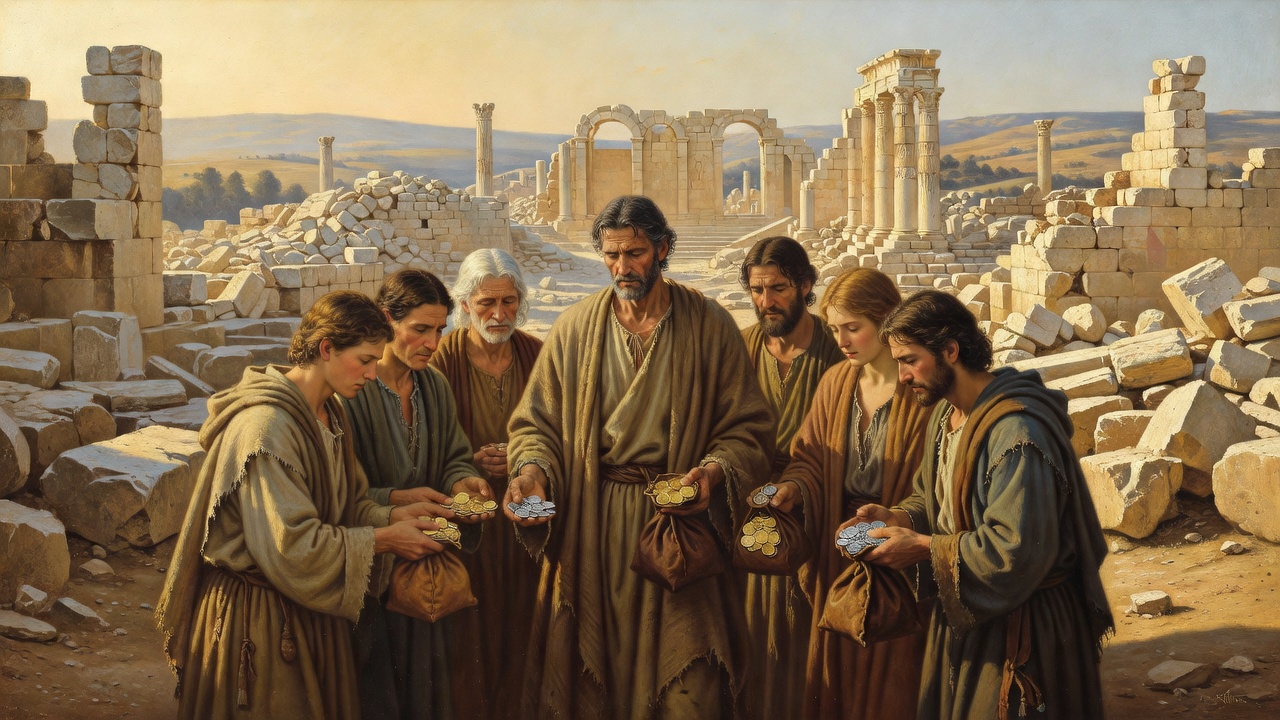
68When they arrived at the temple of Yahweh in Jerusalem, some of the clan leaders gave money for the supplies needed to rebuild the temple at the place where the temple had been previously. 69They all gave as much money as they were able to give. Altogether they gave 61,000 gold coins, ◄6,250 pounds/3,000 kg.► of silver, and 100 robes for the priests.
70Then the priests, the other descendants of Levi, the musicians, the temple guards, and some of the other people started to live in the towns and villages near Jerusalem. The rest of the people went to the other places in Israel where their ancestors had lived.
Did you know?
The List of the Returning Exiles
- Under the leadership of figures like Zerubbabel and Jeshua, the first wave of Jewish exiles returned from Babylon to Judah and Jerusalem after their captivity under Nebuchadnezzar. The whole assembly totaled 42,360 people, along with more than 7,000 servants, singers, and their livestock.Sources: the Bible text itself · Zerubbabel · Nebuchadnezzar
- Genealogical records were essential for verifying communal and religious status after the exile. Priests who could not locate their ancestral lineage in the written registers were excluded from priestly duties and forbidden from eating the sacred food until a priest could consult the Urim and Thummim.Sources: the Bible text itself
- Upon reaching the site of the ruined temple in Jerusalem, family leaders presented freewill offerings of gold darics, minas of silver, and priestly robes to fund rebuilding the house of God on its original foundations.Sources: the Bible text itself · Jerusalem
Notes written with AI assistance from open sources (Theographic Bible Metadata, CC BY-SA 4.0; Easton’s Bible Dictionary, public domain) and reviewed before publishing.
Places in this chapter
- Babylon · 32.543, 44.422 · verse 1
- Babylonia · 32.543, 44.422 · verse 1
- Jerusalem · 31.777, 35.234 · verses 1, 68, 70
- Bethlehem · 31.704, 35.208 · verse 21
- Kiriath-jearim · Today: Deir el Azar · 31.809, 35.104 · verse 25
- Lod · 31.950, 34.900 · verse 33
- Jericho · Today: Tell es Sultan · 31.872, 35.445 · verse 34
- Immer · Today: in Babylonia · 32.543, 44.422 · verse 59
- Gilead · Today: Gilead 1 · 32.187, 35.692 · verse 61
Only places identified with high confidence are shown (90% or more according to the scholarly sources compiled by OpenBible). Period map: DARE (Digital Atlas of the Roman Empire), CC BY 4.0; modern map: © OpenStreetMap contributors; places: OpenBible.info (CC BY 4.0).
Credits and license for this translation
Translation for Translators
A Bible Translation for Bible Translators which makes implied information explicit in the text as an aid to the translator who may need that information to correctly translate into a particular language.
Copyright © 2008-2017 Ellis W. Deibler, Jr.
Language: English
Dialect: American
This translation is made available to you under the terms of the
Creative Commons Attribution Share-Alike license 4.0.
You have permission to share and redistribute this Bible translation in any format and to make reasonable revisions and adaptations of this translation, provided that:
You include the above copyright and source information.
If you make any changes to the text, you must indicate that you did so in a way that makes it clear that the original licensor is not necessarily endorsing your changes.
If you redistribute this text, you must distribute your contributions under the same license as the original.
Pictures included with Scriptures and other documents on this site are licensed just for use with those Scriptures and documents.
For other uses, please contact the respective copyright owners.
Note that in addition to the rules above, revising and adapting God's Word involves a great responsibility to be true to God's Word. See Revelation 22:18-19.
2026-10-02
Source: http://ebible.org/eng-t4t/ · eBible.org