Ezekiel 17
Translation for Translators · Tap a verse to see its cross-references.
An illustration about two eagles and a vine
1Yahweh gave me another message. He said, 2“You human, tell this story/parable [DOU] to the people [MTY] of Israel. 3Say to them, ‘This is what Yahweh the Lord says: A huge eagle that had strong wings and long beautiful feathers of many colors flew to Lebanon. It grasped the top of a cedar tree 4and broke it off. Then the eagle carried it away to Babylonia, a country that had many merchants/businessmen, and planted it in one of the cities there.
5Then that eagle took a seedling from your country and planted it in a fertile field. He planted it like people plant a willow tree, alongside a stream that had plenty of water. 6It grew and became a low grapevine that spread along the ground. Its branches turned up towards the eagle, but its roots grew down into the ground. So it became a good vine and produced lots of branches and leaves.
7But there was another huge eagle that had strong wings and beautiful feathers. And some of the roots of the vine grew toward that eagle, and its branches also turned toward it, hoping that the eagle would bring more water to it. 8That happened in spite of the fact that the vine had already been planted in good soil, where there was plenty of water, with the result that it had produced branches and produced grapes and had become a very healthy/productive vine.’
9Then after you have told that to the people, say to them, ‘This is what Yahweh the Lord says: That vine will certainly not [RHQ] remain healthy/productive. It will be [RHQ] pulled up by its roots by the eagle that planted it, and all its fruit will be stripped off and its leaves will wither. And it will not need someone with strong arms or many people to pull it out by its roots. 10Even if that vine is transplanted, it certainly will not continue to grow [RHQ]. When the hot wind from the east blows against it, it will completely wither, there where it was planted! [RHQ]’ ”
11Then Yahweh gave this message to me: 12“Ask these rebellious Israeli people, ‘Do you know what this parable/story means?’ Tell them that it signifies that the King of Babylon went to Jerusalem with his army and captured the King of Judah and his officials, and took them back to Babylon. 13Then he took one of the king’s close relatives and appointed him to be the king, and made an agreement with him, forcing him to solemnly promise to remain loyal. The King of Babylon also took to Babylon the other important citizens of Judah, 14in order that the kingdom of Judah would not be able to become powerful again. The King of Babylon intended that the kingdom of Judah would not continue to exist if the people did not obey that agreement that he made with the King of Babylon. 15But the King of Judah rebelled against the King of Babylon by sending officials to Egypt to request from them horses and a large army to fight against the army of Babylonia. But the King of Judah will certainly not [RHQ] be sucessful. Rulers who rebel like that and and refuse to obey solemn agreements will never [RHQ] escape.
16I, Yahweh the Lord, declare that as surely as I am alive, the King of Judah will die in Babylon, in the city where the King of Babylon appointed him to be the King [MTY] of Judah. He will die because he despised the solemn agreement and refused to do what he promised to do. 17The King of Egypt with all his very huge army [DOU] will not be able to help the King of Judah: The soldiers from Babylonia will build ramps up against the walls of Jerusalem and set up devices to batter the walls. They will enter Jerusalem and kill many of its people. 18The King of Judah despised the solemn agreement by disregarding the treaty. Although he had solemnly promised to be under the control of the King of Babylon, he sent officials to request help from Egypt. Therefore he will not escape being punished by the King of Babylon.
19Therefore this is what I, Yahweh the Lord, say: 'Just as surely as I am alive, I will cause the King of Judah to be punished [IDM] for ignoring the solemn agreement that he made with the King of Babylon and then refusing to obey it. 20It will be as though I will spread a net to capture him, and he will be caught in it. He will be captured and taken to Babylon and punished because he rebelled against me. 21Most [HYP] of his soldiers who try to escape will be killed by their enemies’ swords, and those who survive will be scattered in all directions. Then you will know that I, Yahweh, have the power to do what I say that I will do.' ”
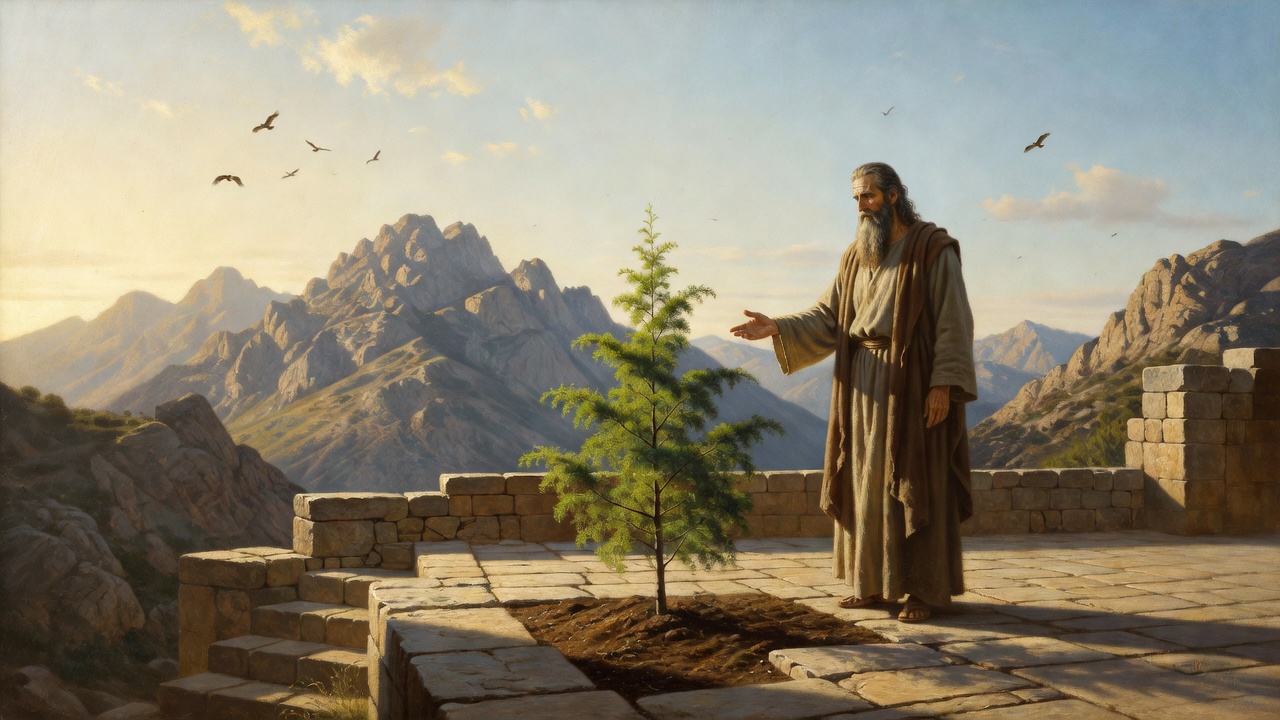
22This is also what Yahweh the Lord says: “ It will be as though I will take a shoot from the top of a very tall cedar tree and plant it [DOU] in another place. I will plant it on a very high [DOU] mountain. 23It will be as though I will plant it on a mountain in Israel, and it will grow and become a beautiful cedar tree. Many [HYP] kinds of birds will make their nests in the tree, and they will have shade in its branches. 24And it will be as though all the trees in the field will know that I, Yahweh, get rid of tall trees and make little ones grow. I cause big green trees to wither, and I cause dry trees to become green.
I, Yahweh have said this, and I will certainly do what I have said that I will do.”
Did you know?
The Parable of the Eagles and the Cedar
- Ezekiel presents a political allegory where the first great eagle represents the king of Babylon, who captured Jerusalem's royal leadership and established a vassal king under a solemn covenant. The second eagle represents Egypt and its Pharaoh, to whom the Judean ruler turned for cavalry and military assistance in defiance of his sworn allegiance.Sources: the Bible text itself · Babylon · Egypt · Pharaoh
- In the prophetic message, breaking a political vassal oath made under Babylon was treated not merely as diplomatic rebellion, but as spiritual treason against God, who regarded the sworn pledge as His own oath.Sources: the Bible text itself
- The chapter concludes with a reversal of human political schemes: God Himself promises to take a tender shoot from the top of the cedar and plant it upon the mountain heights of Israel, where it will grow into a majestic tree offering shelter to birds of every kind.Sources: the Bible text itself
Notes written with AI assistance from open sources (Theographic Bible Metadata, CC BY-SA 4.0; Easton’s Bible Dictionary, public domain) and reviewed before publishing.
Places in this chapter
- Lebanon · 33.540, 35.584 · verse 3
- Canaan · 32.767, 35.333 · verse 4
- Babylon · 32.543, 44.422 · verses 12, 14, 15, 16, 17, 20
- Jerusalem · 31.777, 35.234 · verses 12, 17
- Egypt · 30.129, 31.308 · verse 15
Only places identified with high confidence are shown (90% or more according to the scholarly sources compiled by OpenBible). Period map: DARE (Digital Atlas of the Roman Empire), CC BY 4.0; modern map: © OpenStreetMap contributors; places: OpenBible.info (CC BY 4.0).
Credits and license for this translation
Translation for Translators
A Bible Translation for Bible Translators which makes implied information explicit in the text as an aid to the translator who may need that information to correctly translate into a particular language.
Copyright © 2008-2017 Ellis W. Deibler, Jr.
Language: English
Dialect: American
This translation is made available to you under the terms of the
Creative Commons Attribution Share-Alike license 4.0.
You have permission to share and redistribute this Bible translation in any format and to make reasonable revisions and adaptations of this translation, provided that:
You include the above copyright and source information.
If you make any changes to the text, you must indicate that you did so in a way that makes it clear that the original licensor is not necessarily endorsing your changes.
If you redistribute this text, you must distribute your contributions under the same license as the original.
Pictures included with Scriptures and other documents on this site are licensed just for use with those Scriptures and documents.
For other uses, please contact the respective copyright owners.
Note that in addition to the rules above, revising and adapting God's Word involves a great responsibility to be true to God's Word. See Revelation 22:18-19.
2026-10-02
Source: http://ebible.org/eng-t4t/ · eBible.org