Esther 6
Translation for Translators · Tap a verse to see its cross-references.
The king honored Mordecai
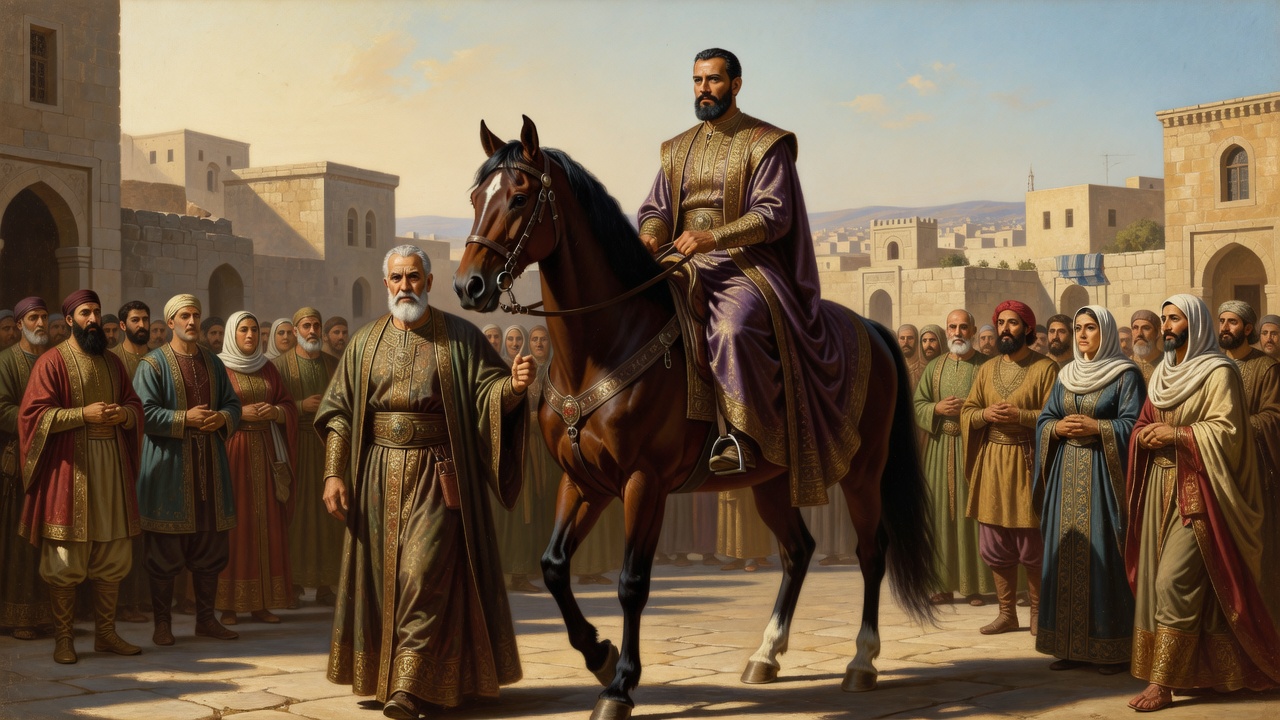
1That night the king was unable to sleep, so he summoned a servant and told him to bring the records of what had happened during all the time he had been king. So the servant brought the records and read some of them to the king. 2The servant read about Bigthana and Teresh, the two men who had guarded the entrance to the king’s rooms. He read the account of when Mordecai had found out that they planned to assassinate the king and that he had told the king about it. 3The king asked some of his servants, “What did we do to reward Mordecai or show that we appreciate what he did?” The servants replied, “We did not do anything for him.” 4At that moment, Haman entered the outer courtyard of the palace. He wanted to talk to the king about hanging Mordecai on the gallows that he had just set up. The king saw him and said, “Who is that out there in the courtyard?” 5His servants replied, “That is Haman standing there in the courtyard.” The king said, “Bring him in here!” 6When Haman came in, the king asked him, “What should I do for a man whom I want to honor?” Haman thought to himself, “◄Whom would the king like to honor more than me?/I think there is no one whom the king would like to honor more than me!►” [RHQ] 7So he replied to the king, “If there is someone you wish to honor, 8you should tell your servants to bring him one of the robes you wear you to show that you are the king. Also tell them to bring one of the horses you have ridden. Tell them to put a fancy headdress on the horse’s head to show that it belongs to you, the king. 9Then tell one of your very important officials to put the robe on the man whom you want to honor, and tell that man to sit on the horse, and then lead the horse through the city streets. And tell that official to keep shouting, ‘This is what ◄the king does/is doing► for the man whom he wants to honor!’” 10The king replied to Haman, “ Fine! Go and do what you said immediately! Get my robe and my horse, and do just what you suggested! Do it for Mordecai, the Jew, who is sitting outside at the gate of the palace. Do not forget anything that you suggested!” 11So Haman did what the king said. He got the robe and the horse. He put the robe on Mordecai, and as Mordecai sat on the horse, Haman led the horse through the city streets proclaiming “This is what the king ◄does/is doing► for the man whom the king wants to honor!” 12Then, Mordecai returned and sat at the gate of the palace. But Haman hurried home, covering his face because he felt completely disgraced/humiliated. 13He told his wife Zeresh and his friends everything that had happened to him that day. Then his wife and his friends said to him, “Mordecai, the man who has caused you to be completely disgraced/humiliated, is a Jew. It is clear that the God whom the Jews worship is fighting for them. So you will never be able to defeat Mordecai. He will defeat you!” 14And while they were still talking, some of the king’s officials arrived to take Haman quickly to the banquet/feast that Esther had prepared.
Did you know?
Mordecai Honored and Haman Humbled
- In the Persian court, official royal chronicles recorded daily events and notable services rendered to the crown. When King Ahasuerus suffered a sleepless night and ordered these records read to him, he realized that Mordecai had never received any reward or honor for uncovering the assassination plot organized by the doorkeepers Bigthana and Teresh.Sources: the Bible text itself · Bigthana · Teresh
- The honors Haman suggested—wearing a royal robe the king himself had worn and riding the king's horse led through the city square by a noble official—represented the highest public marks of Persian royal favor. Haman conceived these extravagant honors assuming they were intended for himself, only to be commanded to bestow every detail upon Mordecai.Sources: the Bible text itself · Haman
- Haman had arrived in the outer courtyard of the palace intending to ask the king to hang Mordecai on the gallows he had prepared. Instead, after being forced to parade Mordecai through the city in triumph, Haman returned home in grief, where his wife Zeresh and advisers predicted his complete downfall.Sources: the Bible text itself · Zeresh · Haman
Notes written with AI assistance from open sources (Theographic Bible Metadata, CC BY-SA 4.0; Easton’s Bible Dictionary, public domain) and reviewed before publishing.
Credits and license for this translation
Translation for Translators
A Bible Translation for Bible Translators which makes implied information explicit in the text as an aid to the translator who may need that information to correctly translate into a particular language.
Copyright © 2008-2017 Ellis W. Deibler, Jr.
Language: English
Dialect: American
This translation is made available to you under the terms of the
Creative Commons Attribution Share-Alike license 4.0.
You have permission to share and redistribute this Bible translation in any format and to make reasonable revisions and adaptations of this translation, provided that:
You include the above copyright and source information.
If you make any changes to the text, you must indicate that you did so in a way that makes it clear that the original licensor is not necessarily endorsing your changes.
If you redistribute this text, you must distribute your contributions under the same license as the original.
Pictures included with Scriptures and other documents on this site are licensed just for use with those Scriptures and documents.
For other uses, please contact the respective copyright owners.
Note that in addition to the rules above, revising and adapting God's Word involves a great responsibility to be true to God's Word. See Revelation 22:18-19.
2026-10-02
Source: http://ebible.org/eng-t4t/ · eBible.org