Esther 4
Translation for Translators · Tap a verse to see its cross-references.
Mordecai requested help from Esther
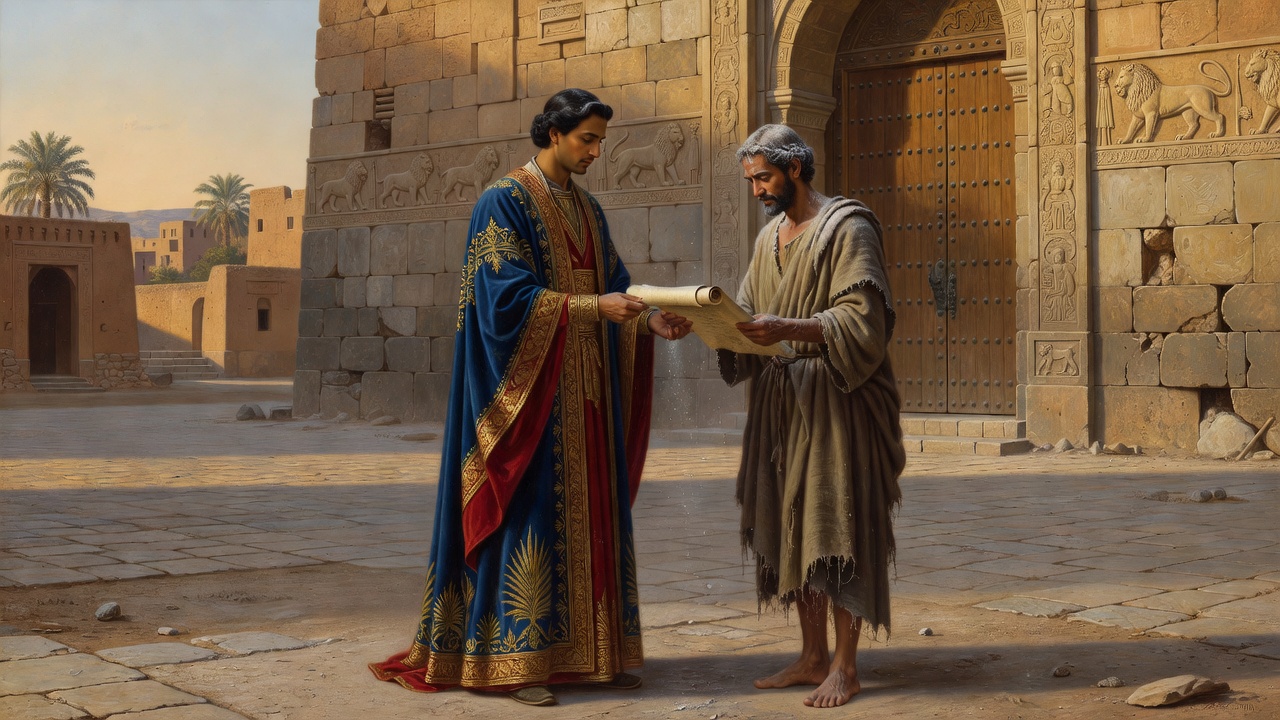
1When Mordecai found out about those letters, he was so anguished that he tore his clothes and put on rough sackcloth and threw ashes over himself. Then he went into the city, crying very loudly. 2He stood outside the gate of the palace, because no one who was wearing sackcloth was allowed to enter the palace. 3In every province of the empire, when the letter from the king was read to the Jewish people, they cried and mourned. They ◄fasted/abstained from eating food►, and wailed loudly. Many of them also put on sackcloth and threw ashes on themselves and lay on the ground. 4When Esther’s maids and other officials came to her and told her what Mordecai had done, she was very distressed. So she sent to Mordecai some good clothes to wear instead of the sackcloth, but he refused to take them. 5Then Esther summoned Hathach, one of the king’s officials whom he had appointed to help take care of Esther. She told him to go out and talk to Mordecai to find out what was distressing him and why he was wearing sackcloth to show that he was grieving. 6Hathach went to Mordecai, who was in the plaza in front of the palace gate. 7Mordecai told him everything that had happened. He told him how much money Haman had promised to give to the government if the king commanded that all the Jews be killed. 8Mordecai also gave to Hathach a copy of the decree that had been read in Susa, in which it was stated that all the Jews must be killed. He told Hathach to show the copy to Esther. He told Hathach to explain to Esther what ◄it meant/would happen►. Then he told him to urge her to go to the king and request the king to act mercifully to her people. 9So Hathach returned to Esther and told her what Mordecai said. 10Then Esther told Hathach to return to Mordecai and tell this to him: 11“There is a law about people going to talk to the king. All the king’s officials and all the people in the empire know this law. In that law it states that anyone who goes to the king in his inner court without having been summoned by the king must be executed. Only those to whom the king has extended his scepter/staff will not be executed. And a month has passed since the king has summoned me, so what will happen to me if I try to see him and he doesn’t want to see me?” 12So Hathach went back to Mordecai and told him what Esther had said. 13Mordecai replied, “ Go back and tell this to Esther: 'Do not think that just because you live there in the palace, you will escape when all the other Jews are killed. 14If you say nothing now, someone from some other place will rescue many of us Jews, but you and your relatives will be killed. Furthermore, ◄perhaps God/who knows if God► has put you here as queen ◄for a situation like this/to prevent this from happening to us►!' ” [RHQ] 15Then after Hathach told this to Esther, she told him to return to Mordecai and say this to him: 16“Gather together all the Jews here in Susa, and tell them to ◄fast/abstain from food► for my sake. Tell them to not eat or drink anything for three days and nights. My maids and I will also fast. Then, I will go to talk to the king. Even if ◄I am executed/they execute me► for disobeying the law by seeing him when he does not hold out the scepter/staff toward me, I am willing for that to happen”. 17So after Hathach told this to Mordecai, Mordecai went and did what Esther told him to do.
Did you know?
Esther's Decision to Plead for Her People
- When Mordecai learned of the decree against the Jews, he put on sackcloth and ashes, but royal law strictly prohibited anyone wearing mourning attire from passing through the king's gate.Sources: the Bible text itself
- Because Queen Esther resided inside the royal palace and Mordecai remained outside in mourning clothes, communication between them was conducted through Hathach, a royal eunuch appointed to attend the queen.Sources: the Bible text itself · Hatach
- Persian court law decreed that any person who approached the king in the inner court without being summoned was subject to execution, unless the monarch spared them by extending his golden scepter.Sources: the Bible text itself
Notes written with AI assistance from open sources (Theographic Bible Metadata, CC BY-SA 4.0; Easton’s Bible Dictionary, public domain) and reviewed before publishing.
Places in this chapter
Only places identified with high confidence are shown (90% or more according to the scholarly sources compiled by OpenBible). Period map: DARE (Digital Atlas of the Roman Empire), CC BY 4.0; modern map: © OpenStreetMap contributors; places: OpenBible.info (CC BY 4.0).
Credits and license for this translation
Translation for Translators
A Bible Translation for Bible Translators which makes implied information explicit in the text as an aid to the translator who may need that information to correctly translate into a particular language.
Copyright © 2008-2017 Ellis W. Deibler, Jr.
Language: English
Dialect: American
This translation is made available to you under the terms of the
Creative Commons Attribution Share-Alike license 4.0.
You have permission to share and redistribute this Bible translation in any format and to make reasonable revisions and adaptations of this translation, provided that:
You include the above copyright and source information.
If you make any changes to the text, you must indicate that you did so in a way that makes it clear that the original licensor is not necessarily endorsing your changes.
If you redistribute this text, you must distribute your contributions under the same license as the original.
Pictures included with Scriptures and other documents on this site are licensed just for use with those Scriptures and documents.
For other uses, please contact the respective copyright owners.
Note that in addition to the rules above, revising and adapting God's Word involves a great responsibility to be true to God's Word. See Revelation 22:18-19.
2026-10-02
Source: http://ebible.org/eng-t4t/ · eBible.org