Esther 2
Translation for Translators · Tap a verse to see its cross-references.
Esther became the new queen
1After a while, King Xerxes quit being so angry. He thought about Vashti, and he thought about the law he had made because of what she had done, and he wanted another wife. 2So his personal servants said to him, “ Your majesty, you should send some men to search throughout the empire for some beautiful young women/virgins for you. 3After they find some, you can appoint some officials in each province to bring them to the place where you keep ◄your wives/the women you sleep with► here in Susa. Then Hegai, the man who is in charge of these women, can arrange for ointments to be put on their bodies to make them more beautiful. 4Then the woman who pleases you most can become queen instead of Vashti.” The king liked what they suggested, so he did it.
5At that time there was a Jew living in Susa, the capital, whose name was Mordecai, the son of Jair. Jair was a descendant of Shimei. Shimei was a descendant of King Saul’s father Kish. They were all from the tribe descended from Benjamin. 6Many years before that, King Nebuchadnezzar had taken ◄Mordecai/Mordecai’s family► and brought them from Jerusalem to Babylon, at the same time he brought King Jehoiachin of Judah and many other people to Babylon. 7Mordecai had a cousin whose Hebrew name was Hadassah. She had a beautiful face and beautiful body/figure. Her Persian name was Esther. After her father and mother died, Mordecai took care of Esther as though she were his own daughter. 8After the king commanded that they search for some beautiful women, they brought Esther and many other young women to the king’s palace in Susa, and ◄the king put Hegai/Hegai was put► in charge of them. 9Hegai was very pleased with Esther, and he treated her well. He immediately arranged for her to be given ointments to make her even more beautiful, and he ordered that special food would be given to her. He arranged that seven maids from the king’s palace would take care of her, and arranged that she/they would stay in the best rooms.
10Esther did not tell anyone that she was a Jew, because Mordecai had told her not to tell anyone. 11Every day Mordecai walked near the courtyard of the place where those women stayed. He asked people who entered the courtyard to find out and tell him what was happening to Esther.
12Before these women were taken to the king, they put ointments on the bodies of these women for one year to make them more beautiful. For six months they rubbed olive oil mixed with myrrh on their bodies each day. For the next six months they rubbed ointments and perfumes on their bodies. 13Then, when one of these women was summoned to go to the king, she was allowed to wear whatever clothes and jewelry she chose. 14In the evening, they would take her to the king’s own room. The next morning, they would take her to another place where the women who had slept with the king stayed. There another official whose name was Shaashgaz was in charge of those women. Those women would live there for the rest of their lives, and one of those women would go back to the king again only if the king very much wanted her to come again, and only if he told Shaashgaz the name of the woman.
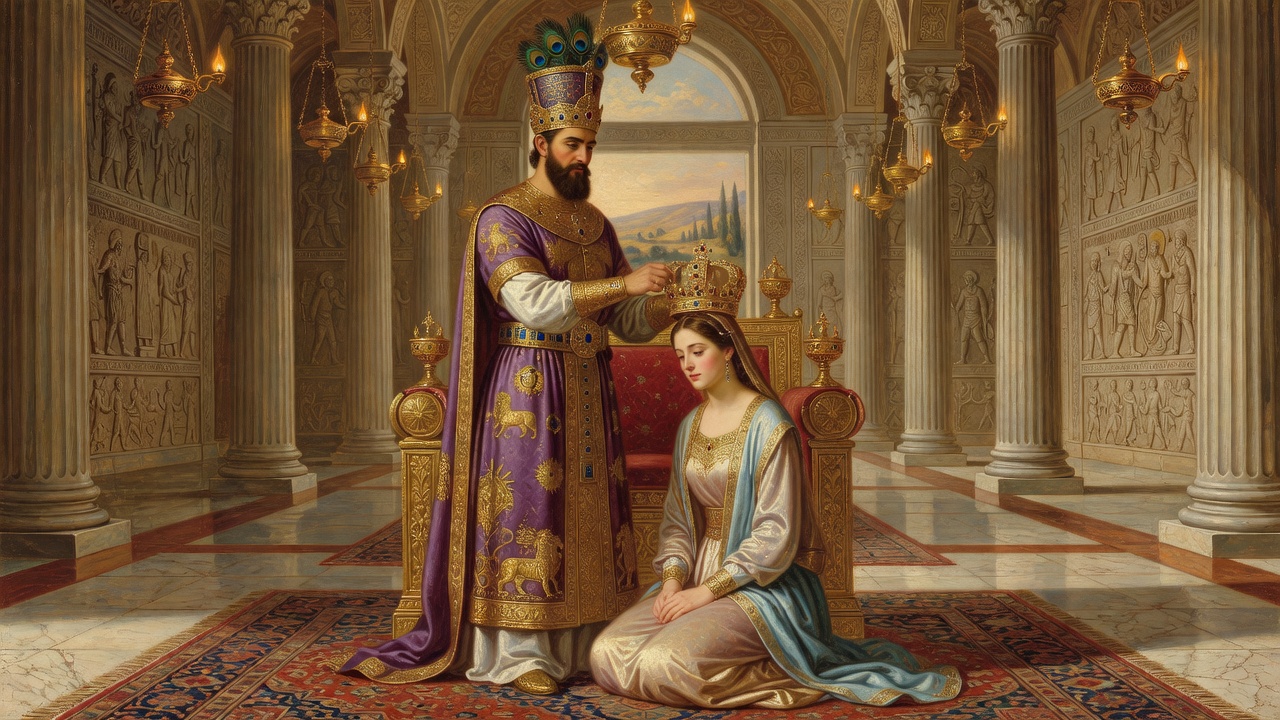
15Everyone who saw Esther liked her. After King Xerxes had been ruling for seven years, it was Esther’s turn to go to him. When they took her to the king, it was during the middle part of the winter. She wore only the things that Hegai suggested. 17The king liked Esther more than he liked any of the other women that they brought to him. He liked her so much that he put on her head the queen’s crown, and he declared that Esther would be the queen instead of Vashti. 18To celebrate her becoming the queen, he had a big banquet/feast prepared for all his administrators and other officials. He generously gave expensive gifts to everyone, and he declared that in all the provinces there would be a holiday, a time when people did not have to pay taxes.
19Later all those women who had spent a night with the king were gathered together again. By that time Mordecai had become an official at the palace. 20But Esther still did not tell anyone that she was a Jew. She continued to do what Mordecai had told her to do. 21One day when Mordecai was doing his work in the palace, two of the king’s officials were there. Their names were Bigthana and Teresh. They were the guards who stood outside the king’s own rooms. They became angry with the king, and they were planning how they could assassinate/kill him. 22But Mordecai heard about what they were planning, and he told that to Queen Esther. Then she told the king what Mordecai had found out. 23The king investigated and found out that Mordecai’s report was true. So the king ordered that those two men be hanged. When that was done, ◄an official wrote a report/a report was written► about it in a book called ‘The book that records what happened while Xerxes was king’.
Did you know?
Esther's Rise to Queen
- Esther originally bore the Hebrew name Hadassah, meaning "myrtle," but became known as Esther (derived from the Persian word for "star") in the Persian court. An orphaned Benjamite, she was brought up by her cousin Mordecai, who instructed her not to disclose her Jewish heritage.Sources: Esther · the Bible text itself
- Young women brought to the citadel of Susa underwent a strict twelve-month preparation under the royal official Hegai. The regimen required six months of treatments with oil of myrrh followed by six months with perfumes and cosmetics before an audience with the king.Sources: Hegai · the Bible text itself
- While sitting at the palace gate, Mordecai uncovered an assassination plot against King Ahasuerus by two royal guards, Bigthan and Teresh. Queen Esther reported the treason in Mordecai's name, and the event was formally recorded in the king's chronicles.Sources: the Bible text itself
Notes written with AI assistance from open sources (Theographic Bible Metadata, CC BY-SA 4.0; Easton’s Bible Dictionary, public domain) and reviewed before publishing.
Places in this chapter
- Susa · Today: Shush · 32.189, 48.258 · verses 3, 5, 8
- Babylon · 32.543, 44.422 · verse 6
- Jerusalem · 31.777, 35.234 · verse 6
Only places identified with high confidence are shown (90% or more according to the scholarly sources compiled by OpenBible). Period map: DARE (Digital Atlas of the Roman Empire), CC BY 4.0; modern map: © OpenStreetMap contributors; places: OpenBible.info (CC BY 4.0).
Credits and license for this translation
Translation for Translators
A Bible Translation for Bible Translators which makes implied information explicit in the text as an aid to the translator who may need that information to correctly translate into a particular language.
Copyright © 2008-2017 Ellis W. Deibler, Jr.
Language: English
Dialect: American
This translation is made available to you under the terms of the
Creative Commons Attribution Share-Alike license 4.0.
You have permission to share and redistribute this Bible translation in any format and to make reasonable revisions and adaptations of this translation, provided that:
You include the above copyright and source information.
If you make any changes to the text, you must indicate that you did so in a way that makes it clear that the original licensor is not necessarily endorsing your changes.
If you redistribute this text, you must distribute your contributions under the same license as the original.
Pictures included with Scriptures and other documents on this site are licensed just for use with those Scriptures and documents.
For other uses, please contact the respective copyright owners.
Note that in addition to the rules above, revising and adapting God's Word involves a great responsibility to be true to God's Word. See Revelation 22:18-19.
2026-10-02
Source: http://ebible.org/eng-t4t/ · eBible.org