Deuteronomy 23
Translation for Translators · Tap a verse to see its cross-references.
Exclusion from Yahweh’s people
1“Any man whose testicles are crushed or whose penis is cut off shall not be ◄included as one of/allowed to worship with► Yahweh’s people.
2“No ◄illegitimate person/person whose mother and father were not married►, or descendant of that person, extending to the tenth generation, shall be included as one of Yahweh’s people.
3“No one from the Ammon or Moab people-groups shall be ◄included as one of/allowed to worship with► Yahweh’s people, extending to the tenth generation. 4One reason is that their leaders refused to give your ancestors food and water when they were traveling from Egypt to Canaan. Another reason is that they wanted to pay Balaam, the son of Beor from Pethor town in Mesopotamia, to curse you Israelis. 5But Yahweh our God did not pay attention to Balaam; instead, he caused Balaam to bless your ancestors, because Yahweh loved them. 6As long as Israel is a nation, you must not do anything to cause things to go well for those two people-groups or enable them to prosper.
7“But do not despise anyone from the Edom people-group, because they are descendants of your ancestor Jacob, just like you are. And do not despise people from Egypt, because they treated your ancestors well when they first lived in Egypt. 8The children and grandchildren of people from Edom and Egypt who live among you may be ◄included among/allowed to worship with► Yahweh’s people.”
Keeping the camp clean
9“When your soldiers are living in tents at a time of fighting your enemies, they must avoid doing things that would make them unacceptable to God. 10If any soldier becomes unacceptable to God because semen comes out of his body during the night, the next morning he must go outside the camp and stay there during that day. 11But in the evening of that day, he must bathe himself, and at sunset he is allowed to come back into the camp.
12“Your soldiers must have a toilet area outside the camp where you can go when you need to. 13When you go to fight against your enemies, carry a stick along with your weapons, in order that when you need to defecate [EUP], you can dig a hole with the stick, and then cover up the hole when you have finished defecating. 14You must keep the camp acceptable to Yahweh our God, because he is with you in your camp to protect you and to enable you to defeat your enemies. Do not do anything disgraceful/indecent that would cause Yahweh to abandon you.”
Various other laws
15“If slaves who escape from their masters come to you and request you to protect them, do not send them back to their masters. 16Allow them to stay/live among you, in whatever town they choose, and do not mistreat them.
17“Do not allow any Israeli man or woman to become a prostitute at the temple. 18Also, do not allow any people who earned money from being a prostitute to bring any of that money into the temple of Yahweh our God, even if they solemnly promised to pay that money to Yahweh. Yahweh hates those who are prostitutes.
19“When you lend money or food or anything else to a fellow Israeli, do not charge them interest. 20You are allowed to charge interest when you lend money to foreigners who live in your land, but not when you lend money to Israelis. Do this in order that Yahweh our God will bless you in everything that you do in the land that you are about to enter and occupy.
21“When you vow to give something to Yahweh your God or to do something for him, do it as soon as you can. Yahweh expects you to do what you promised, and if you do not do it, you will be committing a sin. 22But if you [SYN] do not vow to do something, that is not sinful. 23But if you voluntarily promise to do something, you must do it.
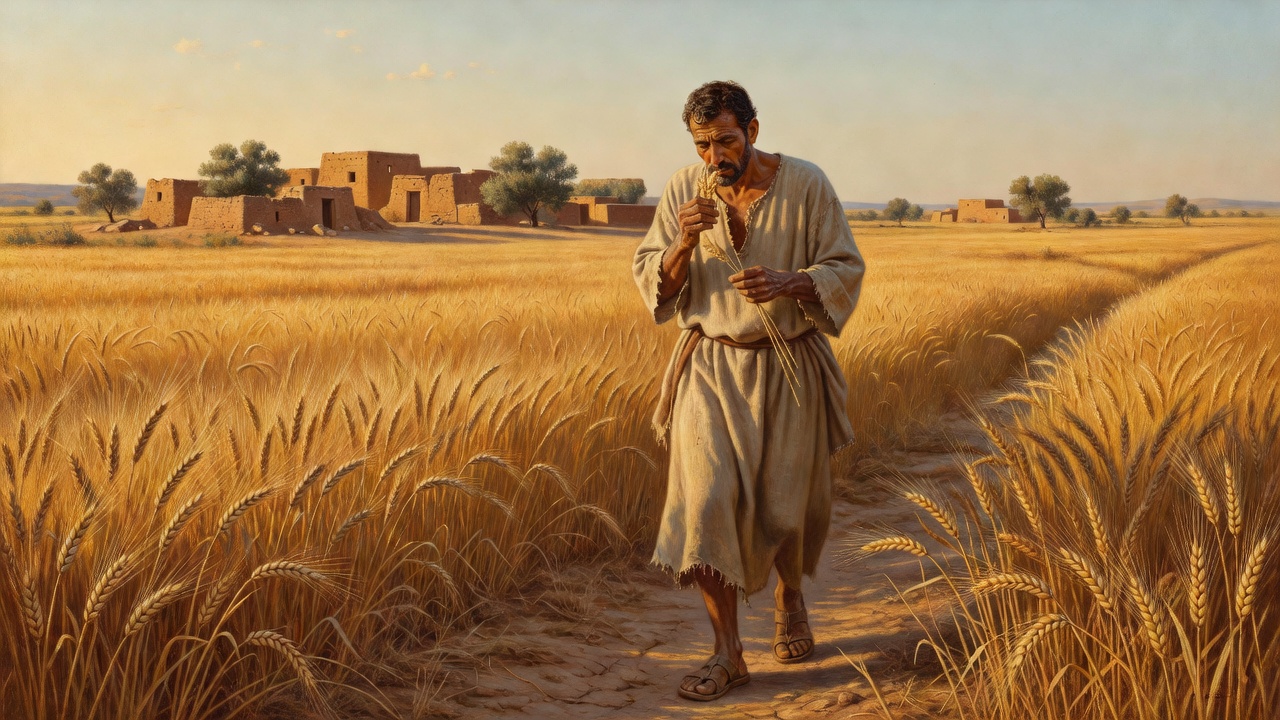
24“When you walk through someone else’s vineyard, you are allowed to pick and eat as many grapes as you want, but you must not cut some from a vine and carry them away in a container. 25When you walk along a path in someone else’s field of grain, you are allowed to pluck/pick some of the grain and eat it, but you must not cut any grain with a sickle and take it with you.”
Did you know?
Community Purity and Social Laws
- Ammonites and Moabites were excluded from the assembly because they withheld food and water and hired Balaam son of Beor against Israel. Balaam came from Pethor in Aram-naharaim (Mesopotamia), a region between the Tigris and Euphrates rivers where Pethor is identified with the ancient site of Pitru.Sources: the Bible text itself · Balaam · Pethor · Mesopotamia
- In contrast to the exclusion of Ammon and Moab, Israelites were instructed not to despise Edomites, whom they regarded as kin, or Egyptians, among whom they had lived as foreigners. Descendants of the third generation from both groups were permitted to enter the assembly of the Lord.Sources: the Bible text itself · Egypt
- The chapter outlines distinct social and military protections, including granting refuge to runaway foreign slaves rather than returning them to their masters. It also permitted hungry travelers to eat grapes or pluck grain by hand in a neighbor's field, provided they did not gather surplus into containers or use a sickle.Sources: the Bible text itself
Notes written with AI assistance from open sources (Theographic Bible Metadata, CC BY-SA 4.0; Easton’s Bible Dictionary, public domain) and reviewed before publishing.
Places in this chapter
- Egypt · 30.129, 31.308 · verse 4
- Mesopotamia · Today: Aram-naharaim · 36.864, 39.033 · verse 4
- Pethor · Today: Til Barsip · 36.701, 38.087 · verse 4
Only places identified with high confidence are shown (90% or more according to the scholarly sources compiled by OpenBible). Period map: DARE (Digital Atlas of the Roman Empire), CC BY 4.0; modern map: © OpenStreetMap contributors; places: OpenBible.info (CC BY 4.0).
Credits and license for this translation
Translation for Translators
A Bible Translation for Bible Translators which makes implied information explicit in the text as an aid to the translator who may need that information to correctly translate into a particular language.
Copyright © 2008-2017 Ellis W. Deibler, Jr.
Language: English
Dialect: American
This translation is made available to you under the terms of the
Creative Commons Attribution Share-Alike license 4.0.
You have permission to share and redistribute this Bible translation in any format and to make reasonable revisions and adaptations of this translation, provided that:
You include the above copyright and source information.
If you make any changes to the text, you must indicate that you did so in a way that makes it clear that the original licensor is not necessarily endorsing your changes.
If you redistribute this text, you must distribute your contributions under the same license as the original.
Pictures included with Scriptures and other documents on this site are licensed just for use with those Scriptures and documents.
For other uses, please contact the respective copyright owners.
Note that in addition to the rules above, revising and adapting God's Word involves a great responsibility to be true to God's Word. See Revelation 22:18-19.
2026-10-02
Source: http://ebible.org/eng-t4t/ · eBible.org