Deuteronomy 21
Translation for Translators · Tap a verse to see its cross-references.
When no one knows who murdered someone
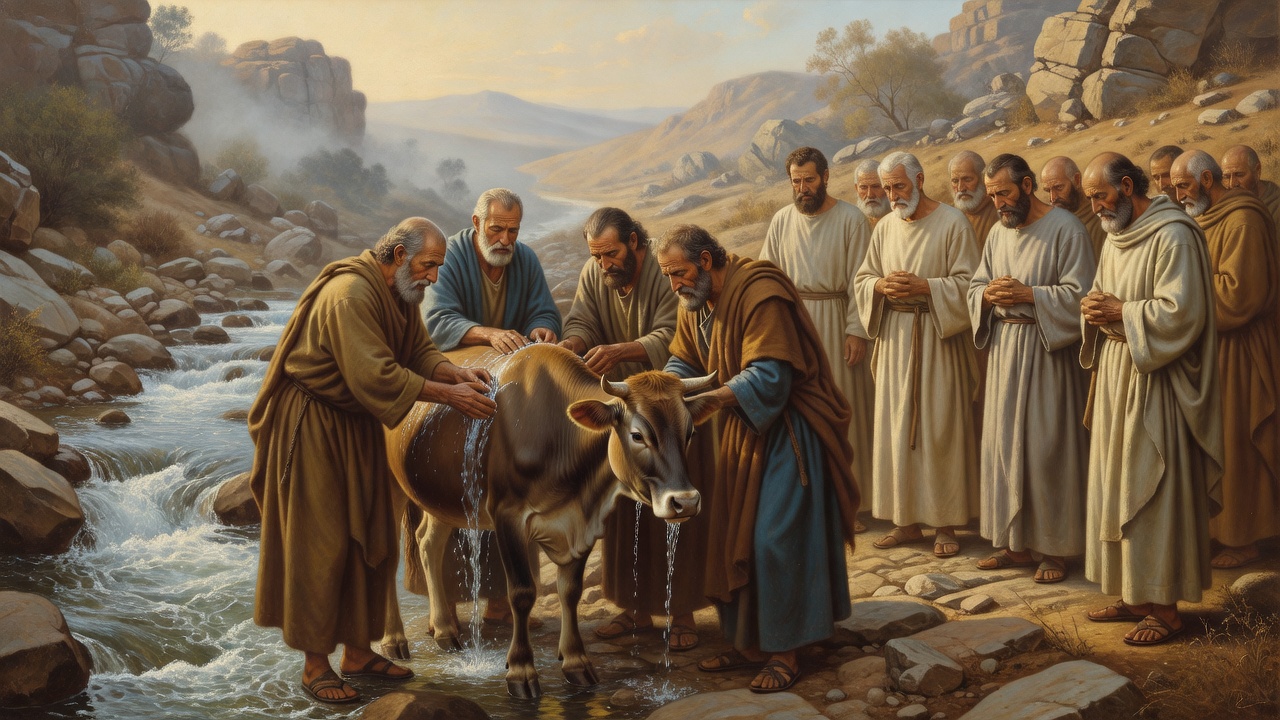
1“Suppose someone has been murdered in a field in the land that Yahweh our God is giving to you, and you do not know who killed that person. 2If that happens, your elders and judges must go out to where that person’s corpse was found and measure the distance from there to each of the nearby towns. 3Then the elders in the town that is closest to where the corpse was found must select a young cow that has never been used for doing work. 4They must take it to a place near a stream where the ground has never been plowed or planted. They must break its neck there in that valley. 5The priests must go there also, because Yahweh our God has chosen them from the tribe of Levi to serve him and to be his representatives [MTY] when they bless people. And he has also chosen them to settle disputes in which someone has been injured. 6The elders from the closest town must wash their hands over the young cow whose neck was broken, 7and they must say, ‘We did not murder this person [MTY], and we did not see who did it. 8Yahweh, forgive us, your Israeli people whom you rescued from Egypt. Do not consider ◄us to be guilty/that we should be punished because► of murdering someone who ◄is innocent/had not done something that is wrong►. Instead, forgive us.’ 9By doing that, you will be doing what Yahweh considers to be right, and you will not be considered to be guilty for murdering that person.”
The rule about marrying women who are captured
10“When you soldiers go to fight against your enemies, and Yahweh our God enables you to defeat them [IDM], and ◄they become your prisoners/you capture them►, 11one of you may see among them a beautiful woman that he likes, and he may want to marry her. 12He should take her to his home, and there she must shave all the hair off her head and cut her fingernails to signify that now she does not belong to her people-group any more, but instead she is becoming an Israeli. 13She must take off the clothes that she was wearing when she was captured, and put on Israeli clothes. She must stay in that man’s house and mourn for a month because of leaving her parents. After that, he will be allowed to marry her. 14Later, if he no longer is pleased with her, he will be permitted to allow her to leave him. But because she was forced to have sex with him, he will not be allowed to treat her like a slave and sell her to someone else.”
The oldest son’s inheritance
15“Suppose that a man has two wives, but he likes one of them and dislikes the other one. And suppose that they both give birth to sons, and the oldest son is the child of the woman that he does not like. 16On the day when that man decides how he will divide his possessions for his sons to possess after he dies, he must not favor the son of the wife that he loves by giving him a bigger share, the share that the older son should receive. 17He must give to the older son, the son of the wife whom he does not like, twice as much of his possessions. That son is his firstborn son, and he must be given the share that he should receive because of his being that man’s firstborn son.”
A rebellious son
18“Suppose there is a boy who is very stubborn and always ◄rebelling against/disobeying► his parents, and who will not heed what they say to him. And suppose that they punish him but he still does not pay attention to what they tell him [MTY]. 19If that happens, his parents must take him to the ◄gate of/central meeting place in► the city where he lives and have him stand in front of the elders of the city. 20Then the parents must say to the elders of that city, ‘This son of ours is stubborn and always rebelling against us. He will not pay attention to what we tell him [MTY]. He wastes a lot of money (OR, eats too much food) and gets drunk.’ 21Then all the elders of that city must execute him by throwing stones at him. By doing that, you will get rid of this evil practice among you. And everyone in Israel will hear about what happened and they will be afraid to do what he did.”
Burying criminals
22“If someone is executed for having committed a crime for which he deserves to die, and you hang his corpse on a post, 23you must not allow his corpse to remain there all night. You must bury it on the day that he died, because God has cursed anyone whose corpse is allowed to remain on a post. You must bury the corpse that day, in order that you do not defile the land that Yahweh our God is giving to you.”
Did you know?
Justice, Family Rights, and Communal Purity
- When a murdered body was found in an open field with no known killer, the elders of the closest town were required to perform an atonement ritual. In an unplowed valley with running water, they washed their hands over a heifer while Levitical priests attended, clearing the community of bloodguilt.Sources: the Bible text itself
- Under the laws of inheritance, a father could not transfer the firstborn's rights to a younger son out of favoritism for a beloved wife. The eldest son, even if born to an unloved wife, was legally guaranteed a double portion of the father's estate.Sources: the Bible text itself
- If an executed criminal's body was hung on a tree as a public warning, it had to be taken down and buried before nightfall. The law stated that anyone hung on a tree was under God's curse, and leaving the corpse overnight would defile the land.Sources: the Bible text itself
Notes written with AI assistance from open sources (Theographic Bible Metadata, CC BY-SA 4.0; Easton’s Bible Dictionary, public domain) and reviewed before publishing.
Credits and license for this translation
Translation for Translators
A Bible Translation for Bible Translators which makes implied information explicit in the text as an aid to the translator who may need that information to correctly translate into a particular language.
Copyright © 2008-2017 Ellis W. Deibler, Jr.
Language: English
Dialect: American
This translation is made available to you under the terms of the
Creative Commons Attribution Share-Alike license 4.0.
You have permission to share and redistribute this Bible translation in any format and to make reasonable revisions and adaptations of this translation, provided that:
You include the above copyright and source information.
If you make any changes to the text, you must indicate that you did so in a way that makes it clear that the original licensor is not necessarily endorsing your changes.
If you redistribute this text, you must distribute your contributions under the same license as the original.
Pictures included with Scriptures and other documents on this site are licensed just for use with those Scriptures and documents.
For other uses, please contact the respective copyright owners.
Note that in addition to the rules above, revising and adapting God's Word involves a great responsibility to be true to God's Word. See Revelation 22:18-19.
2026-10-02
Source: http://ebible.org/eng-t4t/ · eBible.org