2 Kings 25
Translation for Translators · Tap a verse to see its cross-references.
1On January 15 of the ninth year that Zedekiah had been ruling, King Nebuchadnezzar arrived with his whole army, and they surrounded Jerusalem. They built ramps made of dirt against the walls of the city, so that they could climb up the ramps and attack the city. 2They did that for two years. 3After Zedekiah had been ruling for eleven years, the ◄famine/shortage of food► had become very bad. All their food was gone. 4On July 18 of that year, the Babylonian soldiers broke through part of the city wall, and that enabled them to enter the city. All the soldiers of Judah wanted to escape. But the Babylonian soldiers surrounded the city, so the king and the soldiers of Judah waited until it was nighttime. Then they fled through the gate that was between the two walls near the king’s park. They ran across the fields and started to go down to the Jordan River Valley. 5But the Babylonian soldiers chased/ran after them. They caught the king when he was by himself in the valley near the Jordan River. He was by himself because all his soldiers had abandoned him. 6The Babylonian soldiers took King Zedekiah to Riblah city in Babylon. There the king of Babylon decided what they would do to punish him. 7There the king of Babylon forced Zedekiah to watch as the Babylonian soldiers killed all of Zedekiah’s sons. Then they gouged out Zedekiah’s eyes. They put bronze chains on his hands and feet and then they took him to Babylon.
8On August 14 of that year, after Nebuchadnezzar had been ruling for 19 years, Nebuzaradan arrived in Jerusalem. He was one of king Nebuchadnezzar’s officials and captain of the men that guarded the king. 9He commanded his soldiers to burn down the temple of Yahweh, the king’s palace, and all the houses in Jerusalem. So they burned down all the important buildings in the city. 10Then Nebuzaradan supervised all the soldiers of the Babylonian army as they tore down the walls of Jerusalem. 11Then he and his soldiers took to Babylon the people who were still living in the city, the other people who lived in that area, and the soldiers who had previously surrendered to the Babylonian army. 12But Nebuzaradan allowed some of the very poor people to stay in Judah to take care of the vineyards and to plant crops in the fields.
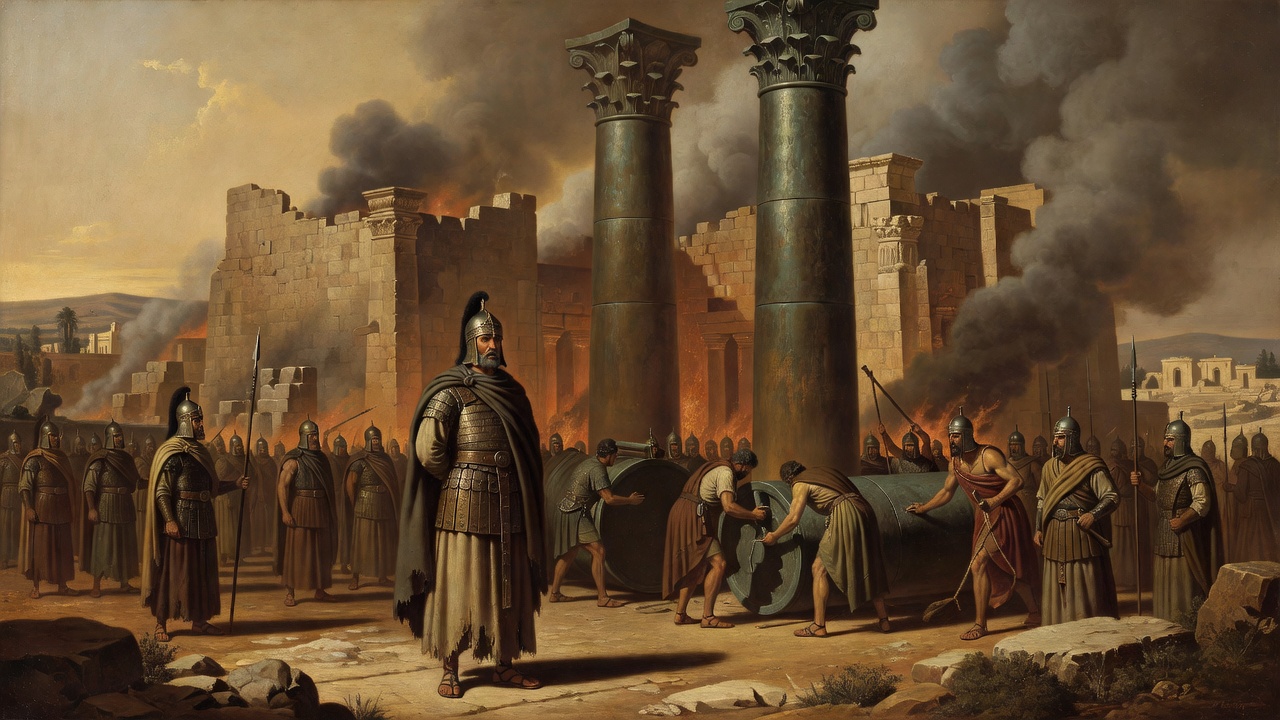
13The Babylonian soldiers broke into pieces the bronze pillars, the bronze carts with wheels, and the huge bronze basin, all of which were in the temple courtyard, and they took all the bronze to Babylon. 14They also took the pots, the shovels, the instruments for ◄snuffing out/extinguishing► the wicks of the lamps, the dishes, and all the other bronze items that the Israeli priests had used for offering sacrifices at the temple. 15The soldiers also took away the ◄firepans/trays for carrying burning coals►, the basins, and all the other items made of pure gold or pure silver.
16The bronze from the two pillars, the carts with wheels, and the huge basin were very heavy; they could not be weighed. ◄Those things had been made/A man named Hiram had made these things► for the temple when Solomon was the king of Israel. 17Each of the pillars was ◄27 feet/8 meters► tall. The bronze capital/top of each pillar was ◄7-1/2 feet/2.3 meters► high. They were each decorated all around with something that looked like a net made of bronze chains connecting bronze pomegranates.
18Nebuzaradan took with him to Babylon Seraiah the Supreme Priest, Zephaniah his assistant, and the three men who guarded the entrance to the temple. 19And they found people who were still hiding in Jerusalem. From those people he took one officer from the Judean army, five of the king’s advisors, the chief secretary of the army commander who was in charge of recruiting men to join the army, and 60 other important Judean men. 20Nebuzaradan took them all to the king of Babylon at Riblah city. 21There at Riblah, in Hamath province, the king of Babylon commanded that they all be executed.
That is what happened when the people of Judah were ◄taken forcefully/exiled► from their land to Babylon.
Gedaliah was appointed governor in Judah
22Then King Nebuchadnezzar appointed Gedaliah, who was the son of Ahikam and grandson of Shaphan, to be the governor of the people who were still living in Judah. 23When all the army captains of Judah and their soldiers who had not surrendered to Nebuchadnezzar found out that the king of Babylon had appointed Gedaliah to be the governor, they met with him at Mizpah town. These army captains were Ishmael the son of Nethaniah, Johanan the son of Kareah, Seraiah the son of Tanhumeth from Netophah town, and Jaazaniah from the Maacah region.
24Gedaliah solemnly promised them that the officials from Babylon were not planning to harm them. He said, “You may live in this land without being afraid and serve the king of Babylon, and if you do, everything will go well for you.”
25But in October of that year, Ishmael, whose grandfather Elishama was one of the relatives of the descendants of King David, went to Mizpah along with ten other men and assassinated/killed Gedaliah and all the men who were with him. There were also men from Judah and men from Babylon whom they assassinated. 26Then many [HYP] of the people from Judah, important people and unimportant ones, and the army captains, were very afraid of what the Babylonians would do to them, so they fled to Egypt.
Jehoiachin was released
27Thirty-seven years after King Jehoiachin of Judah was taken to Babylon, Nebuchadnezzar’s son Evil-Merodach became the king of Babylon. He was kind to Jehoiachin, and on April 2 of that year, he released/freed Jehoiachin from prison. 28He always spoke kindly to Jehoiachin and honored him more than the other kings who had been taken/exiled to Babylon. 29He gave Jehoiachin new clothes to replace the clothes that he had been wearing in prison, and he allowed Jehoiachin to eat at the king’s table every day for the rest of his life. 30The king of Babylon also gave him money every day, so that he could buy the things that he needed. The king continued to do that until Jehoiachin died.
Did you know?
The Fall of Jerusalem and the Exile
- King Nebuchadnezzar directed the campaign against Jerusalem from his headquarters at Riblah, situated in the land of Hamath on the Orontes River. After being captured on the plains of Jericho, King Zedekiah was brought to Riblah, where his sons were slaughtered before him and he was blinded before being carried in bronze shackles to Babylon.Sources: Riblah · Zedekiah · the Bible text itself
- When Nebuzaradan, captain of the guard, burned Jerusalem, the Babylonians broke up the monumental bronze pillars, the movable stands, and the large bronze Sea that King Solomon had made for the temple, carrying the metal off to Babylon.Sources: Nebuzar-adan · Solomon · the Bible text itself
- Following the city's destruction, Nebuchadnezzar appointed Gedaliah son of Ahikam as governor over the remaining population at Mizpah. However, Ishmael son of Nethaniah, a member of the royal family, assassinated Gedaliah, causing the terrified remnant to flee to Egypt.Sources: Gedaliah · Ishmael · Mizpah · the Bible text itself
Notes written with AI assistance from open sources (Theographic Bible Metadata, CC BY-SA 4.0; Easton’s Bible Dictionary, public domain) and reviewed before publishing.
Places in this chapter
- Babylon · 32.543, 44.422 · verses 1, 6, 7, 8, 11, 13, 20, 21, 22, 23, 24, 27, 28, 29
- Jerusalem · 31.777, 35.234 · verses 1, 2, 8, 9, 10
- Arabah · 30.417, 35.151 · verses 4, 5
- Chaldea · 30.962, 46.104 · verses 4, 5, 10, 13, 25, 26
- Jericho · Today: Tell es Sultan · 31.872, 35.445 · verse 5
- Riblah · Today: Rableh · 34.460, 36.573 · verses 6, 20, 21
- Hamath · Today: Hama · 35.136, 36.750 · verse 21
- Egypt · 30.129, 31.308 · verse 26
Only places identified with high confidence are shown (90% or more according to the scholarly sources compiled by OpenBible). Period map: DARE (Digital Atlas of the Roman Empire), CC BY 4.0; modern map: © OpenStreetMap contributors; places: OpenBible.info (CC BY 4.0).
Credits and license for this translation
Translation for Translators
A Bible Translation for Bible Translators which makes implied information explicit in the text as an aid to the translator who may need that information to correctly translate into a particular language.
Copyright © 2008-2017 Ellis W. Deibler, Jr.
Language: English
Dialect: American
This translation is made available to you under the terms of the
Creative Commons Attribution Share-Alike license 4.0.
You have permission to share and redistribute this Bible translation in any format and to make reasonable revisions and adaptations of this translation, provided that:
You include the above copyright and source information.
If you make any changes to the text, you must indicate that you did so in a way that makes it clear that the original licensor is not necessarily endorsing your changes.
If you redistribute this text, you must distribute your contributions under the same license as the original.
Pictures included with Scriptures and other documents on this site are licensed just for use with those Scriptures and documents.
For other uses, please contact the respective copyright owners.
Note that in addition to the rules above, revising and adapting God's Word involves a great responsibility to be true to God's Word. See Revelation 22:18-19.
2026-10-02
Source: http://ebible.org/eng-t4t/ · eBible.org