2 Chronicles 14
Translation for Translators · Tap a verse to see its cross-references.
1When Abijah died, he was buried in the part of Jerusalem called ‘The City of David’. His son Asa became the king. While Asa was ruling, there was peace in Judah for ten years.
King Asa’s rule in Judah
2Asa did things that Yahweh his God considers to be right and good. 3His workers got rid of the altars to worship foreign gods that were on the high hills. They smashed the sacred stone pillars and cut down the poles for worshiping the goddess Asherah. 4Asa commanded the people of Judah to worship only Yahweh, the God whom their ancestors worshiped, and to obey his laws and commands. 5His workers destroyed all the shrines on the hilltops and the altars for burning incense to idols in every town in Judah. As a result, there was peace while Asa ruled the kingdom of Judah. 6His workers built cities and constructed walls around them. No army attacked Judah during that time, because Yahweh enabled them to have peace.
7Asa said to the people of Judah, “We should protect these towns by building walls around them, with watchtowers and gates that have bars. This country still belongs to us because we have requested Yahweh our God to help us. We requested him for his help, and he has given us peace in our entire country.” So they built buildings and prospered.
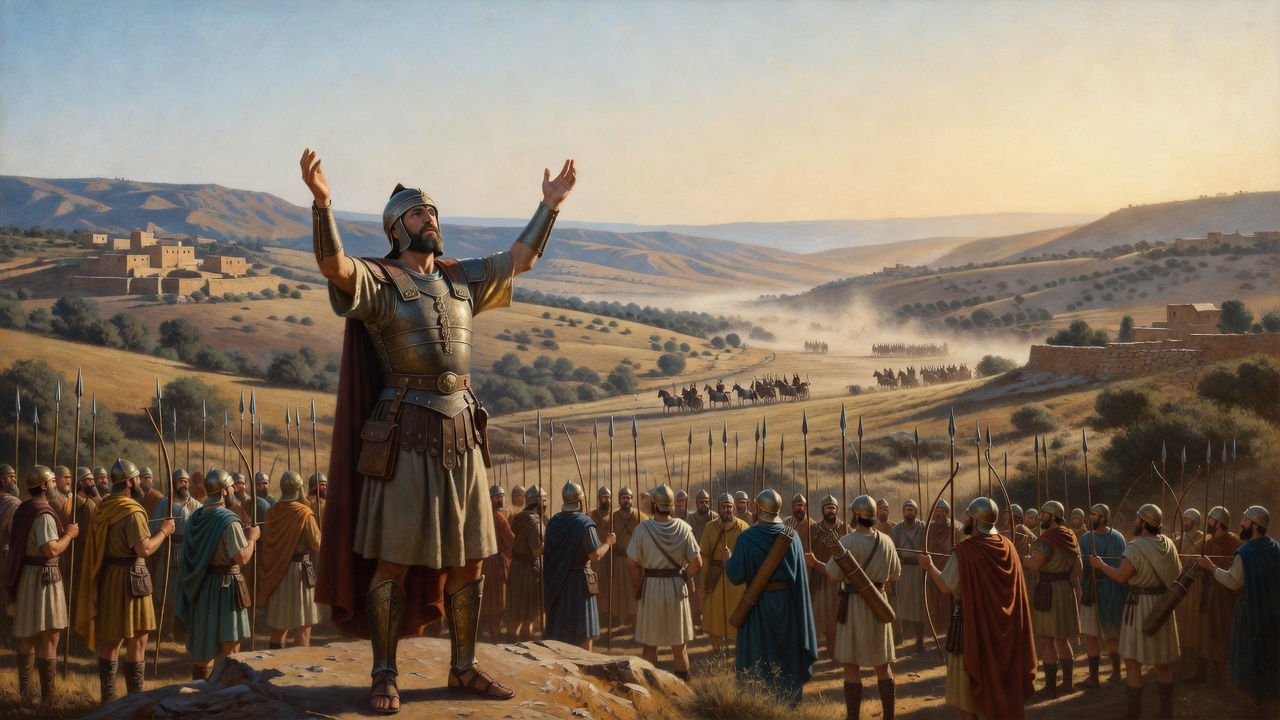
8Asa had an army of 300,000 men from Judah. They all carried large shields and spears. He also had 280,000 men from the tribe of Benjamin in his army. They carried smaller shields, and bows and arrows. They were all brave soldiers.
9Zerah, a man from Ethiopia/Sudan, marched with a huge army and 300 chariots to attack the army of Judah and Benjamin. They went as far as the town of Mareshah about 25 miles/southwest of Jerusalem. 10Asa went with his army to fight against them, and both armies took their positions in the Zephathah Valley.
11Then Asa cried out to Yahweh his God, saying, “Yahweh, there is no one like you who can help those who have very little power to resist a mighty army. Yahweh our God, help us, because we are relying on you; and trusting in you we have come to fight against this huge army. Yahweh, you are our God; do not allow anyone to defeat you.”
12Then Yahweh enabled Asa and the army of Judah to defeat the army from Ethiopia. They fled, 13and Asa and his army pursued them to the southwest as far as Gerar. A huge number of the soldiers from Ethiopia were killed, with the result that those who were not killed were unable to fight any more. They were greatly defeated by Yahweh and his army, and the men of Judah carried away a great amount of their possessions. 14The men of Judah were able to destroy the people in villages near Gerar because Yahweh had caused the people there to become terrified and unable to fight. The army of Judah took away all the valuable things from those villages. 15They also attacked the places where the local people who took care of domestic animals had set up their tents, and they took away big herds of sheep and goats and camels. Then they returned to Jerusalem.
Did you know?
Asa's Reforms and Victory
- Upon succeeding his father Abijah, King Asa initiated sweeping religious reforms across Judah, removing foreign altars, incense altars, high places, sacred pillars, and Asherah poles to re-establish the worship of God.Sources: Asa · the Bible text itself
- The army of Judah was composed of distinct tribal divisions: 300,000 warriors from Judah equipped with large shields and spears, alongside 280,000 warriors from Benjamin trained with smaller shields and bows.Sources: the Bible text itself
- When Zerah the Cushite invaded with a vast force of a million men and three hundred chariots, Asa met them in battle in the Valley of Zephathah near Mareshah, completely routing the invaders and pursuing them to Gerar.Sources: Zerah · Mareshah · Gerar · the Bible text itself
Notes written with AI assistance from open sources (Theographic Bible Metadata, CC BY-SA 4.0; Easton’s Bible Dictionary, public domain) and reviewed before publishing.
Places in this chapter
- City of David · 31.774, 35.236 · verse 1
- Mareshah · Today: Tel Maresha · 31.593, 34.898 · verses 9, 10
- Jerusalem · 31.777, 35.234 · verse 15
Only places identified with high confidence are shown (90% or more according to the scholarly sources compiled by OpenBible). Period map: DARE (Digital Atlas of the Roman Empire), CC BY 4.0; modern map: © OpenStreetMap contributors; places: OpenBible.info (CC BY 4.0).
Credits and license for this translation
Translation for Translators
A Bible Translation for Bible Translators which makes implied information explicit in the text as an aid to the translator who may need that information to correctly translate into a particular language.
Copyright © 2008-2017 Ellis W. Deibler, Jr.
Language: English
Dialect: American
This translation is made available to you under the terms of the
Creative Commons Attribution Share-Alike license 4.0.
You have permission to share and redistribute this Bible translation in any format and to make reasonable revisions and adaptations of this translation, provided that:
You include the above copyright and source information.
If you make any changes to the text, you must indicate that you did so in a way that makes it clear that the original licensor is not necessarily endorsing your changes.
If you redistribute this text, you must distribute your contributions under the same license as the original.
Pictures included with Scriptures and other documents on this site are licensed just for use with those Scriptures and documents.
For other uses, please contact the respective copyright owners.
Note that in addition to the rules above, revising and adapting God's Word involves a great responsibility to be true to God's Word. See Revelation 22:18-19.
2026-10-02
Source: http://ebible.org/eng-t4t/ · eBible.org