1 Chronicles 23
Translation for Translators · Tap a verse to see its cross-references.
The duties of the descendants of Levi
1David was a very old man [DOU] when he appointed his son Solomon to be the next king.
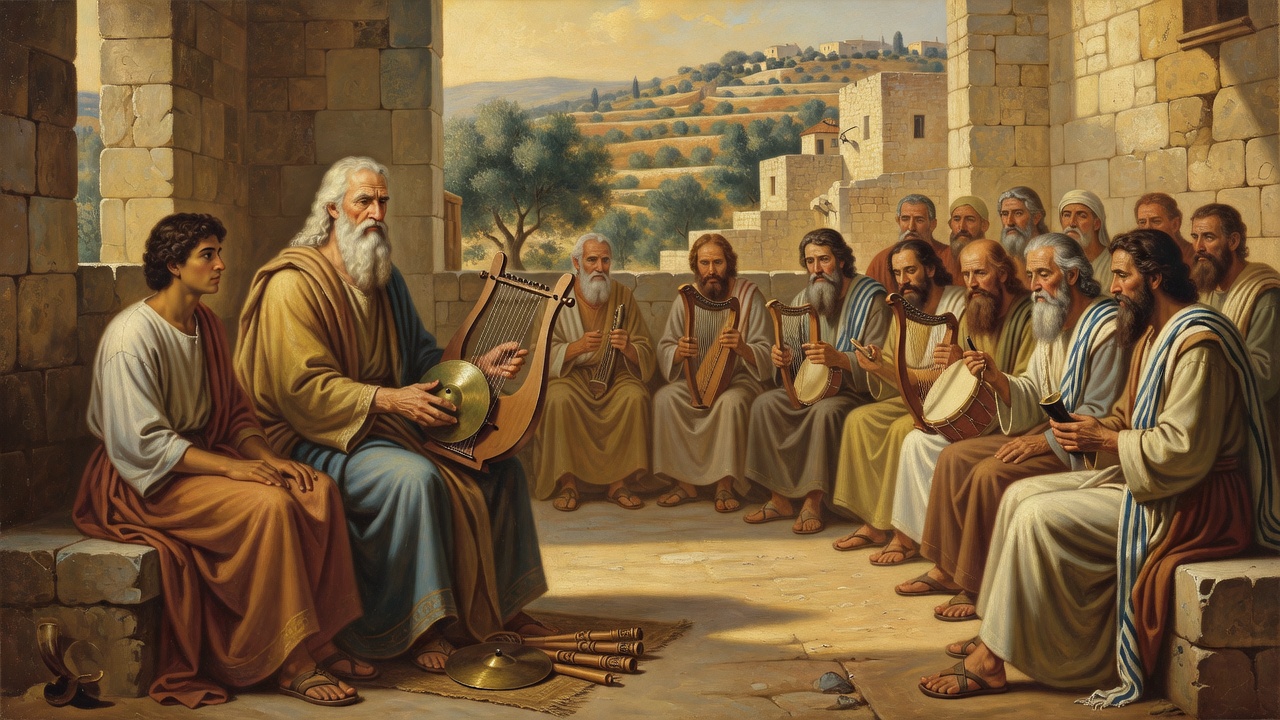
2David gathered the leaders of Israel and the priests and other descendants of Levi. 3He commanded some of his officials to count the descendants of Levi who were at least thirty years old, and they found out that there were 38,000 of them. 4Then David said, “From those 38,000 men, I want 24,000 of them to supervise the work at the temple of Yahweh, and I want 6,000 of them to be officials and judges. 5I want 4,000 to be guards at the gates, and 4,000 to praise Yahweh, using the musical instruments that I have provided for them.”
6David divided the descendants of Levi into three family groups; each group consisted of men who were descendants of one of the three sons of Levi—Gershon, Kohath, and Merari.
The descendants of Gershon
7From the descendants of Gershon there were Ladan and Shimei.
8There were three sons of Ladan: Jehiel was the oldest, and his younger brothers Zetham and Joel.
9There were three of the sons of Shimei: Shelomoth, Haziel, and Haran.
They were all leaders of the clans of Ladan.
10There were four men who were other sons of Shimei:
11Jahath, who was his oldest son, and his younger brothers Ziza, Jeush, and Beriah.
Jeush and Beriah did not have many sons, so they were counted as though they were one family.
The descendants of Kohath
12Kohath had four sons: Amram, Izhar, Hebron, and Uzziel.
13There were two sons of Amram: Aaron and Moses.
Aaron and his descendants were set apart to dedicate the very holy things, to offer sacrifices to Yahweh, to serve in his presence, and to declare to the people what Yahweh [MTY] would do to bless them. They were to do those things forever.
14The sons of Moses, the man who served God well, were counted as part of the tribe of Levi.
15The sons of Moses were Gershom and Eliezer.
16The oldest son of Gershom was Shubael.
17Rehabiah was the oldest son of Eliezer.
Eliezer had no other sons, but Rehabiah had many sons.
18The oldest son of Izhar was Shelomith.
19Hebron had four sons.
Jeriah was his oldest son, and his younger brothers were Amariah, Jahaziel, and Jekameam.
20Uzziel had two sons.
Micah was the oldest son, and his younger brother was Isshiah.
The descendants of Merari
21Merari had two sons: Mahli and Mushi.
The sons of Mahli were Eleazar and Kish.
22Eleazar had no sons; he had only daughters. Their cousins, the sons of Kish, married them.
23The three sons of Mushi were Mahli, Eder, and Jerimoth.
24Those were the descendants of Levi, whose names were listed according to their families/clans. They were chosen for special jobs by ◄casting lots/throwing small marked stones►. Each person who was at least 20 years old was listed. They all worked in the temple of Yahweh. 25David had said previously, “Yahweh, the God to whom we Israeli people belong, has enabled us to have peace, and he has come to live in Jerusalem forever. 26Therefore, the descendants of Levi no longer need to carry the Sacred Tent and the items used in the work there.” 27Obeying the final instructions of David before he died, instructions for doing this work at the temple, they counted only the descendants of Levi who were at least 20 years old.
28The work of those descendants of Levi was to assist the descendants of Aaron in their work in the temple of Yahweh: To be in charge of the temple courtyards and the side rooms, the ceremonies for purifying all the sacred things, and to do other work at the temple. 29They were also in charge of the sacred loaves of bread that were placed each week on the table in the temple, the flour for the grain offerings, the wafers that were made without yeast, and the measuring the ingredients and mixing them and baking that bread and those wafers. 30They were also told to stand every morning at the temple and thank Yahweh and praise him. They were also required to do the same thing every evening. 31And they were to do the same thing whenever offerings that were to be completely burned on the altar were presented/offered to Yahweh on Sabbath days and during the new moon celebrations and other religious festivals. They were told how many of them should be there and what they should do each time.
32So the descendants of Levi did the work that was assigned to them by their fellow Israelis who were descendants of Aaron. They did that work in the area surrounding the Sacred Tent, and in the Sacred Tent, and later at the temple.
Did you know?
David Organizes the Levites
- A census counted 38,000 Levites aged thirty and above in Israel. David organized them into distinct roles: 24,000 to oversee the sanctuary's work, 6,000 as officials and judges, 4,000 as gatekeepers, and 4,000 as musicians praising the LORD with specially made instruments.Sources: the Bible text itself
- Because God had granted rest and chosen Jerusalem as a permanent dwelling place, the Levites no longer needed to transport the tabernacle and its furnishings. David therefore updated their duties to assisting Aaron's priestly line with temple offerings, maintenance, and daily morning and evening praise, lowering the entry age to twenty.Sources: the Bible text itself · Jerusalem
- Although both Aaron and Moses were sons of Amram from the lineage of Kohath, their descendants held different roles. Aaron and his descendants were set apart perpetually for the priesthood to burn incense and bless in the LORD's name, while the sons of Moses were counted among the general Levite clans.Sources: the Bible text itself · Aaron · Moses
Notes written with AI assistance from open sources (Theographic Bible Metadata, CC BY-SA 4.0; Easton’s Bible Dictionary, public domain) and reviewed before publishing.
Places in this chapter
- Jerusalem · 31.777, 35.234 · verse 25
Only places identified with high confidence are shown (90% or more according to the scholarly sources compiled by OpenBible). Period map: DARE (Digital Atlas of the Roman Empire), CC BY 4.0; modern map: © OpenStreetMap contributors; places: OpenBible.info (CC BY 4.0).
Credits and license for this translation
Translation for Translators
A Bible Translation for Bible Translators which makes implied information explicit in the text as an aid to the translator who may need that information to correctly translate into a particular language.
Copyright © 2008-2017 Ellis W. Deibler, Jr.
Language: English
Dialect: American
This translation is made available to you under the terms of the
Creative Commons Attribution Share-Alike license 4.0.
You have permission to share and redistribute this Bible translation in any format and to make reasonable revisions and adaptations of this translation, provided that:
You include the above copyright and source information.
If you make any changes to the text, you must indicate that you did so in a way that makes it clear that the original licensor is not necessarily endorsing your changes.
If you redistribute this text, you must distribute your contributions under the same license as the original.
Pictures included with Scriptures and other documents on this site are licensed just for use with those Scriptures and documents.
For other uses, please contact the respective copyright owners.
Note that in addition to the rules above, revising and adapting God's Word involves a great responsibility to be true to God's Word. See Revelation 22:18-19.
2026-10-02
Source: http://ebible.org/eng-t4t/ · eBible.org