1 Chronicles 19
Translation for Translators · Tap a verse to see its cross-references.
The battle against the Ammon people-group
1Some time later, Nahash, the king of the Ammon people-group, died. Then his son Hanun became their king. 2When David heard about that, he thought to himself, “Nahash was kind to me, so I will be kind to his son.” So David sent some officials there, to tell Hanun that he was sorry to hear that Hanun’s father had died.
But when David’s officials came to Hanun in the land where the Ammon people-group lived, 3the leaders of the Ammon people-group said to Hanun, “Do you think that it is really to honor your father that King David is sending these men to say that he is sorry that your father died? We think that his men have come to ◄look around/spy► our city in order to determine how his army can conquer us.”
4Hanun believed what they said, so he commanded some soldiers to seize the officials whom David had sent, and shave off their beards, and insult them by cutting off the lower part of their robes, and then send them away. So his soldiers did that.
5The officials were greatly humiliated/ashamed. When David found out about what had happened to his officials, he sent some messengers to them to tell them, “Stay at Jericho until your beards have grown again, and then return home.”
6Then the leaders of the Ammon people-group realized that they had greatly insulted [IDM] David. So Hanun and some of his officials sent about ◄37,000 pounds/34,000 kg.► of silver to hire chariots and chariot-drivers from the Aram-Naharaim, Aram-Maacah and Zobah regions of Syria northeast of Israel. 7They hired 32,000 chariots and chariot-drivers, as well as the king of the Maacah region and his army. They came and set up their tents near Medeba town in Moab region. The soldiers from the Ammon people-group also marched out and ◄stood in their positions/arranged themselves for battle► at the entrance to their capital city, Rabbah.
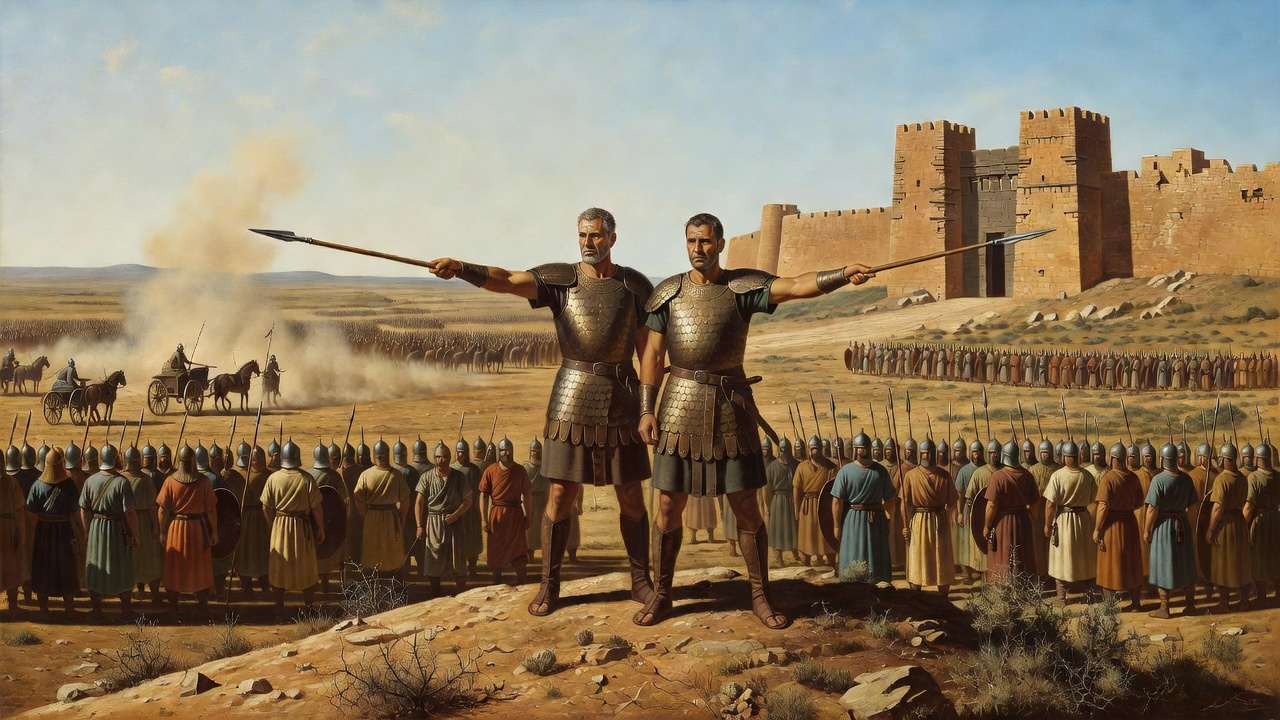
8When David heard about that, he sent Joab and all his army. 9The soldiers of the Ammon people-group came out of their city and lined up for battle at the entrance to their capital city, Rabbah. Meanwhile, the other kings who had come with their armies stood in their positions in the open fields.
10Joab saw that there were groups of enemy soldiers in front of his troops and behind his troops. So he selected some of the best Israeli troops and put them in positions to fight against the soldiers of Syria. 11He appointed his older brother Abishai to be the commander of his other soldiers and he told them to ◄stand in their positions/arrange themselves► in front of the army of the Ammon people-group. 12Joab said to them, “If the soldiers from Syria are too strong for us to defeat them, then your soldiers must come and help us. But if the soldiers from the Ammon people-group are too strong for you to defeat them, then my soldiers will come and help your men. 13We must be strong/courageous, and fight hard to defend our people and our cities ◄that belong to/where we worship► our God. I will pray that Yahweh will do what he considers to be good.”
14So Joab and his troops advanced to fight the army of Syria, and the soldiers from Syria ran away from them. 15And when the soldiers of the Ammon people-group saw that the soldiers from Syria were running away, they also started to run away from Abishai and his army, and they retreated back inside the city. So Joab and his army returned to Jerusalem.
16After the leaders of the army of Syria realized that they had been defeated by the army of Israel, they sent messengers to another part of Syria on the east side of the Euphrates river, and brought troops from there to the battle area, with Shophach, the commander of Hadadezer’s army, leading them.
17When David heard about that, he gathered all the Israeli soldiers, and they crossed the Jordan River. They advanced and took their battle positions to attack the army of Syria. 18But the army of Syria ran away from the soldiers of Israel. However, David’s soldiers killed 7,000 of their chariot-drivers and 40,000 other soldiers. They also killed Shophach, their army commander.
19When the kings who had been ruled by Hadadezer realized that they had been defeated by the Israeli army, they made peace with David, and agreed to allow him to rule them.
So the rulers of Syria did not want to help the rulers of the Ammon people-group any more.
Did you know?
War with Ammon and the Arameans
- When Hanun king of the Ammonites suspected David's envoys of espionage, he publicly humiliated them by shaving their beards and cutting their garments. To spare them further shame, David instructed the men to stay at the oasis city of Jericho until their beards grew back.Sources: the Bible text itself · Jericho
- Facing war with Israel, the Ammonites spent one thousand talents of silver to hire chariots and horsemen from Aramean kingdoms such as Zobah, Aram-naharaim, and Maacah. Faced with a two-front battle near Medeba, Joab divided the Israelite forces, leading elite troops against the Arameans while his brother Abishai engaged the Ammonites.Sources: the Bible text itself · Joab · Abishai · Medeba
- After their initial retreat, the Arameans summoned reinforcements from across the Euphrates River led by Shophach, the general of King Hadadezer of Zobah. David personally crossed the Jordan to defeat them, prompting Hadadezer's vassals to make peace and end their support for Ammon.Sources: the Bible text itself · Hadarezer · Shobach · Zobah
Notes written with AI assistance from open sources (Theographic Bible Metadata, CC BY-SA 4.0; Easton’s Bible Dictionary, public domain) and reviewed before publishing.
Places in this chapter
- Ammon · 31.955, 35.934 · verses 1, 2, 3, 6, 7, 9, 11, 12, 15, 19
- Jericho · Today: Tell es Sultan · 31.872, 35.445 · verse 5
- Maacah · 33.258, 35.581 · verses 6, 7
- Mesopotamia · Today: Aram-naharaim · 36.864, 39.033 · verse 6
- Zobah · 33.935, 36.151 · verse 6
- Medeba · Today: Madaba · 31.716, 35.795 · verse 7
- Syria · Today: Aram · 33.511, 36.306 · verses 10, 12, 14, 15, 16, 17, 18, 19
- Jerusalem · 31.777, 35.234 · verse 15
- Euphrates · Today: Euphrates River · 31.004, 47.442 · verse 16
- Jordan · Today: Jordan River · 31.761, 35.558 · verse 17
Only places identified with high confidence are shown (90% or more according to the scholarly sources compiled by OpenBible). Period map: DARE (Digital Atlas of the Roman Empire), CC BY 4.0; modern map: © OpenStreetMap contributors; places: OpenBible.info (CC BY 4.0).
Credits and license for this translation
Translation for Translators
A Bible Translation for Bible Translators which makes implied information explicit in the text as an aid to the translator who may need that information to correctly translate into a particular language.
Copyright © 2008-2017 Ellis W. Deibler, Jr.
Language: English
Dialect: American
This translation is made available to you under the terms of the
Creative Commons Attribution Share-Alike license 4.0.
You have permission to share and redistribute this Bible translation in any format and to make reasonable revisions and adaptations of this translation, provided that:
You include the above copyright and source information.
If you make any changes to the text, you must indicate that you did so in a way that makes it clear that the original licensor is not necessarily endorsing your changes.
If you redistribute this text, you must distribute your contributions under the same license as the original.
Pictures included with Scriptures and other documents on this site are licensed just for use with those Scriptures and documents.
For other uses, please contact the respective copyright owners.
Note that in addition to the rules above, revising and adapting God's Word involves a great responsibility to be true to God's Word. See Revelation 22:18-19.
2026-10-02
Source: http://ebible.org/eng-t4t/ · eBible.org