Luke 24
Revised Version with Apocrypha (1895) · Tap a verse to see its cross-references.
The Resurrection
1But on the first day of the week, at early dawn, they came unto the tomb, bringing the spices which they had prepared. 2And they found the stone rolled away from the tomb. 3And they entered in, and found not the body of the Lord Jesus. 4And it came to pass, while they were perplexed thereabout, behold, two men stood by them in dazzling apparel: 5and as they were affrighted, and bowed down their faces to the earth, they said unto them, Why seek ye the living among the dead? 6He is not here, but is risen: remember how he spake unto you when he was yet in Galilee, 7saying that the Son of man must be delivered up into the hands of sinful men, and be crucified, and the third day rise again. 8And they remembered his words, 9and returned from the tomb, and told all these things to the eleven, and to all the rest. 10Now they were Mary Magdalene, and Joanna, and Mary the mother of James: and the other women with them told these things unto the apostles. 11And these words appeared in their sight as idle talk; and they disbelieved them. 12But Peter arose, and ran unto the tomb; and stooping and looking in, he seeth the linen cloths by themselves; and he departed to his home, wondering at that which was come to pass.
The Road to Emmaus
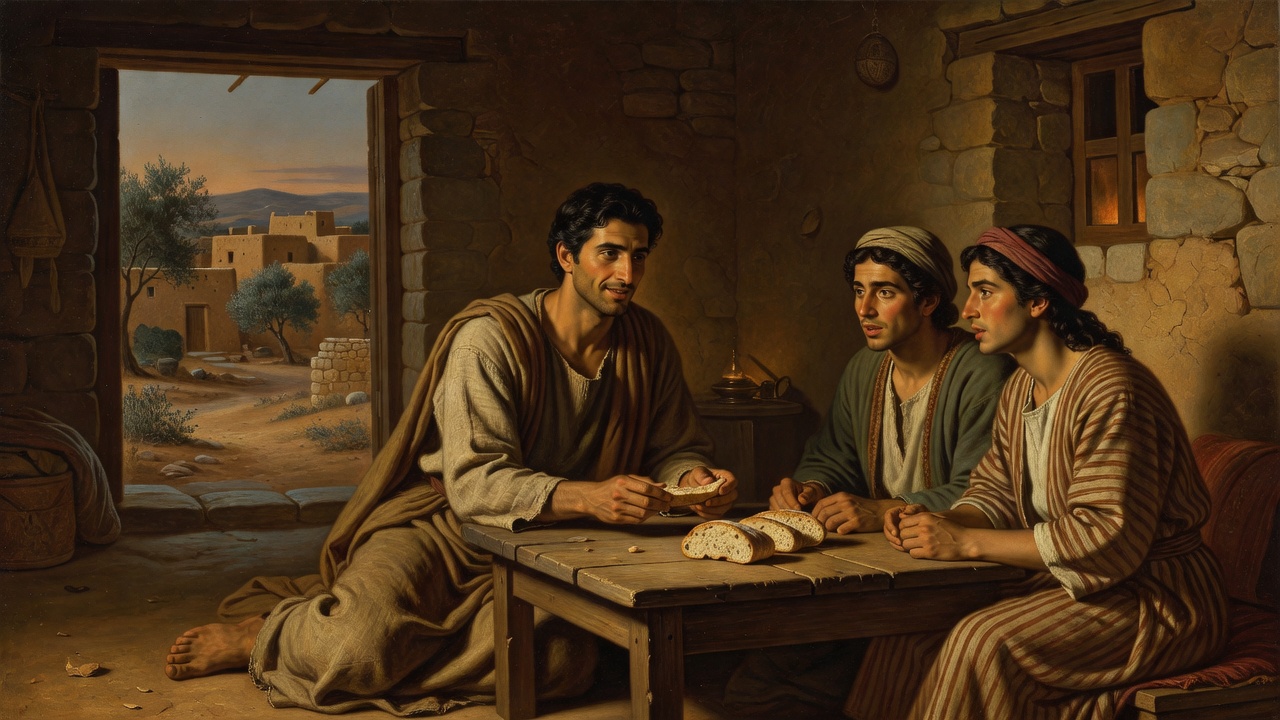
13And behold, two of them were going that very day to a village named Emmaus, which was threescore furlongs from Jerusalem. 14And they communed with each other of all these things which had happened. 15And it came to pass, while they communed and questioned together, that Jesus himself drew near, and went with them. 16But their eyes were holden that they should not know him. 17And he said unto them, What communications are these that ye have one with another, as ye walk? And they stood still, looking sad. 18And one of them, named Cleopas, answering said unto him, Dost thou alone sojourn in Jerusalem and not know the things which are come to pass there in these days? 19And he said unto them, What things? And they said unto him, The things concerning Jesus of Nazareth, which was a prophet mighty in deed and word before God and all the people: 20and how the chief priests and our rulers delivered him up to be condemned to death, and crucified him. 21But we hoped that it was he which should redeem Israel. Yea and beside all this, it is now the third day since these things came to pass. 22Moreover certain women of our company amazed us, having been early at the tomb; 23and when they found not his body, they came, saying, that they had also seen a vision of angels, which said that he was alive. 24And certain of them that were with us went to the tomb, and found it even so as the women had said: but him they saw not. 25And he said unto them, O foolish men, and slow of heart to believe in all that the prophets have spoken! 26Behoved it not the Christ to suffer these things, and to enter into his glory? 27And beginning from Moses and from all the prophets, he interpreted to them in all the scriptures the things concerning himself. 28And they drew nigh unto the village, whither they were going: and he made as though he would go further. 29And they constrained him, saying, Abide with us: for it is toward evening, and the day is now far spent. And he went in to abide with them. 30And it came to pass, when he had sat down with them to meat, he took the bread, and blessed it, and brake, and gave to them. 31And their eyes were opened, and they knew him; and he vanished out of their sight. 32And they said one to another, Was not our heart burning within us, while he spake to us in the way, while he opened to us the scriptures? 33And they rose up that very hour, and returned to Jerusalem, and found the eleven gathered together, and them that were with them, 34saying, The Lord is risen indeed, and hath appeared to Simon. 35And they rehearsed the things that happened in the way, and how he was known of them in the breaking of the bread.
Jesus Appears to the Disciples
36And as they spake these things, he himself stood in the midst of them, and saith unto them, Peace be unto you. 37But they were terrified and affrighted, and supposed that they beheld a spirit. 38And he said unto them, Why are ye troubled? and wherefore do reasonings arise in your heart? 39See my hands and my feet, that it is I myself: handle me, and see; for a spirit hath not flesh and bones, as ye behold me having. 40And when he had said this, he shewed them his hands and his feet. 41And while they still disbelieved for joy, and wondered, he said unto them, Have ye here anything to eat? 42And they gave him a piece of a broiled fish. 43And he took it, and did eat before them. 44And he said unto them, These are my words which I spake unto you, while I was yet with you, how that all things must needs be fulfilled, which are written in the law of Moses, and the prophets, and the psalms, concerning me. 45Then opened he their mind, that they might understand the scriptures; 46and he said unto them, Thus it is written, that the Christ should suffer, and rise again from the dead the third day; 47and that repentance and remission of sins should be preached in his name unto all the nations, beginning from Jerusalem. 48Ye are witnesses of these things. 49And behold, I send forth the promise of my Father upon you: but tarry ye in the city, until ye be clothed with power from on high.
The Ascension
50And he led them out until they were over against Bethany: and he lifted up his hands, and blessed them. 51And it came to pass, while he blessed them, he parted from them, and was carried up into heaven. 52And they worshipped him, and returned to Jerusalem with great joy: 53and were continually in the temple, blessing God.
Did you know?
Resurrection morning and the road to Emmaus
- Luke describes Emmaus as a village about seven miles from Jerusalem. Easton's Bible Dictionary (1897) quotes that distance as three-score furlongs and records two identifications: el-Kubeibeh, over seven miles northwest of Jerusalem, whose name, 'little dome,' comes from the remains of a Crusaders' church still found there, and Khurbet Khamasa, 'the ruins of Khamasa,' about eight miles southwest, where Crusader ruins are also found.Sources: Emmaus · the Bible text itself
- Mary Magdalene, Joanna, Mary the mother of James, and other women with them were the ones who told the apostles what had happened at the tomb. Mary Magdalene takes her name from Magdala, her birthplace, and Easton's Bible Dictionary (1897) calls it a mistake to identify her with the woman called 'a sinner' in Luke 7. Joanna, the wife of Chuza, steward of Herod Antipas, tetrarch of Galilee, was one of the women who ministered to Jesus, and the same dictionary says he appeared to her after the resurrection.Sources: Mary Magdalene · Joanna · the Bible text itself
- One of the two disciples on the road is named Cleopas, a shortened form of Cleopatros. Easton's Bible Dictionary (1897) says that nothing definite is known about him, and that it is not certain he was the Clopas of John 19:25 or the Alphaeus of Matthew 10:3, although he may have been.Sources: Cleophas · the Bible text itself
Notes written with AI assistance from open sources (Theographic Bible Metadata, CC BY-SA 4.0; Easton’s Bible Dictionary, public domain) and reviewed before publishing.
Places in this chapter
- Galilee · 32.760, 35.527 · verse 6
- Jerusalem · 31.777, 35.234 · verses 13, 18, 33, 47, 49, 52
- Nazareth · 32.702, 35.298 · verse 19
Only places identified with high confidence are shown (90% or more according to the scholarly sources compiled by OpenBible). Period map: DARE (Digital Atlas of the Roman Empire), CC BY 4.0; modern map: © OpenStreetMap contributors; places: OpenBible.info (CC BY 4.0).
Credits and license for this translation
Revised Version with Apocrypha (1895)
The Revised Version of the Holy Bible (1895) with Apocrypha
Public Domain
Language: English
Dialect: archaic British
This work is in the Public Domain. You may copy and use it freely.
2026-10-02
Section headings adapted from the Berean Standard Bible (public domain); they are not part of this translation’s text.
Source: http://ebible.org/eng-rv/ · eBible.org