Jonah 4
Revised Version with Apocrypha (1895) · Tap a verse to see its cross-references.
Jonah’s Anger at the LORD’s Compassion
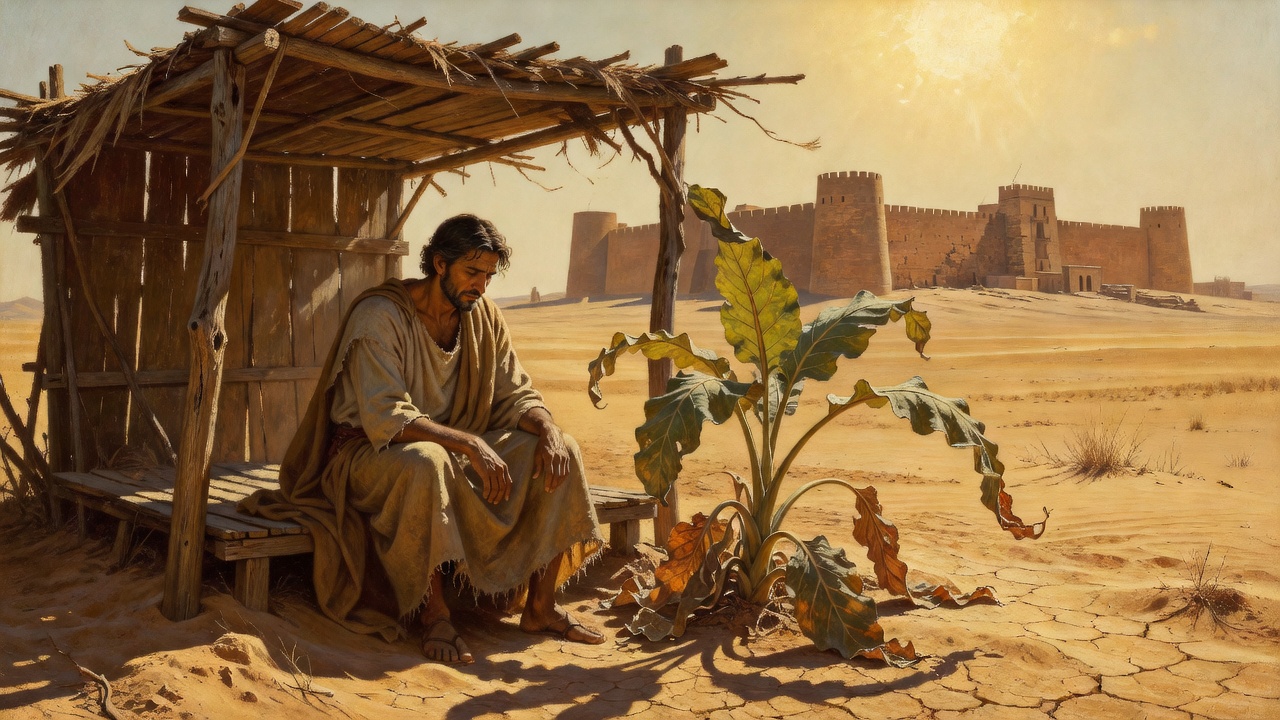
1But it displeased Jonah exceedingly, and he was angry. 2And he prayed unto the LORD, and said, I pray thee, O LORD, was not this my saying, when I was yet in my country? Therefore I hasted to flee unto Tarshish: for I knew that thou art a gracious God, and full of compassion, slow to anger, and plenteous in mercy, and repentest thee of the evil. 3Therefore now, O LORD, take, I beseech thee, my life from me; for it is better for me to die than to live. 4And the LORD said, Doest thou well to be angry? 5Then Jonah went out of the city, and sat on the east side of the city, and there made him a booth, and sat under it in the shadow, till he might see what would become of the city. 6And the LORD God prepared a gourd, and made it to come up over Jonah, that it might be a shadow over his head, to deliver him from his evil case. So Jonah was exceeding glad because of the gourd. 7But God prepared a worm when the morning rose the next day, and it smote the gourd, that it withered. 8And it came to pass, when the sun arose, that God prepared a sultry east wind; and the sun beat upon the head of Jonah, that he fainted, and requested for himself that he might die, and said, It is better for me to die than to live. 9And God said to Jonah, Doest thou well to be angry for the gourd? And he said, I do well to be angry even unto death. 10And the LORD said, Thou hast had pity on the gourd; for the which thou hast not laboured, neither madest it grow; which came up in a night, and perished in a night: 11and should not I have pity on Nineveh, that great city; wherein are more than sixscore thousand persons that cannot discern between their right hand and their left hand; and also much cattle?
Did you know?
Jonah's Anger and God's Compassion
- Jonah admits that he originally attempted to flee toward Tarshish precisely because he knew God is gracious, compassionate, slow to anger, and relents from sending disaster. His distress arose when God chose to spare Nineveh rather than destroy it.Sources: the Bible text itself · Tarshish
- Nineveh, the flourishing capital of the Assyrian empire, is described at the conclusion of the book as home to more than 120,000 people who cannot discern between their right and left hand, along with many cattle. God highlights this massive population to contrast divine compassion with Jonah's concern for a single withered plant.Sources: the Bible text itself · Nineveh
Notes written with AI assistance from open sources (Theographic Bible Metadata, CC BY-SA 4.0; Easton’s Bible Dictionary, public domain) and reviewed before publishing.
Places in this chapter
- Nineveh · 36.359, 43.153 · verse 11
Only places identified with high confidence are shown (90% or more according to the scholarly sources compiled by OpenBible). Period map: DARE (Digital Atlas of the Roman Empire), CC BY 4.0; modern map: © OpenStreetMap contributors; places: OpenBible.info (CC BY 4.0).
Credits and license for this translation
Revised Version with Apocrypha (1895)
The Revised Version of the Holy Bible (1895) with Apocrypha
Public Domain
Language: English
Dialect: archaic British
This work is in the Public Domain. You may copy and use it freely.
2026-10-02
Section headings adapted from the Berean Standard Bible (public domain); they are not part of this translation’s text.
Source: http://ebible.org/eng-rv/ · eBible.org