Song of Songs 8
LXX2012: Septuagint in American English 2012 · Tap a verse to see its cross-references.
Longing for Her Beloved
1I would that you, O my kinsman, were he that sucked the breasts of my mother; when I found you without, I would kiss you; yes, they should not despise me. 2I would take you, I would bring you into my mother's house, and into the chamber of her that conceived me; I would make you to drink of spiced wine, of the juice of my pomegranates. 3His left hand should be under my head, and his right hand should embrace me. 4I have charged you, you⌃ daughters of Jerusalem, by the virtues of the field, that you⌃ stir not up, nor awake my love, until he please.
The Friends
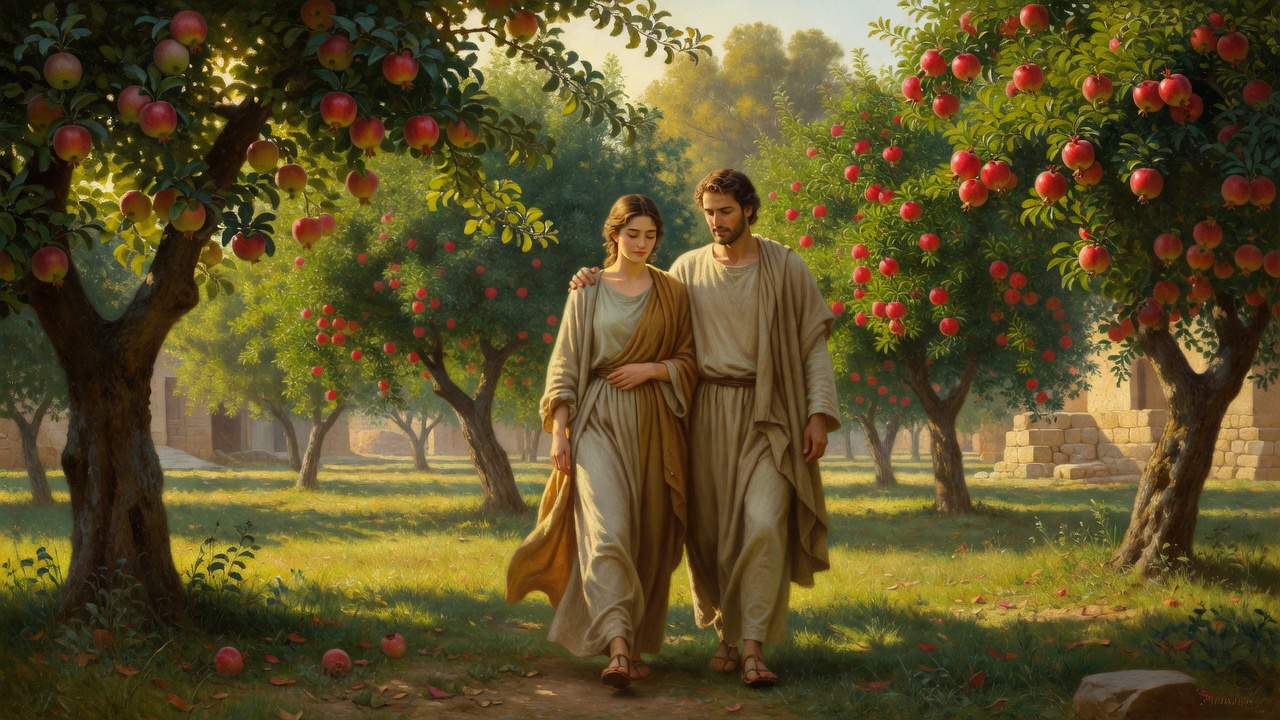
5Who is this that comes up all white, leaning on her kinsman? I raised you up under an apple tree; there your mother brought you forth; there she that bore you brought you forth.
The Bride
6Set me as a seal upon your heart, as a seal upon your arm; for love is strong as death; jealousy is cruel as the grave, her shafts are shafts of fire, even the flames thereof. 7Much water will not be able to quench love, and rivers shall not drown it; if a man would give all his substance for love, men would utterly despise it.
The Friends
8Our sister is little, and has no breasts; what shall we do for our sister, in the day wherein she shall be spoken for? 9If she is a wall, let us build upon her silver bulwarks; and if she is a door, let us carve for her cedar panels.
The Bride
10I am a wall, and my breasts are as towers; I was in their eyes as one that found peace. 11Solomon had a vineyard in Beelamon; he let his vineyard to keepers; every one was to bring for its fruit a thousand pieces of silver. 12My vineyard, even mine, is before me; Solomon shall have a thousand, and they that keep its fruit two hundred.
The Bridegroom
13You that dwell in the gardens, the companions listen to your voice: make me hear it.
The Bride
14Away, my kinsman, and be like a doe or a fawn on the mountains of spices.
Did you know?
Unquenchable Love and Royal Vineyards
- Song of Songs 8:11 mentions a royal vineyard at Baal-hamon, a name meaning place of a multitude. Geographers and scholars have proposed several identifications for this site, including Hammon in the tribal territory of Asher or Belamon near Dothan.Sources: the Bible text itself · Baal-hamon · Solomon
- The request to be set as a seal over the beloved's heart and arm draws upon the ancient custom of wearing personal seals close to the body, signifying permanent belonging, protection, and unbroken devotion.Sources: the Bible text itself
- The chapter celebrates love as an unconquerable power that cannot be bought with all the wealth of a household, describing its flame as fierce and unquenchable even by mighty rivers and floods.Sources: the Bible text itself
Notes written with AI assistance from open sources (Theographic Bible Metadata, CC BY-SA 4.0; Easton’s Bible Dictionary, public domain) and reviewed before publishing.
Places in this chapter
- Jerusalem · 31.777, 35.234 · verse 4
Only places identified with high confidence are shown (90% or more according to the scholarly sources compiled by OpenBible). Period map: DARE (Digital Atlas of the Roman Empire), CC BY 4.0; modern map: © OpenStreetMap contributors; places: OpenBible.info (CC BY 4.0).
Credits and license for this translation
LXX2012: Septuagint in American English 2012
The Septuagint with Apocrypha, translated from Greek to English by Sir Lancelot C. L. Brenton and published in 1885, with some language updates (American English)
Public Domain
Language: English
Dialect (if applicable): American
Language in English: English
Translation by:
Sir Lancelot Charles Lee Brenton
Michael Paul Johnson
LXX2012: Septuagint in English 2012
This is a translation of the Old Testament and Apocrypha/Deuterocanon from Hebrew to Greek to 19th Century British English, with some updates of spelling and word usage to contemporary American English. The original English translation was done by Sir Lancelot Charles Lee Brenton and published by Samuel Bagster & Sons, Ltd., in London in 1851. It has entered the Public Domain due to the passage of sufficient time. In the process of scanning and typing the text, the original poetry and prose formatting, as well as peripheral material like introductions and notes, have been omitted.
This edition of the Septuagint has some language updates. Brenton's word order and punctuation has been mostly retained, meaning that quotation marks are not used, and sentences within quotes may not start with capital letters, as was standard usage in 1851. Names transliterated from Greek to those transliterated from Hebrew in the common English Bibles often differ. These language updates are dedicated to the Public Domain by the author of those edits, Michael Paul Johnson. Therefore this edition may be freely copied, published, etc.
Before considering making changes to the text of this work, I recommend that you consult with God, because this is really His Book.
If you find errors in the text, please report them so that we can correct them.
Donations to help with the expenses of operating this web site and thus help others have free access to the Word of God may be made to us, but are not required. Please see http://MLJohnson.org/partner/ for more about that.
Section headings adapted from the Berean Standard Bible (public domain); they are not part of this translation’s text.
Source: http://ebible.org/eng-lxx2012/ · eBible.org