Song of Songs 4
LXX2012: Septuagint in American English 2012 · Tap a verse to see its cross-references.
Solomon Admires His Bride
The Bridegroom
1Behold, you are fair, my companion; behold, you are fair; your eyes are doves, beside your veil: your hair is as flocks of goats, that have appeared from Galaad. 2Your teeth are as flocks of shorn sheep, that have gone up from the washing; all of them bearing twins, and there is not a barren one among them. 3Your lips are as a thread of scarlet, and your speech is comely: like the rind of a pomegranate is your cheek without your veil. 4Your neck is as the tower of David, that was built for an armory: a thousand shields hang upon it, and all darts of mighty men. 5Your two breasts are as two twin fawns, that feed among the lilies. 6Until the day dawn, and the shadows depart, I will betake me to the mountain of myrrh, and to the hill of frankincense. 7You are all fair, my companion, and there is no spot in you. 8Come from Libanus, my bride, come from Libanus: you shall come and pass from the top of Faith, from the top of Sanir and Hermon, from the lions' dens, from the mountains of the leopards. 9My sister, my spouse, you have ravished my heart; you have ravished my heart with one of your eyes, with one chain of your neck. 10How beautiful are your breasts, my sister, my spouse! how much more beautiful are your breasts than wine, and the smell of your garments than all spices! 11Your lips drop honeycomb, my spouse: honey and milk are under your tongue; and the smell of your garments is as the smell of Libanus. 12My sister, my spouse is a garden enclosed; a garden enclosed, a fountain sealed. 13Your shoots are a garden of pomegranates, with the fruit of choice berries; camphor, with spikenard: 14spikenard and saffron, calamus and cinnamon; with all woods of Libanus, myrrh, aloes, with all chief spices: 15a fountain of a garden, and a well of water springing and gurgling from Libanus.
The Bride
16Awake, O north wind; and come, O south; and blow through my garden, and let my spices flow out.
Did you know?
The Bride's Beauty and the Garden of Spices
- The poem calls the bride down from the dramatic northern mountain ranges of Lebanon, including Amana, Senir, and Mount Hermon. Mount Hermon is the highest peak in the Anti-Lebanon range, and biblical sources note that Senir was the Amorite name for Hermon.Sources: the Bible text itself · Hermon · Senir · Lebanon
- The beloved's hair is compared to a flock of goats descending Mount Gilead, a fertile and mountainous region located east of the Jordan River.Sources: the Bible text itself · Gilead
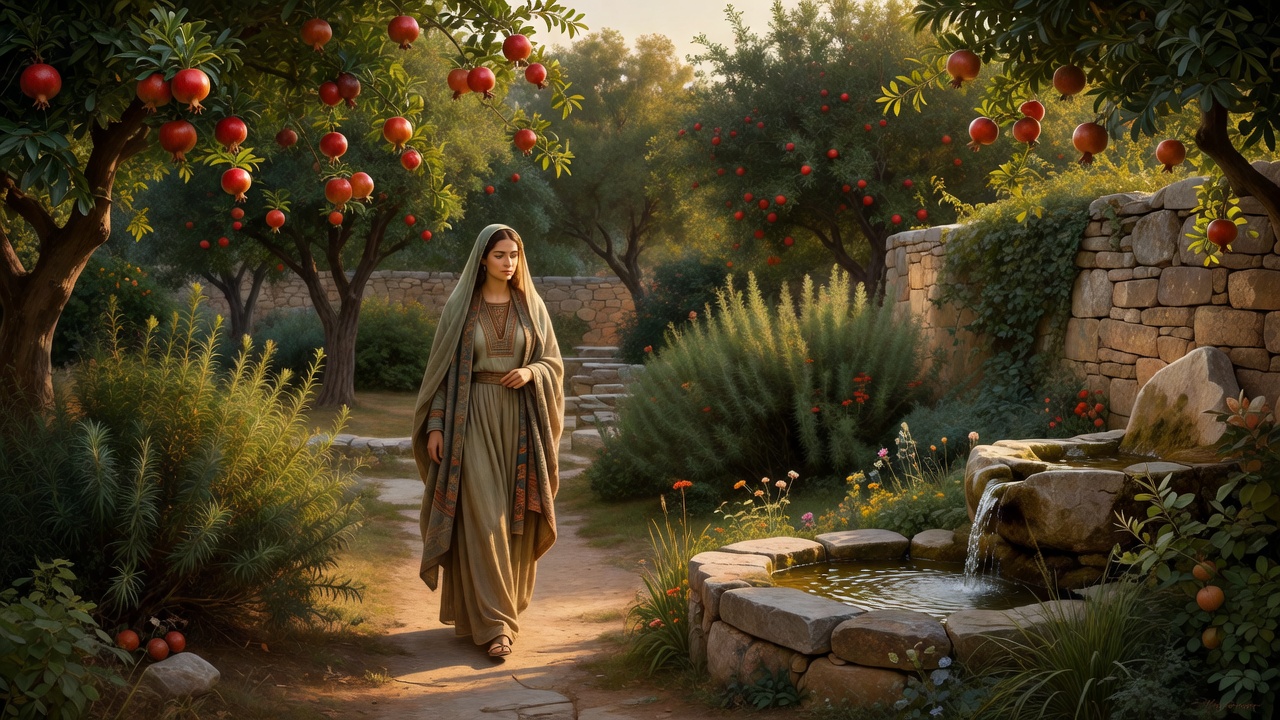
- The bride is portrayed as an enclosed garden, a sealed fountain, and an orchard laden with precious spices such as nard, saffron, cinnamon, and frankincense, evoking exclusivity, refreshment, and fragrance.Sources: the Bible text itself
Notes written with AI assistance from open sources (Theographic Bible Metadata, CC BY-SA 4.0; Easton’s Bible Dictionary, public domain) and reviewed before publishing.
Places in this chapter
- Gilead · Today: Gilead 1 · 32.187, 35.692 · verse 1
- Lebanon · 33.540, 35.584 · verses 8, 11, 15
- Mount Hermon · 33.400, 35.850 · verse 8
- Senir · Today: Mount Hermon · 33.400, 35.850 · verse 8
Only places identified with high confidence are shown (90% or more according to the scholarly sources compiled by OpenBible). Period map: DARE (Digital Atlas of the Roman Empire), CC BY 4.0; modern map: © OpenStreetMap contributors; places: OpenBible.info (CC BY 4.0).
Credits and license for this translation
LXX2012: Septuagint in American English 2012
The Septuagint with Apocrypha, translated from Greek to English by Sir Lancelot C. L. Brenton and published in 1885, with some language updates (American English)
Public Domain
Language: English
Dialect (if applicable): American
Language in English: English
Translation by:
Sir Lancelot Charles Lee Brenton
Michael Paul Johnson
LXX2012: Septuagint in English 2012
This is a translation of the Old Testament and Apocrypha/Deuterocanon from Hebrew to Greek to 19th Century British English, with some updates of spelling and word usage to contemporary American English. The original English translation was done by Sir Lancelot Charles Lee Brenton and published by Samuel Bagster & Sons, Ltd., in London in 1851. It has entered the Public Domain due to the passage of sufficient time. In the process of scanning and typing the text, the original poetry and prose formatting, as well as peripheral material like introductions and notes, have been omitted.
This edition of the Septuagint has some language updates. Brenton's word order and punctuation has been mostly retained, meaning that quotation marks are not used, and sentences within quotes may not start with capital letters, as was standard usage in 1851. Names transliterated from Greek to those transliterated from Hebrew in the common English Bibles often differ. These language updates are dedicated to the Public Domain by the author of those edits, Michael Paul Johnson. Therefore this edition may be freely copied, published, etc.
Before considering making changes to the text of this work, I recommend that you consult with God, because this is really His Book.
If you find errors in the text, please report them so that we can correct them.
Donations to help with the expenses of operating this web site and thus help others have free access to the Word of God may be made to us, but are not required. Please see http://MLJohnson.org/partner/ for more about that.
Section headings adapted from the Berean Standard Bible (public domain); they are not part of this translation’s text.
Source: http://ebible.org/eng-lxx2012/ · eBible.org