Song of Songs 2
LXX2012: Septuagint in American English 2012 · Tap a verse to see its cross-references.
The Bride’s Admiration
The Bride
1I am a flower of the plain, a lily of the valleys.
The Bridegroom
2As a lily among thorns, so is my companion among the daughters.
The Bride
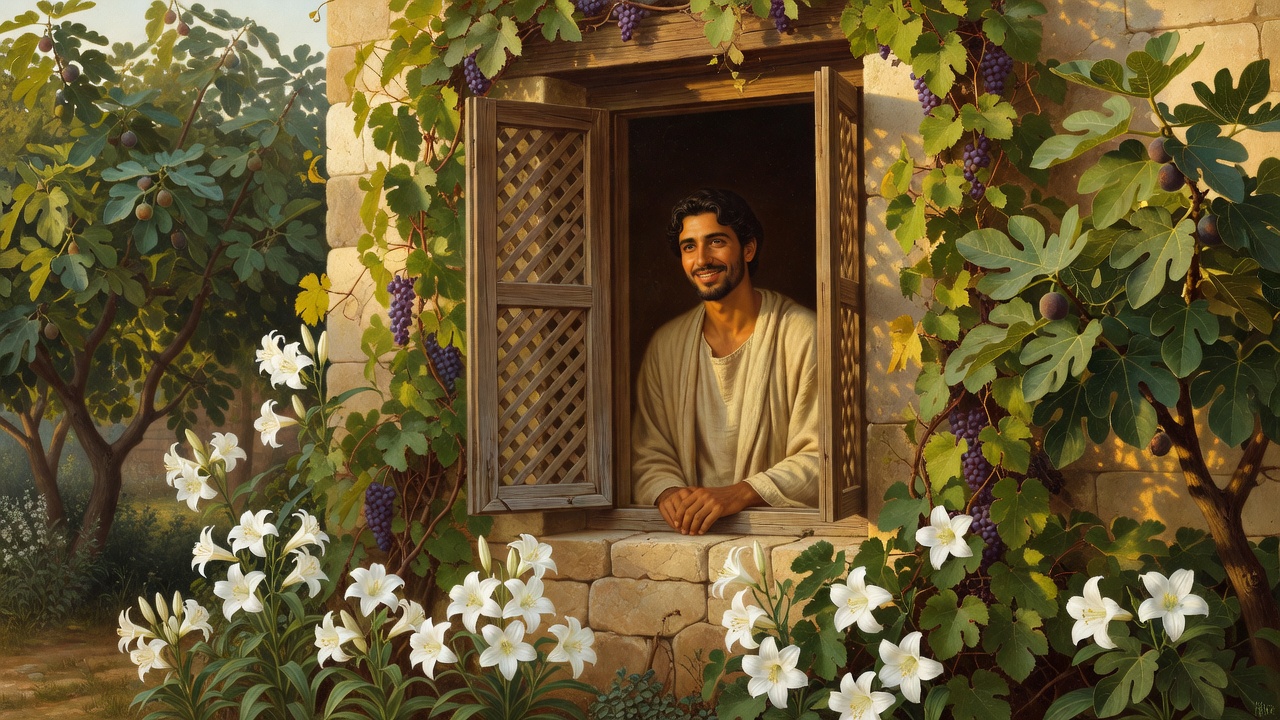
3As the apple among the trees of the wood, so is my kinsman among the sons. I desired his shadow, and sat down, and his fruit was sweet in my throat. 4Bring me into the wine house; set love before me. 5Strengthen me with perfumes, stay me with apples: for I am wounded with love. 6His left hand shall be under my head, and his right hand shall embrace me. 7I have charged you, you⌃ daughters of Jerusalem, by the powers and by the virtues of the field, that you⌃ do not rouse or wake my love, until he please. 8The voice of my kinsman! behold, he comes leaping over the mountains, bounding over the hills. 9My kinsman is like a roe or a young hart on the mountains of Baethel: behold, he is behind our wall, looking through the windows, peeping through the lattices. 10My kinsman answers, and says to me, Rise up, come, my companion, my fair one, my dove. 11For, behold, the winter is past, the rain is gone, it has departed. 12The flowers are seen in the land; the time of pruning has arrived; the voice of the turtle-dove has been heard in our land. 13The fig tree has put forth its young figs, the vines put forth the tender grape, they yield a smell: arise, come, my companion, my fair one, my dove; yes, come.
The Bridegroom
14You are my dove, in the shelter of the rock, near the wall: show me your face, and cause me to hear your voice; for your voice is sweet, and your countenance is beautiful.
The Friends
15Take us the little foxes that spoil the vines: for our vines put forth tender grapes.
The Bride
16My kinsman is mine, and I am his: he feeds his flock among the lilies. 17Until the day dawn, and the shadows depart, turn, my kinsman, be you like to a roe or young hart on the mountains of the ravines.
Did you know?
Springtime and Awakening Love
- Sharon was a fertile coastal plain stretching between the Mediterranean Sea and the hill country west of Jerusalem, celebrated for its beauty and vegetation, which gave rise to imagery like the rose of Sharon.Sources: Saron · the Bible text itself
- The poem marks the arrival of spring through natural changes in the countryside, such as the end of winter rains, the cooing of turtledoves, ripening fig trees, and flowering grapevines that needed protection from foraging foxes.Sources: the Bible text itself
- The speaker repeatedly appeals to the daughters of Jerusalem, framing her cautions about love around wild animals of the open hills, such as gazelles and does of the field.Sources: Jerusalem · the Bible text itself
Notes written with AI assistance from open sources (Theographic Bible Metadata, CC BY-SA 4.0; Easton’s Bible Dictionary, public domain) and reviewed before publishing.
Places in this chapter
Only places identified with high confidence are shown (90% or more according to the scholarly sources compiled by OpenBible). Period map: DARE (Digital Atlas of the Roman Empire), CC BY 4.0; modern map: © OpenStreetMap contributors; places: OpenBible.info (CC BY 4.0).
Credits and license for this translation
LXX2012: Septuagint in American English 2012
The Septuagint with Apocrypha, translated from Greek to English by Sir Lancelot C. L. Brenton and published in 1885, with some language updates (American English)
Public Domain
Language: English
Dialect (if applicable): American
Language in English: English
Translation by:
Sir Lancelot Charles Lee Brenton
Michael Paul Johnson
LXX2012: Septuagint in English 2012
This is a translation of the Old Testament and Apocrypha/Deuterocanon from Hebrew to Greek to 19th Century British English, with some updates of spelling and word usage to contemporary American English. The original English translation was done by Sir Lancelot Charles Lee Brenton and published by Samuel Bagster & Sons, Ltd., in London in 1851. It has entered the Public Domain due to the passage of sufficient time. In the process of scanning and typing the text, the original poetry and prose formatting, as well as peripheral material like introductions and notes, have been omitted.
This edition of the Septuagint has some language updates. Brenton's word order and punctuation has been mostly retained, meaning that quotation marks are not used, and sentences within quotes may not start with capital letters, as was standard usage in 1851. Names transliterated from Greek to those transliterated from Hebrew in the common English Bibles often differ. These language updates are dedicated to the Public Domain by the author of those edits, Michael Paul Johnson. Therefore this edition may be freely copied, published, etc.
Before considering making changes to the text of this work, I recommend that you consult with God, because this is really His Book.
If you find errors in the text, please report them so that we can correct them.
Donations to help with the expenses of operating this web site and thus help others have free access to the Word of God may be made to us, but are not required. Please see http://MLJohnson.org/partner/ for more about that.
Section headings adapted from the Berean Standard Bible (public domain); they are not part of this translation’s text.
Source: http://ebible.org/eng-lxx2012/ · eBible.org