Psalms 131
LXX2012: Septuagint in American English 2012 · Tap a verse to see its cross-references.
(132) A Song of Degrees.
I Have Stilled My Soul
1Lord, remember David, and all his meekness:
2how he swore to the Lord, and vowed to the God of Jacob, saying,
3I will not go into the tabernacle of my house; I will not go up to the couch of my bed;
4I will not give sleep to my eyes, nor slumber to my eyelids, nor rest to my temples,
5until I find a place for the Lord, a tabernacle for the God of Jacob.
6Behold, we heard of it in Ephratha; we found it in the fields of the wood.
7Let us enter into his tabernacles: let us worship at the place where his feet stood.
8Arise, O Lord, into your rest; you, and the ark of your holiness.
9Your priests shall clothe themselves with righteousness; and your saints shall exult.
10For the sake of your servant David turn not away the face of your anointed.
11The Lord swore in truth to David, and he will not annul it, saying, Of the fruit of your body will I set a king upon your throne.
12If your children will keep my covenant, and these my testimonies which I shall teach them, their children also shall sit upon your throne for ever.
13For the Lord has elected Sion, he has chosen her for a habitation for himself, saying,
14This is my rest for ever: here will I dwell; for I have chosen it.
15I will surely bless her provision: I will satisfy her poor with bread.
16I will clothe her priests with salvation; and her saints shall greatly exult.
17There will I cause to spring up a horn to David: I have prepared a lamp for my anointed.
18His enemies will I clothe with a shame; but upon himself shall my holiness flourish.
Did you know?
A Song of Humility and Contentment
- Psalm 131 is titled a 'song of ascents' attributed to David, making it part of the collection of short pilgrimage songs in the Psalter that emphasize quiet trust over pride and ambition.Sources: the Bible text itself
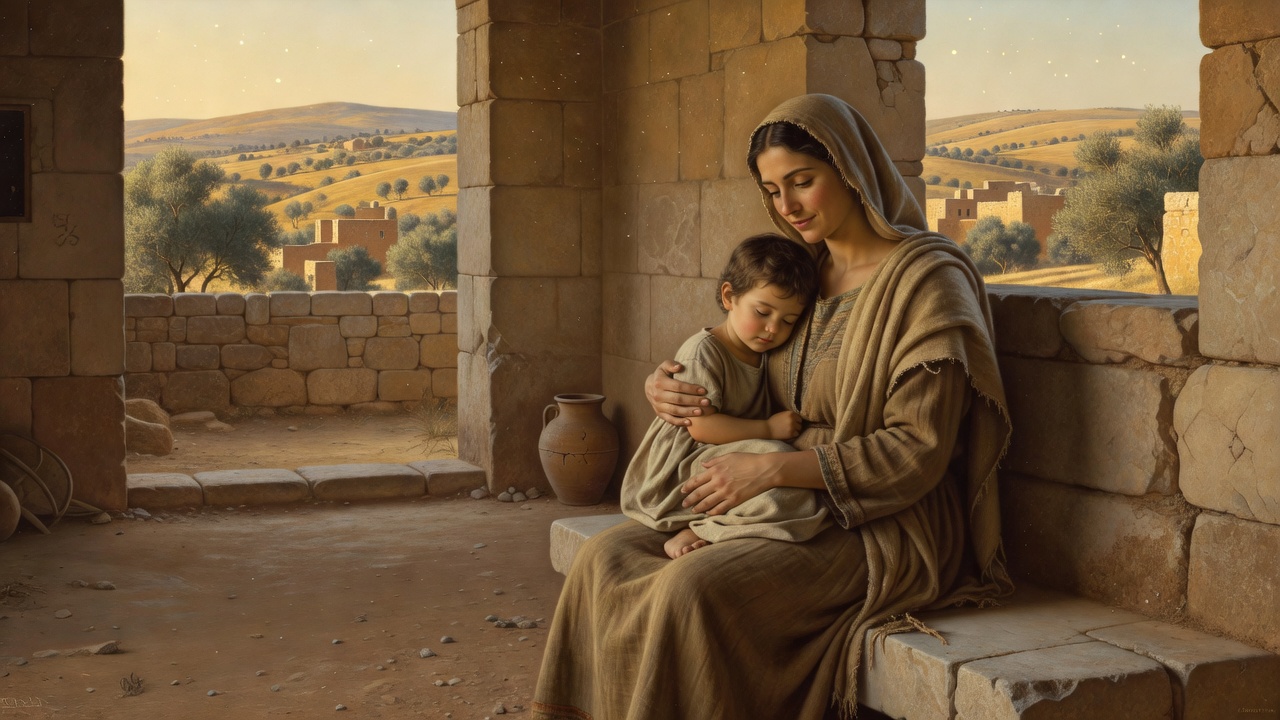
- The psalm uses the vivid domestic image of a weaned child resting peacefully with its mother to illustrate a soul that has learned contentment, stillness, and calm dependency rather than striving for matters too great for it.Sources: the Bible text itself
Notes written with AI assistance from open sources (Theographic Bible Metadata, CC BY-SA 4.0; Easton’s Bible Dictionary, public domain) and reviewed before publishing.
Places in this chapter
- Jerusalem · 31.777, 35.234 · verse 1
Only places identified with high confidence are shown (90% or more according to the scholarly sources compiled by OpenBible). Period map: DARE (Digital Atlas of the Roman Empire), CC BY 4.0; modern map: © OpenStreetMap contributors; places: OpenBible.info (CC BY 4.0).
Credits and license for this translation
LXX2012: Septuagint in American English 2012
The Septuagint with Apocrypha, translated from Greek to English by Sir Lancelot C. L. Brenton and published in 1885, with some language updates (American English)
Public Domain
Language: English
Dialect (if applicable): American
Language in English: English
Translation by:
Sir Lancelot Charles Lee Brenton
Michael Paul Johnson
LXX2012: Septuagint in English 2012
This is a translation of the Old Testament and Apocrypha/Deuterocanon from Hebrew to Greek to 19th Century British English, with some updates of spelling and word usage to contemporary American English. The original English translation was done by Sir Lancelot Charles Lee Brenton and published by Samuel Bagster & Sons, Ltd., in London in 1851. It has entered the Public Domain due to the passage of sufficient time. In the process of scanning and typing the text, the original poetry and prose formatting, as well as peripheral material like introductions and notes, have been omitted.
This edition of the Septuagint has some language updates. Brenton's word order and punctuation has been mostly retained, meaning that quotation marks are not used, and sentences within quotes may not start with capital letters, as was standard usage in 1851. Names transliterated from Greek to those transliterated from Hebrew in the common English Bibles often differ. These language updates are dedicated to the Public Domain by the author of those edits, Michael Paul Johnson. Therefore this edition may be freely copied, published, etc.
Before considering making changes to the text of this work, I recommend that you consult with God, because this is really His Book.
If you find errors in the text, please report them so that we can correct them.
Donations to help with the expenses of operating this web site and thus help others have free access to the Word of God may be made to us, but are not required. Please see http://MLJohnson.org/partner/ for more about that.
Section headings adapted from the Berean Standard Bible (public domain); they are not part of this translation’s text.
Source: http://ebible.org/eng-lxx2012/ · eBible.org