Proverbs 5
LXX2012: Septuagint in American English 2012 · Tap a verse to see its cross-references.
Avoiding Immorality
1My son, attend to my wisdom, and apply your ear to my words; 2that you may keep good understanding, and the discretion of my lips gives you a charge. Give no heed to a worthless woman; 3for honey drops from the lips of a harlot, who for a season pleases your palate: 4but afterwards you will find her more bitter than gall, and sharper than a two-edged sword. 5For the feet of folly lead those who deal with her down to the grave with death; and her steps are not established. 6For she goes not upon the paths of life; but her ways are slippery, and not easily known. 7Now then, my son, hear me, and make not my words of none effect. 8Remove your way far from her; draw not near to the doors of her house: 9lest you give away your life to others, and your substance to the merciless: 10lest strangers be filled with your strength, and your labors come into the houses of strangers; 11And you repent at last, when the flesh of your body is consumed, 12and you shall say, How have I hated instruction, and my heart avoided reproofs! 13I heard not the voice of him that instructed me, and taught me, neither did I apply my ear. 14I was almost in all evil in the midst of the congregation and assembly. 15Drink waters out of your own vessels, and out of your own springing wells. 16Let not waters out of your fountain be spilled by you, but let your waters go into your streets. 17Let them be only your own, and let no stranger partake with you. 18Let your fountain of water be truly your own; and rejoice with the wife of your youth. 19Let your loving hart and your graceful colt company with you, and let her be considered your own, and be with you at all times; for ravished with her love you shall be greatly increased. 20Be not intimate with a strange woman, neither fold yourself in the arms of a woman not your own. 21For the ways of a man are before the eyes of God, and he looks on all his paths. 22Iniquities ensnare a man, and every one is bound in the chains of his own sins. 23Such a man dies with the uninstructed; and he is cast forth from the abundance of his own substance, and has perished through folly.
Did you know?
Wisdom, Fidelity, and the Pitfalls of Seduction
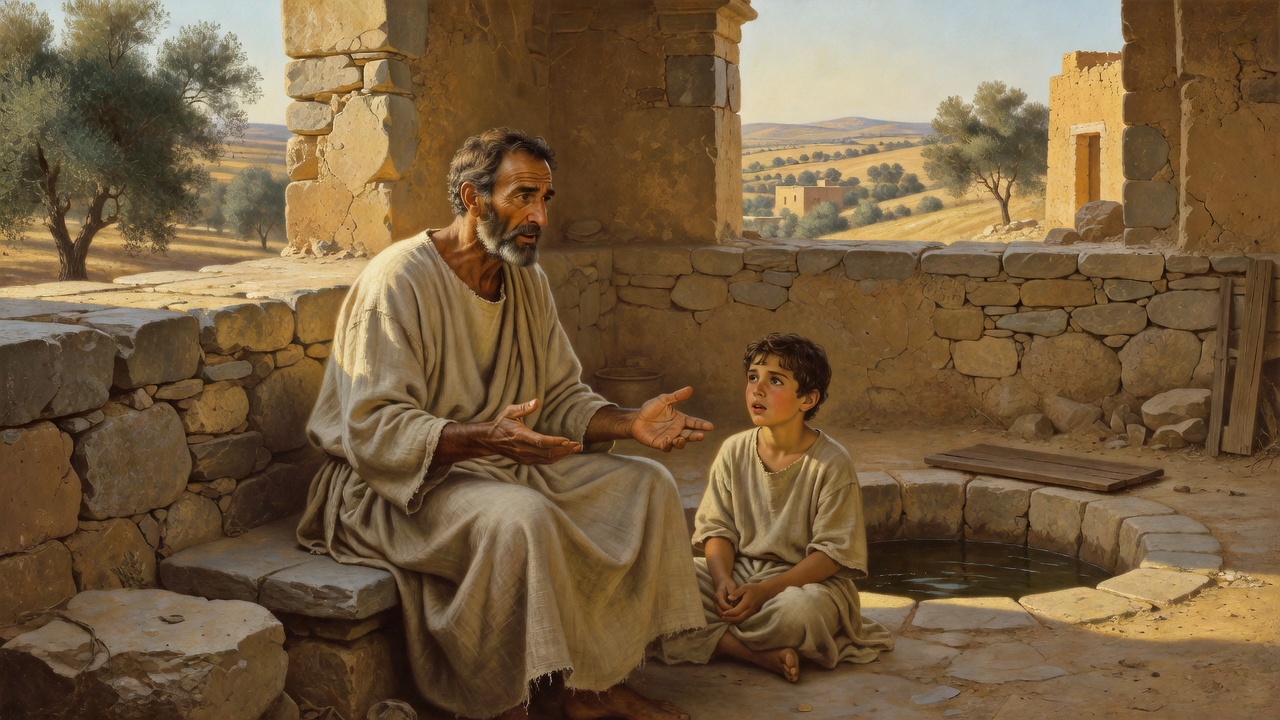
- The passage uses domestic water sources, such as a personal cistern and well, as metaphors for marital intimacy and fidelity. The father advises finding satisfaction at home rather than letting one's springs and streams scatter into public streets and squares.Sources: the Bible text itself
- Seductive speech is contrasted with its consequences: while its words are portrayed as sweet like honey and smooth like oil, the ultimate outcome is described as bitter like wormwood, piercing like a double-edged sword, and leading to death and Sheol.Sources: the Bible text itself
- The warning highlights both practical and spiritual costs of infidelity, from the loss of personal wealth and physical vigor to public disgrace before the community assembly, concluding that all human ways are examined by the LORD.Sources: the Bible text itself
Notes written with AI assistance from open sources (Theographic Bible Metadata, CC BY-SA 4.0; Easton’s Bible Dictionary, public domain) and reviewed before publishing.
Credits and license for this translation
LXX2012: Septuagint in American English 2012
The Septuagint with Apocrypha, translated from Greek to English by Sir Lancelot C. L. Brenton and published in 1885, with some language updates (American English)
Public Domain
Language: English
Dialect (if applicable): American
Language in English: English
Translation by:
Sir Lancelot Charles Lee Brenton
Michael Paul Johnson
LXX2012: Septuagint in English 2012
This is a translation of the Old Testament and Apocrypha/Deuterocanon from Hebrew to Greek to 19th Century British English, with some updates of spelling and word usage to contemporary American English. The original English translation was done by Sir Lancelot Charles Lee Brenton and published by Samuel Bagster & Sons, Ltd., in London in 1851. It has entered the Public Domain due to the passage of sufficient time. In the process of scanning and typing the text, the original poetry and prose formatting, as well as peripheral material like introductions and notes, have been omitted.
This edition of the Septuagint has some language updates. Brenton's word order and punctuation has been mostly retained, meaning that quotation marks are not used, and sentences within quotes may not start with capital letters, as was standard usage in 1851. Names transliterated from Greek to those transliterated from Hebrew in the common English Bibles often differ. These language updates are dedicated to the Public Domain by the author of those edits, Michael Paul Johnson. Therefore this edition may be freely copied, published, etc.
Before considering making changes to the text of this work, I recommend that you consult with God, because this is really His Book.
If you find errors in the text, please report them so that we can correct them.
Donations to help with the expenses of operating this web site and thus help others have free access to the Word of God may be made to us, but are not required. Please see http://MLJohnson.org/partner/ for more about that.
Section headings adapted from the Berean Standard Bible (public domain); they are not part of this translation’s text.
Source: http://ebible.org/eng-lxx2012/ · eBible.org