Numbers 21
LXX2012: Septuagint in American English 2012 · Tap a verse to see its cross-references.
The Defeat of Arad
1And Arad the Chananitish king who lived by the wilderness, heard that Israel came by the way of Atharin; and he made war on Israel, and carried off some of them captives. 2And Israel vowed a vow to the Lord, and said, If you will deliver this people into my power, I will devote it and its cities to you. 3And the Lord listened to the voice of Israel, and delivered the Chananite into his power; and Israel devoted him and his cities, and they called the name of that place Anathema.
The Bronze Serpent
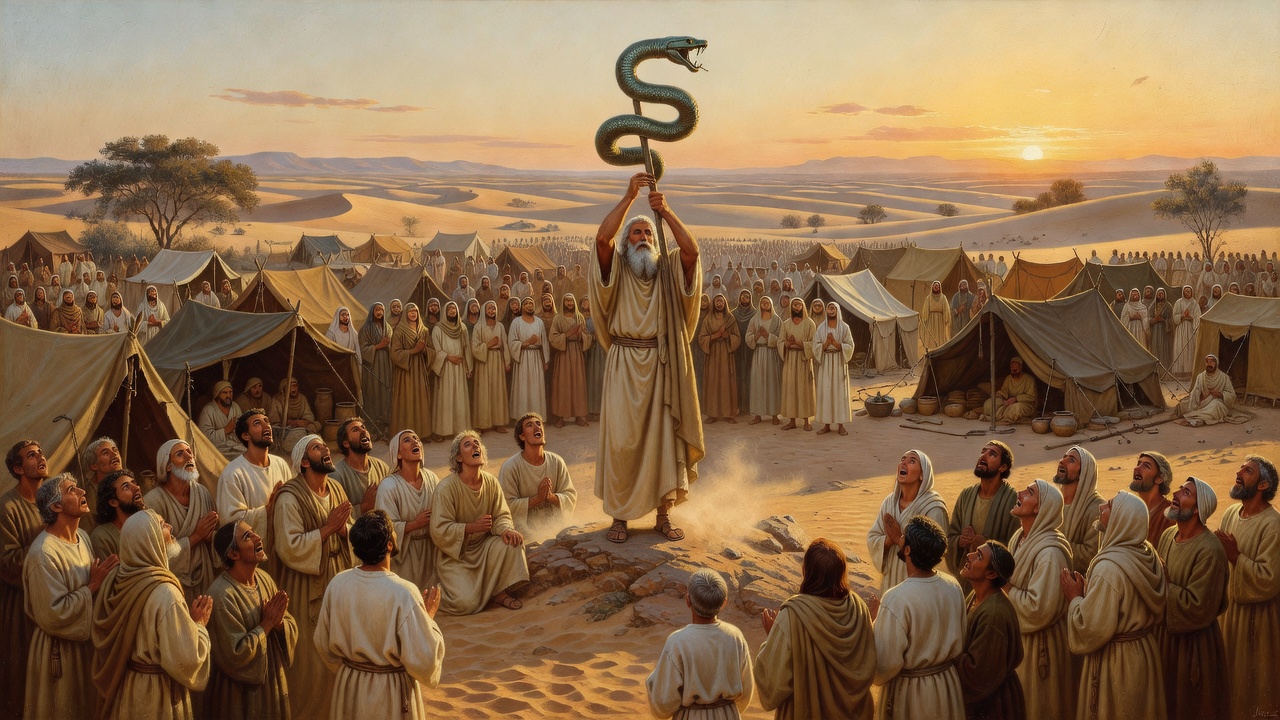
4And having departed from mount Or by the way leading to the Red Sea, they compassed the land of Edom, and the people lost courage by the way. 5And the people spoke against God and against Moses, saying, Why is this? Have you brought us ought of Egypt to kill us in the wilderness? for there is not bread nor water; and our soul loathes this light bread. 6And the Lord sent among the people deadly serpents, and they bit the people, and much people of the children of Israel died. 7And the people came to Moses and said, We have sinned, for we have spoken against the Lord, and against you: pray therefore to the Lord, and let him take away the serpent from us. 8And Moses prayed to the Lord for the people; and the Lord said to Moses, Make you a serpent, and put it on a signal- staff; and it shall come to pass that whenever a serpent shall bite a man, every one so bitten that looks upon it shall live. 9And Moses made a serpent of brass, and put it upon a signal- staff: and it came to pass that whenever a serpent bit a man, and he looked on the brazen serpent, he lived.
The Journey to Moab
10And the children of Israel departed, and encamped in Oboth. 11And having departed from Oboth, they encamped in Achalgai, on the farther side in the wilderness, which is opposite Moab, toward the east. 12And thence they departed, and encamped in the valley of Zared. 13And they departed thence and encamped on the other side of Arnon in the wilderness, the country which extends from the coasts of the Amorites; for Arnon is the borders of Moab, between Moab and the Amorites. 14Therefore it is said in a book, A war of the Lord has set on fire Zoob, and the brooks of Arnon. 15And he has appointed brooks to cause Er to dwell there; and it lies near to the coasts of Moab. 16And thence they came to the well; this is the well of which the Lord said to Moses, Gather the people, and I will give them water to drink. 17Then Israel sang this song at the well, Begin to sing of the well; 18the princes digged it, the kings of the nations in their kingdom, in their lordship sank it in the rock: and they went from the well to Manthanain, 19and from Manthanain to Naaliel, and from Naaliel to Bamoth, and from Bamoth to Janen, which is in the plain of Moab as seen from the top of the quarried rock that looks toward the wilderness. 20And Moses sent ambassadors to Seon king of the Amorites, with peaceful words, saying,
The Defeat of Sihon
21We will pass through your land, we will go by the road; we will not turn aside to the field or to the vineyard. 22We will not drink water out of your well; we will go by the king's highway, until we have past your boundaries. 23And Seon did not allow Israel to pass through his borders, and Seon gathered all his people, and went out to set the battle in array against Israel into the wilderness; and he came to Jassa, and set the battle in array against Israel. 24And Israel struck him with the slaughter of the sword, and they became possessors of his land, from Arnon to Jaboc, as far as the children of Amman, for Jazer is the borders of the children of Amman. 25And Israel took all their cities, and Israel lived in all the cities of the Amorites, in Esebon, and in all cities belonging to it. 26For Esebon is the city of Seon king of the Amorites; and he before fought against the king of Moab, and they took all his land, from Aroer to Arnon. 27Therefore say they who deal in dark speeches, Come to Esebon, that the city of Seon may be built and prepared. 28For a fire has gone forth from Esebon, a flame from the city of Seon, and has consumed as far as Moab, and devoured the pillars of Arnon. 29Woe to you, Moab; you are lost, you people of Chamos: their sons are sold for preservation, and their daughters are captives to Seon king of the Amorites. 30And their seed shall perish from Esebon to Daebon; and their women have yet farther kindled a fire against Moab.
The Defeat of Og
31And Israel lived in all the cities of the Amorites. 32And Moses sent to spy out Jazer; and they took it, and its villages, and cast out the Amorite that lived there. 33And having returned, they went up the road that leads to Basan; and Og the king of Basan went forth to meet them, and all his people to war to Edrain. 34And the Lord said to Moses, Fear him not; for I have delivered him and all his people, and all his land, into your hands; and you shall do to him as you did to Seon king of the Amorites, who lived in Esebon. 35And he struck him and his sons, and all his people, until he left none of his to be taken alive; and they inherited his land.
Did you know?
The Bronze Serpent and the March Beyond the Arnon
- When the Israelites grew impatient during their journey around Edom and complained about the lack of food and water, venomous snakes appeared in the camp. Moses was instructed to craft a bronze serpent and mount it on a pole so that anyone bitten could look at it and live.Sources: the Bible text itself
- This chapter cites an otherwise unknown ancient Hebrew text called the Book of the Wars of the LORD to delineate the boundary along the Arnon river, which separated the Moabites from the Amorites.Sources: the Bible text itself · Arnon
- The passage includes an ancient poem mentioning Chemosh, the deity worshipped by the Moabites. The poem recounts how Sihon king of the Amorites had previously conquered Moabite lands from Heshbon down to the Arnon before Israel defeated him in battle.Sources: the Bible text itself · Chemosh · Sihon · Heshbon
Notes written with AI assistance from open sources (Theographic Bible Metadata, CC BY-SA 4.0; Easton’s Bible Dictionary, public domain) and reviewed before publishing.
Places in this chapter
- Negeb · 31.245, 34.841 · verse 1
- Edom · 30.746, 35.604 · verse 4
- Way of the Red Sea · Today: road between the Dead Sea and the Gulf of Aqaba · 29.727, 34.998 · verse 4
- Egypt · 30.129, 31.308 · verse 5
- Moab · Today: Moab 1 · 31.181, 35.701 · verses 11, 13, 15, 20, 26, 28, 29
- Valley of Zered · Today: Wadi al Hasa · 31.027, 35.485 · verse 12
- Arnon · Today: Wadi Mujib · 31.466, 35.573 · verses 13, 14, 24, 26, 28
- Waheb · Today: within 50 km of Sufeh · 31.666, 35.817 · verse 14
- Jeshimon · 31.470, 35.223 · verse 20
- King’s Highway · 31.955, 35.934 · verse 22
- Ammon · 31.955, 35.934 · verse 24
- Jabbok · Today: Zarqa River · 32.115, 35.543 · verse 24
- Dibon · Today: Tall Dhiban · 31.502, 35.777 · verse 30
- Medeba · Today: Madaba · 31.716, 35.795 · verse 30
- Bashan · 32.781, 35.935 · verse 33
Only places identified with high confidence are shown (90% or more according to the scholarly sources compiled by OpenBible). Period map: DARE (Digital Atlas of the Roman Empire), CC BY 4.0; modern map: © OpenStreetMap contributors; places: OpenBible.info (CC BY 4.0).
Credits and license for this translation
LXX2012: Septuagint in American English 2012
The Septuagint with Apocrypha, translated from Greek to English by Sir Lancelot C. L. Brenton and published in 1885, with some language updates (American English)
Public Domain
Language: English
Dialect (if applicable): American
Language in English: English
Translation by:
Sir Lancelot Charles Lee Brenton
Michael Paul Johnson
LXX2012: Septuagint in English 2012
This is a translation of the Old Testament and Apocrypha/Deuterocanon from Hebrew to Greek to 19th Century British English, with some updates of spelling and word usage to contemporary American English. The original English translation was done by Sir Lancelot Charles Lee Brenton and published by Samuel Bagster & Sons, Ltd., in London in 1851. It has entered the Public Domain due to the passage of sufficient time. In the process of scanning and typing the text, the original poetry and prose formatting, as well as peripheral material like introductions and notes, have been omitted.
This edition of the Septuagint has some language updates. Brenton's word order and punctuation has been mostly retained, meaning that quotation marks are not used, and sentences within quotes may not start with capital letters, as was standard usage in 1851. Names transliterated from Greek to those transliterated from Hebrew in the common English Bibles often differ. These language updates are dedicated to the Public Domain by the author of those edits, Michael Paul Johnson. Therefore this edition may be freely copied, published, etc.
Before considering making changes to the text of this work, I recommend that you consult with God, because this is really His Book.
If you find errors in the text, please report them so that we can correct them.
Donations to help with the expenses of operating this web site and thus help others have free access to the Word of God may be made to us, but are not required. Please see http://MLJohnson.org/partner/ for more about that.
Section headings adapted from the Berean Standard Bible (public domain); they are not part of this translation’s text.
Source: http://ebible.org/eng-lxx2012/ · eBible.org