Jeremiah 44
LXX2012: Septuagint in American English 2012 · Tap a verse to see its cross-references.
Judgment on the Jews in Egypt
1And Sedekias the son of Josias reigned instead of Joakim, whom Nabuchodonosor appointed to reign over Juda. 2And he and his servants and the people of the land listened not to the words of the Lord, which he spoke by Jeremias. 3And king Sedekias sent Joachal son of Selemias and Sophonias the priest son of Maasaeas to Jeremias, saying, Pray now for us to the Lord. 4Now Jeremias came and went through the midst of the city: for they had not put him into the house of the prison. 5And the host of Pharao was come forth out of Egypt; and the Chaldeans heard the report of them, and they went up from Jerusalem. 6And the word of the Lord came to Jeremias, saying, 7Thus said the Lord; Thus shall you say to the king of Juda who sent to you, to seek me; Behold, the army of Pharao which is come forth to help you: they shall return to the land of Egypt: 8and the Chaldeans themselves shall turn again, and fight against this city, and take it, and burn it with fire. 9For thus says the Lord; Suppose not in your hearts, saying, The Chaldeans will certainly depart from us: for they shall not depart. 10And though you⌃ should strike the whole host of the Chaldeans that fight against you, and there should be left a few wounded men, these should rise up each in his place, and burn this city with fire. 11And it came to pass, when the host of the Chaldeans had gone up from Jerusalem for fear of the host of Pharao, 12that Jeremias went forth from Jerusalem to go into the land of Benjamin, to buy thence a property in the midst of the people. 13And he was in the gate of Benjamin, and there was there a man with whom he lodged, Saruia the son of Selemias, the son of Ananias; and he caught Jeremias, saying, You are fleeing to the Chaldeans. 14And he said, It is false; I do not flee to the Chaldeans. But he listened not to him; and Saruia caught Jeremias, and brought him to the princes.
The Stubbornness of the People
15And the princes were very angry with Jeremias, and struck him, and sent him into the house of Jonathan the scribe: for they had made this a prison. 16So Jeremias came into the dungeon, and into the cells, and he remained there many days. 17Then Sedekias sent, and called him; and the king asked him secretly, saying, Is there a word from the Lord? and he said, There is: you shall be delivered into the hands of the king of Babylon. 18And Jeremias said to the king, Wherein have I wronged you, or your servants, or this people, that you put me in prison? 19And where are your prophets who prophesied to you saying, The king of Babylon shall not come against this land?
Calamity for the Jews
20Now therefore, my lord the king, let my supplication come before your face: and why do you send me back to the house of Jonathan the scribe? and let me not on any account die there. 21Then the king commanded, and they cast him into the prison, and gave him a loaf a day out of the place where they bake, until the bread failed out of the city. So Jeremias continued in the court of the prison.
Did you know?
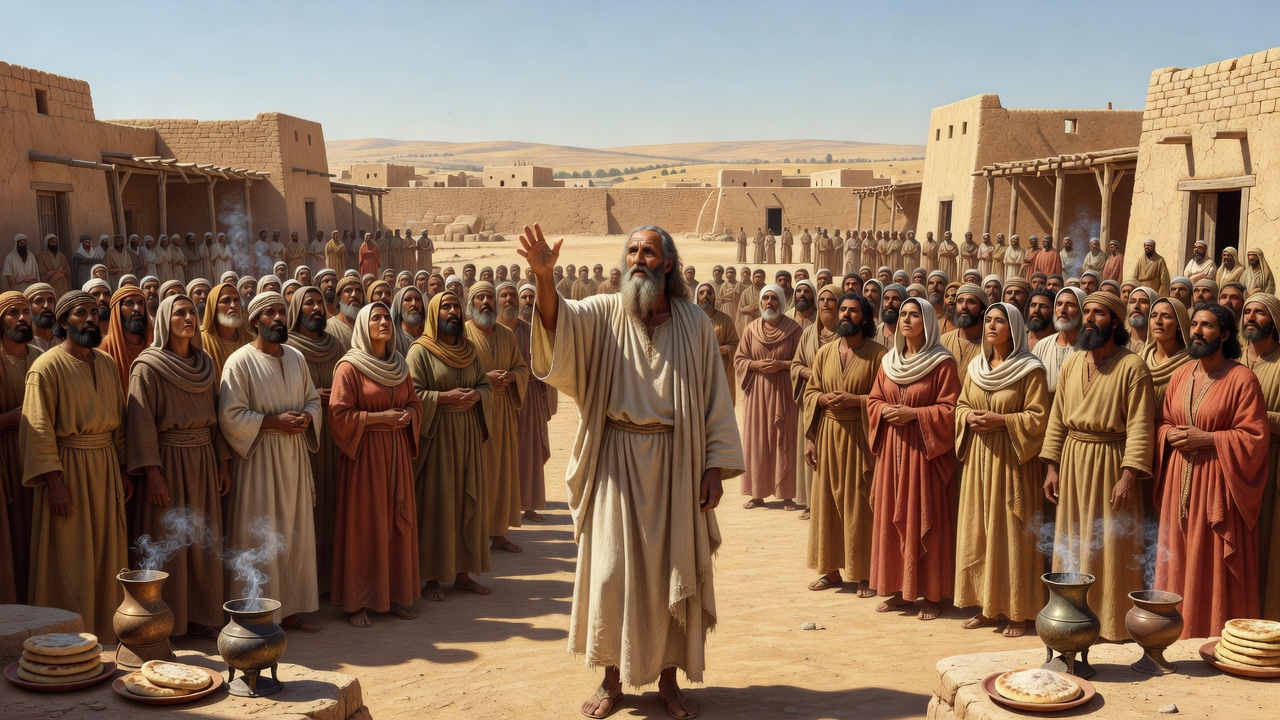
Jeremiah's Warning to the Judeans in Egypt
- The Judean refugees had settled across the full extent of Egypt, from northern locations such as Migdol, Tahpanhes, and Memphis in Lower Egypt, to the southern region known as Pathros in Upper Egypt.Sources: the Bible text itself · Pathros · Memphis · Migdol
- The gathered community openly refused Jeremiah's warning, insisting on continuing their offerings and cakes shaped in the image of the Queen of Heaven, claiming that life in Jerusalem had been prosperous only when they performed those rituals.Sources: the Bible text itself
- As a confirming sign of impending judgment, Jeremiah prophesied that Pharaoh Hophra of Egypt would fall into the hands of his enemies, just as King Zedekiah of Judah had been captured by Nebuchadnezzar of Babylon.Sources: the Bible text itself · Zedekiah · Nebuchadnezzar
Notes written with AI assistance from open sources (Theographic Bible Metadata, CC BY-SA 4.0; Easton’s Bible Dictionary, public domain) and reviewed before publishing.
Places in this chapter
- Egypt · 30.129, 31.308 · verses 1, 8, 12, 13, 14, 15, 24, 26, 27, 28, 30
- Memphis · 29.849, 31.253 · verse 1
- Pathros · Today: Upper Egypt · 24.100, 32.700 · verses 1, 15
- Tahpanhes · Today: Tell Defenneh · 30.861, 32.171 · verse 1
- Jerusalem · 31.777, 35.234 · verses 2, 5, 6, 9, 13, 17, 21
- Babylon · 32.543, 44.422 · verse 30
Only places identified with high confidence are shown (90% or more according to the scholarly sources compiled by OpenBible). Period map: DARE (Digital Atlas of the Roman Empire), CC BY 4.0; modern map: © OpenStreetMap contributors; places: OpenBible.info (CC BY 4.0).
Credits and license for this translation
LXX2012: Septuagint in American English 2012
The Septuagint with Apocrypha, translated from Greek to English by Sir Lancelot C. L. Brenton and published in 1885, with some language updates (American English)
Public Domain
Language: English
Dialect (if applicable): American
Language in English: English
Translation by:
Sir Lancelot Charles Lee Brenton
Michael Paul Johnson
LXX2012: Septuagint in English 2012
This is a translation of the Old Testament and Apocrypha/Deuterocanon from Hebrew to Greek to 19th Century British English, with some updates of spelling and word usage to contemporary American English. The original English translation was done by Sir Lancelot Charles Lee Brenton and published by Samuel Bagster & Sons, Ltd., in London in 1851. It has entered the Public Domain due to the passage of sufficient time. In the process of scanning and typing the text, the original poetry and prose formatting, as well as peripheral material like introductions and notes, have been omitted.
This edition of the Septuagint has some language updates. Brenton's word order and punctuation has been mostly retained, meaning that quotation marks are not used, and sentences within quotes may not start with capital letters, as was standard usage in 1851. Names transliterated from Greek to those transliterated from Hebrew in the common English Bibles often differ. These language updates are dedicated to the Public Domain by the author of those edits, Michael Paul Johnson. Therefore this edition may be freely copied, published, etc.
Before considering making changes to the text of this work, I recommend that you consult with God, because this is really His Book.
If you find errors in the text, please report them so that we can correct them.
Donations to help with the expenses of operating this web site and thus help others have free access to the Word of God may be made to us, but are not required. Please see http://MLJohnson.org/partner/ for more about that.
Section headings adapted from the Berean Standard Bible (public domain); they are not part of this translation’s text.
Source: http://ebible.org/eng-lxx2012/ · eBible.org