Isaiah 60
LXX2012: Septuagint in American English 2012 · Tap a verse to see its cross-references.
Future Glory for Zion
1Be enlightened, be enlightened, O Jerusalem, for your light is come, and the glory of the Lord is risen upon you. 2Behold, darkness shall cover the earth, and there shall be gross darkness on the nations: but the Lord shall appear upon you, and his glory shall be seen upon you. 3And kings shall walk in your light, and nations in your brightness. 4Lift up your eyes round about, and behold your children gathered: all your sons have come from far, and your daughters shall be borne on men's shoulders. 5Then shall you see, and fear, and be amazed in your heart; for the wealth of the sea shall come round to you, and of nations and peoples; and herds of camels shall come to you, 6and the camels of Madiam and Gaepha shall cover you: all from Saba shall come bearing gold, and shall bring frankincense, and they shall publish the salvation of the Lord. 7And all the flocks of Kedar shall be gathered, and the rams of Nabaeoth shall come; and acceptable sacrifices shall be offered on my altar, and my house of prayer shall be glorified. 8Who are these that fly as clouds, and as doves with young ones to me? 9The isles have waited for me, and the ships of Tharsis among the first, to bring your children from afar, and their silver and their gold with them, and that for the sake of the holy name of the Lord, and because the Holy One of Israel is glorified. 10And strangers shall build your walls, and their kings shall wait upon you: for by reason of my wrath I struck you, and by reason of mercy I loved you. 11And your gates shall be opened continually; they shall not be shut day nor night; to bring in to you the power of the Gentiles, and their kings as captives. 12For the nations and the kings which will not serve you shall perish; and those nations shall be made utterly desolate. 13And the glory of Libanus shall come to you, with the cypress, and pine, and cedar together, to glorify my holy place. 14And the sons of them that afflicted you, and of them that provoked you, shall come to you in fear; and you shall be called Sion, the city of the Holy One of Israel. 15Because you have become desolate and hated, and there was no helper, therefore I will make you a perpetual gladness, a joy of many generations. 16And you shall suck the milk of the Gentiles, and shall eat the wealth of kings: and shall know that I am the Lord that saves you and delivers you, the Holy One of Israel. 17And for brass I will bring you gold, and for iron I will bring you silver, and instead of wood I will bring you brass, and instead of stones, iron; and I will make your princes peaceful, and your overseers righteous. 18And injustice shall no more be heard in your land, nor destruction nor misery in your coasts; but your walls shall be called Salvation, and your gates Sculptured Work. 19And you shall no more have the sun for a light by day, nor shall the rising of the moon lighten your night; but the Lord shall be your everlasting light, and God your glory. 20For the sun shall no more set, nor shall the moon be eclipsed; for the Lord shall be your everlasting light, and the days of your mourning shall be completed. 21Your people also shall be all righteous; they shall inherit the land for ever, preserving that which they have planted, even the works of their hands, for glory. 22The little one shall become thousands, and the least a great nation; I the Lord will gather them in due time.
Did you know?
The Glorious Restoration of Zion
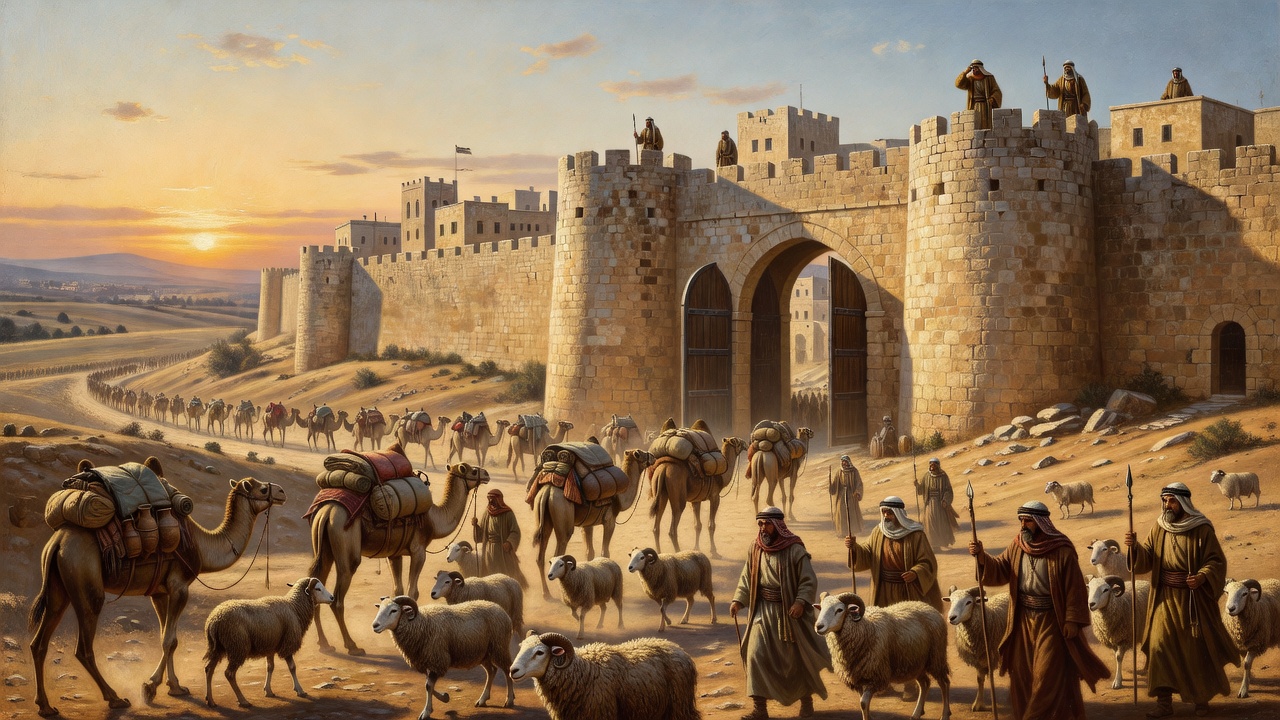
- Sheba was a kingdom in southern Arabia renowned for its ancient trade in gold and spices, while Midian was a nomadic Arabian tribe long engaged in desert commerce. Isaiah 60 envisions these distant peoples arriving on vast camel caravans, bearing gold and frankincense to praise the Lord.Sources: Sheba · Midian · the Bible text itself
- Kedar and Nebaioth trace back in biblical genealogies to the sons of Ishmael, with Kedar designating pastoral nomadic tribes of northwestern Arabia known for their large flocks and black tents. In this prophetic vision, their sheep and rams are brought to Jerusalem to be accepted as offerings upon the altar.Sources: Kedar · Nebajoth · Kedar · the Bible text itself
Notes written with AI assistance from open sources (Theographic Bible Metadata, CC BY-SA 4.0; Easton’s Bible Dictionary, public domain) and reviewed before publishing.
Places in this chapter
- Jerusalem · 31.777, 35.234 · verses 1, 14
- Ephah · Today: Midian · 28.495, 35.012 · verse 6
- Midian · 28.495, 35.012 · verse 6
- Sheba · 15.348, 44.206 · verse 6
- Kedar · 29.811, 39.868 · verse 7
- Lebanon · 33.540, 35.584 · verse 13
- Zion · Today: Jerusalem · 31.777, 35.234 · verse 14
Only places identified with high confidence are shown (90% or more according to the scholarly sources compiled by OpenBible). Period map: DARE (Digital Atlas of the Roman Empire), CC BY 4.0; modern map: © OpenStreetMap contributors; places: OpenBible.info (CC BY 4.0).
Credits and license for this translation
LXX2012: Septuagint in American English 2012
The Septuagint with Apocrypha, translated from Greek to English by Sir Lancelot C. L. Brenton and published in 1885, with some language updates (American English)
Public Domain
Language: English
Dialect (if applicable): American
Language in English: English
Translation by:
Sir Lancelot Charles Lee Brenton
Michael Paul Johnson
LXX2012: Septuagint in English 2012
This is a translation of the Old Testament and Apocrypha/Deuterocanon from Hebrew to Greek to 19th Century British English, with some updates of spelling and word usage to contemporary American English. The original English translation was done by Sir Lancelot Charles Lee Brenton and published by Samuel Bagster & Sons, Ltd., in London in 1851. It has entered the Public Domain due to the passage of sufficient time. In the process of scanning and typing the text, the original poetry and prose formatting, as well as peripheral material like introductions and notes, have been omitted.
This edition of the Septuagint has some language updates. Brenton's word order and punctuation has been mostly retained, meaning that quotation marks are not used, and sentences within quotes may not start with capital letters, as was standard usage in 1851. Names transliterated from Greek to those transliterated from Hebrew in the common English Bibles often differ. These language updates are dedicated to the Public Domain by the author of those edits, Michael Paul Johnson. Therefore this edition may be freely copied, published, etc.
Before considering making changes to the text of this work, I recommend that you consult with God, because this is really His Book.
If you find errors in the text, please report them so that we can correct them.
Donations to help with the expenses of operating this web site and thus help others have free access to the Word of God may be made to us, but are not required. Please see http://MLJohnson.org/partner/ for more about that.
Section headings adapted from the Berean Standard Bible (public domain); they are not part of this translation’s text.
Source: http://ebible.org/eng-lxx2012/ · eBible.org