Isaiah 4
LXX2012: Septuagint in American English 2012 · Tap a verse to see its cross-references.
A Remnant in Zion
1And seven women shall take hold of one man, saying, We will eat our own bread, and wear our own raiment: only let your name be called upon us, and take away our reproach. 2And in that day God shall shine gloriously in counsel on the earth, to exalt and glorify the remnant of Israel. 3And it shall be, that the remnant left in Sion, and the remnant left in Jerusalem, even all that are appointed to life in Jerusalem, shall be called holy. 4For the Lord shall wash away the filth of the sons and daughters of Sion, and shall purge out the blood from the midst of them, with the spirit of judgment, and the spirit of burning. 5And he shall come, and it shall be with regard to every place of mount Sion, yes, all the region round about it shall a cloud overshadow by day, and there shall be as it were the smoke and light of fire burning by night: and upon all the glory shall be a defence. 6And it shall be for a shadow from the heat, and as a shelter and a hiding place from inclemency of weather and from rain.
Did you know?
The Purification and Restoration of Zion
- Mount Zion was one of the natural elevations on which Jerusalem was built. Captured from the Jebusites by David, it became known as the City of David and in prophetic writings frequently represents the core of the holy community.Sources: Mount Zion · Jerusalem · the Bible text itself
- The chapter opens with the aftermath of devastating conflict, where seven women plead to share the name of a single man while providing their own food and clothes, seeking to remove their social disgrace.Sources: the Bible text itself
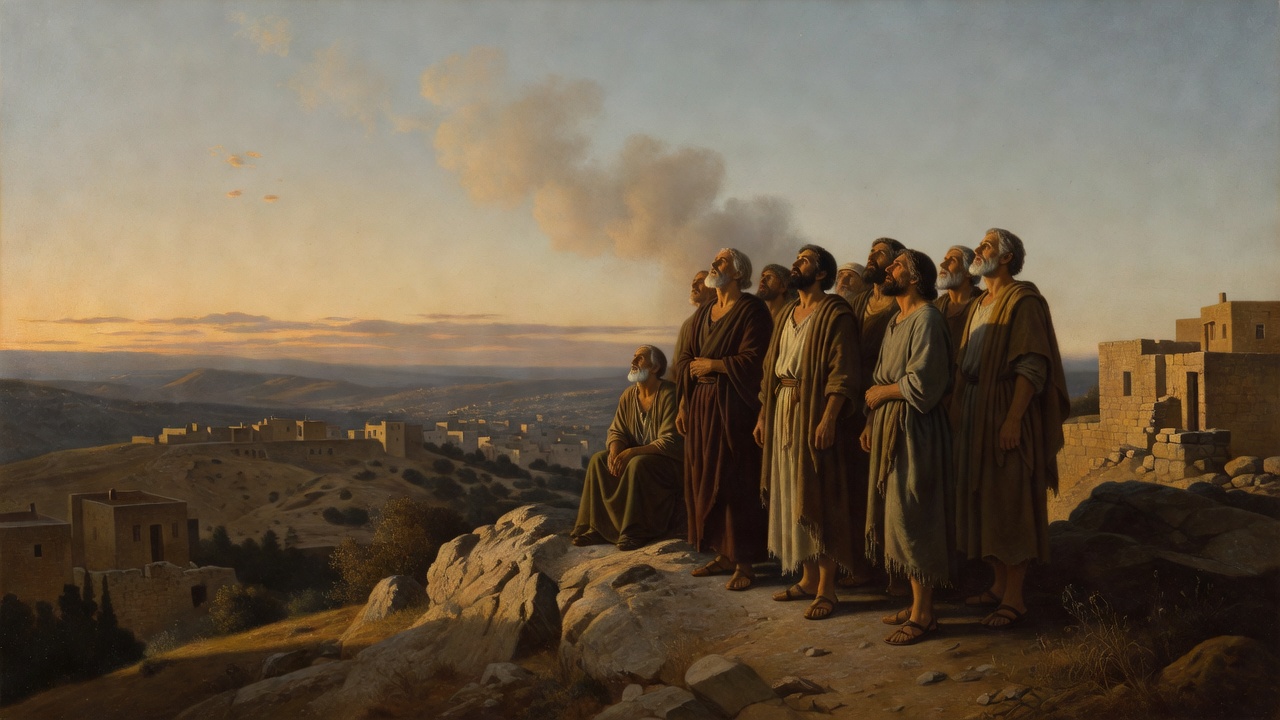
- Isaiah portrays divine restoration through the imagery of a protective canopy over Mount Zion, taking the form of a cloud of smoke by day and a glowing fire by night to provide shade and shelter for those recorded among the living.Sources: the Bible text itself
Notes written with AI assistance from open sources (Theographic Bible Metadata, CC BY-SA 4.0; Easton’s Bible Dictionary, public domain) and reviewed before publishing.
Places in this chapter
- Jerusalem · 31.777, 35.234 · verses 3, 4
- Zion · Today: Jerusalem · 31.777, 35.234 · verses 3, 4
- Mount Zion · 31.772, 35.229 · verse 5
Only places identified with high confidence are shown (90% or more according to the scholarly sources compiled by OpenBible). Period map: DARE (Digital Atlas of the Roman Empire), CC BY 4.0; modern map: © OpenStreetMap contributors; places: OpenBible.info (CC BY 4.0).
Credits and license for this translation
LXX2012: Septuagint in American English 2012
The Septuagint with Apocrypha, translated from Greek to English by Sir Lancelot C. L. Brenton and published in 1885, with some language updates (American English)
Public Domain
Language: English
Dialect (if applicable): American
Language in English: English
Translation by:
Sir Lancelot Charles Lee Brenton
Michael Paul Johnson
LXX2012: Septuagint in English 2012
This is a translation of the Old Testament and Apocrypha/Deuterocanon from Hebrew to Greek to 19th Century British English, with some updates of spelling and word usage to contemporary American English. The original English translation was done by Sir Lancelot Charles Lee Brenton and published by Samuel Bagster & Sons, Ltd., in London in 1851. It has entered the Public Domain due to the passage of sufficient time. In the process of scanning and typing the text, the original poetry and prose formatting, as well as peripheral material like introductions and notes, have been omitted.
This edition of the Septuagint has some language updates. Brenton's word order and punctuation has been mostly retained, meaning that quotation marks are not used, and sentences within quotes may not start with capital letters, as was standard usage in 1851. Names transliterated from Greek to those transliterated from Hebrew in the common English Bibles often differ. These language updates are dedicated to the Public Domain by the author of those edits, Michael Paul Johnson. Therefore this edition may be freely copied, published, etc.
Before considering making changes to the text of this work, I recommend that you consult with God, because this is really His Book.
If you find errors in the text, please report them so that we can correct them.
Donations to help with the expenses of operating this web site and thus help others have free access to the Word of God may be made to us, but are not required. Please see http://MLJohnson.org/partner/ for more about that.
Section headings adapted from the Berean Standard Bible (public domain); they are not part of this translation’s text.
Source: http://ebible.org/eng-lxx2012/ · eBible.org