Genesis 42
LXX2012: Septuagint in American English 2012 · Tap a verse to see its cross-references.
Joseph’s Brothers Sent to Egypt
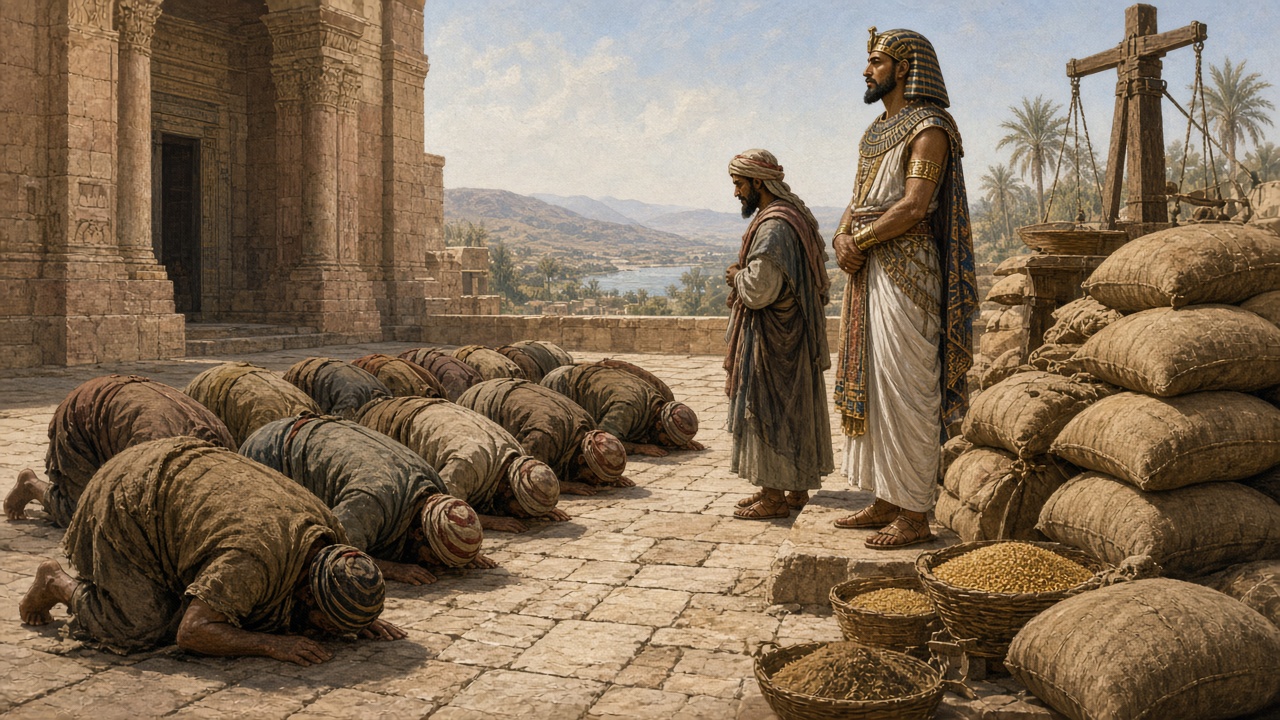
1And Jacob having seen that there was a sale of corn in Egypt, said to his sons, Why are you⌃ indolent? 2Behold, I have heard that there is corn in Egypt; go down there, and buy for us a little food, that we may live, and not die. 3And the ten brethren of Joseph went down to buy corn out of Egypt. 4But Jacob sent not Benjamin, the brother of Joseph, with his brethren; for he said, Lest, haply, disease befall him. 5And the sons of Israel came to buy with those that came, for the famine was in the land of Chanaan. 6And Joseph was ruler of the land; he sold to all the people of the land. And the brethren of Joseph, having come, did reverence to him, bowing with the face to the ground. 7And when Joseph saw his brethren, he knew them, and estranged himself from them, and spoke hard words to them; and said to them, Whence are you⌃ come? And they said, Out of the land of Chanaan, to buy food. 8And Joseph knew his brethren, but they knew not him. 9And Joseph remembered his dream, which he saw; and he said to them, You⌃ are spies; to observe the marks of the land are you⌃ come. 10But they said, Nay, Sir, we your servants are come to buy food; 11we are all sons of one man; we are peaceful, your servants are not spies. 12And he said to them, Nay, but you⌃ are come to observe the marks of the land. 13And they said, We your servants are twelve brethren, in the land of Chanaan; and, behold, the youngest is with our father today, but the other one is not. 14And Joseph said to them, This is it that I spoke to you, saying, you⌃ are spies; 15herein shall you⌃ be manifested; by the health of Pharao, you⌃ shall not depart hence, unless your younger brother come here. 16Send one of you, and take your brother; and go you⌃ to prison, till your words be clear, whether you⌃ speak the truth or not; but, if not, by the health of Pharao, verily you⌃ are spies. 17And he put them in prison three days. 18And he said to them on the third day, This do, and you⌃ shall live, for I fear God. 19If you⌃ be peaceful, let one of your brethren be detained in prison; but go you⌃, and carry back the corn you⌃ have purchased. 20And bring your younger brother to me, and your words shall be believed; but, if not, you⌃ shall die. And they did so. 21And each said to his brother, Yes, indeed, for we are in fault concerning our brother, when we disregarded the anguish of his soul, when he implored us, and we listened not to him; and therefore has this affliction come upon us. 22And Ruben answered them, saying, Did I not speak to you, saying, Hurt not the boy, and you⌃ heard me not? and, behold, his blood is required. 23But they knew not that Joseph understood them; for there was an interpreter between them. 24And Joseph turned away from them, and wept; and again he came to them, and spoke to them; and he took Symeon from them, and bound him before their eyes.
Joseph’s Brothers Return to Canaan
25And Joseph gave orders to fill their vessels with corn, and to return their money to each into his sack, and to give them provision for the way; and it was so done to them. 26And having put the corn on the asses, they departed thence. 27And one having opened his sack to give his asses fodder, at the place where they rested, saw also his bundle of money, for it was on the mouth of his sack. 28And he said to his brethren, My money has been restored to me, and behold this is in my sack. And their heart was wonder-struck, and they were troubled, saying one to another, What is this that God has done to us? 29And they came to their father, Jacob, into the land of Chanaan, and reported to him all that had happened to them, saying, 30The man, the lord of the land, spoke harsh words to us, and put us in prison as spies of the land. 31And we said to him, We are men of peace, we are not spies. 32We are twelve brethren, sons of our father; one is not, and the youngest is with his father today in the land of Chanaan. 33And the man, the lord of the land, said to us, Herein shall I know that you⌃ are peaceful; leave one brother here with me, and having taken the corn you⌃ have purchased for your family, depart. 34And bring to me your younger brother; then I shall know that you⌃ are not spies, but that you⌃ are men of peace: and I will restore you your brother, and you⌃ shall trade in the land. 35And it came to pass as they were emptying their sacks, there was each man's bundle of money in his sack; and they and their father saw their bundles of money, and they were afraid. 36And their father Jacob said to them, You⌃ have bereaved me. Joseph is not, Symeon is not, and will you⌃ take Benjamin? all these things have come upon me. 37And Ruben spoke to his father, saying, Slay my two sons, if I bring him not to you; give him into my hand, and I will bring him back to you. 38But he said, My son shall not go down with you, because his brother is dead, and he only has been left; and suppose it shall come to pass that he is afflicted by the way by which you⌃ go, then you⌃ shall bring down my old age with sorrow to Hades.
Did you know?
The Brothers Come to Egypt for Grain
- Jacob heard that there was grain in Egypt, the land of the Nile, and sent ten of his sons from Canaan to buy some so the family would not die in the famine. The seven-year famine is dated to a beginning in 1707 BC, and the brothers' journey to Egypt to 1706 BC.Sources: the Bible text itself · Egypt · 7 years of famine · Joseph's brothers go to Egypt
- Joseph, ruler of the land and the one who sold grain to its people, recognized his brothers when they bowed before him, but they did not recognize him. An interpreter stood between them, so they did not realize that he understood what they said. He turned away and wept, then had Simeon, Jacob's second son by Leah, bound before their eyes and held as a hostage.Sources: the Bible text itself · Simeon
- Benjamin, the younger son of Jacob and Rachel, stayed behind with his father; Joseph was Rachel's elder son, and Jacob believed that brother was already dead. Jacob refused to let Benjamin go down to Egypt, saying that harm to him would bring his gray hair down to Sheol in sorrow. Reuben, the eldest son of Jacob and Leah, who had earlier saved Joseph when the other brothers would have put him to death, pledged his own life and the lives of his two sons if he failed to bring Benjamin back.Sources: the Bible text itself · Benjamin (patriarch) · Joseph (son of Jacob) · Reuben
Notes written with AI assistance from open sources (Theographic Bible Metadata, CC BY-SA 4.0; Easton’s Bible Dictionary, public domain) and reviewed before publishing.
Places in this chapter
Only places identified with high confidence are shown (90% or more according to the scholarly sources compiled by OpenBible). Period map: DARE (Digital Atlas of the Roman Empire), CC BY 4.0; modern map: © OpenStreetMap contributors; places: OpenBible.info (CC BY 4.0).
Credits and license for this translation
LXX2012: Septuagint in American English 2012
The Septuagint with Apocrypha, translated from Greek to English by Sir Lancelot C. L. Brenton and published in 1885, with some language updates (American English)
Public Domain
Language: English
Dialect (if applicable): American
Language in English: English
Translation by:
Sir Lancelot Charles Lee Brenton
Michael Paul Johnson
LXX2012: Septuagint in English 2012
This is a translation of the Old Testament and Apocrypha/Deuterocanon from Hebrew to Greek to 19th Century British English, with some updates of spelling and word usage to contemporary American English. The original English translation was done by Sir Lancelot Charles Lee Brenton and published by Samuel Bagster & Sons, Ltd., in London in 1851. It has entered the Public Domain due to the passage of sufficient time. In the process of scanning and typing the text, the original poetry and prose formatting, as well as peripheral material like introductions and notes, have been omitted.
This edition of the Septuagint has some language updates. Brenton's word order and punctuation has been mostly retained, meaning that quotation marks are not used, and sentences within quotes may not start with capital letters, as was standard usage in 1851. Names transliterated from Greek to those transliterated from Hebrew in the common English Bibles often differ. These language updates are dedicated to the Public Domain by the author of those edits, Michael Paul Johnson. Therefore this edition may be freely copied, published, etc.
Before considering making changes to the text of this work, I recommend that you consult with God, because this is really His Book.
If you find errors in the text, please report them so that we can correct them.
Donations to help with the expenses of operating this web site and thus help others have free access to the Word of God may be made to us, but are not required. Please see http://MLJohnson.org/partner/ for more about that.
Section headings adapted from the Berean Standard Bible (public domain); they are not part of this translation’s text.
Source: http://ebible.org/eng-lxx2012/ · eBible.org