Genesis 29
LXX2012: Septuagint in American English 2012 · Tap a verse to see its cross-references.
Jacob Meets Rachel
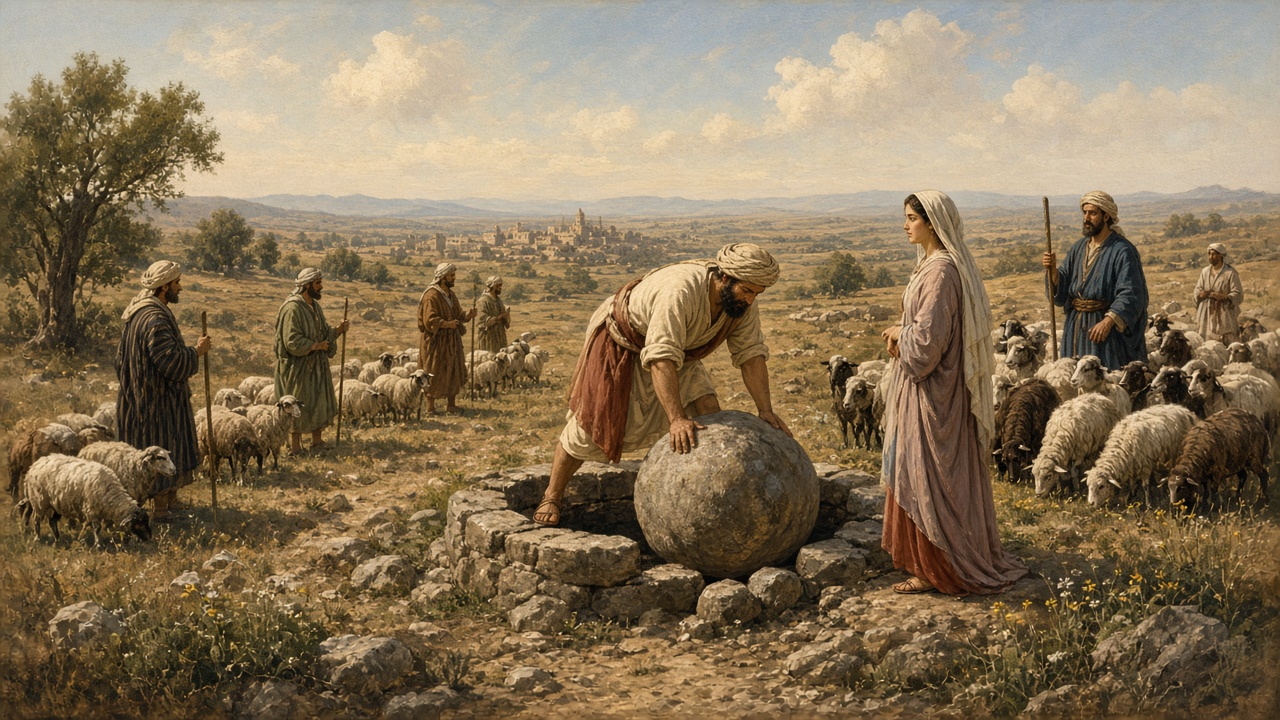
1And Jacob started and went to the land of the east to Laban, the son of Bathuel the Syrian, and the brother of Rebecca, mother of Jacob and Esau. 2And he looks, and behold! a well in the plain; and there were there three flocks of sheep resting at it, for out of that well they watered the flocks, but there was a great stone at the mouth of the well. 3And there were all the flocks gathered, and they used to roll away the stone from the mouth of the well, and water the flocks, and set the stone again in its place on the mouth of the well. 4And Jacob said to them, Brethren, whence are you⌃? and they said, We are of Charrhan. 5And he said to them, Know you⌃ Laban, the son of Nachor? and they said, We do know him. 6And he said to them, Is he well? And they said, He is well. And behold Rachel his daughter came with the sheep. 7And Jacob said, it is yet high day, it is not yet time that the flocks be gathered together; water you⌃ the flocks, and depart and feed them. 8And they said, We shall not be able, until all the shepherds be gathered together, and they shall roll away the stone from the mouth of the well, then we will water the flocks. 9While he was yet speaking to them, behold, Rachel the daughter of Laban came with her father's sheep, for she fed the sheep of her father. 10And it came to pass when Jacob saw Rachel the daughter of Laban, his mother's brother, and the sheep of Laban, his mother's brother, that Jacob came and rolled away the stone from the mouth of the well, and watered the sheep of Laban, his mother's brother. 11And Jacob kissed Rachel, and cried with a loud voice and wept. 12And he told Rachel that he was the near relative of her father, and the son of Rebecca; and she ran and reported to her father according to these words. 13And it came to pass when Laban heard the name of Jacob, his sister's son, he ran to meet him, and embraced and kissed him, and brought him into his house; and he told Laban all these sayings.
Jacob Marries Leah and Rachel
14And Laban said to him, You are of my bones and of my flesh; and he was with him a full month. 15And Laban said to Jacob, Surely you shall not serve me for nothing, because you are my brother; tell me what your reward is to be. 16Now Laban had two daughters, the name of the elder was Lea, and the name of the younger, Rachel. 17And the eyes of Lea were weak. But Rachel was beautiful in appearance, and exceedingly fair in countenance. 18And Jacob loved Rachel, and said, I will serve you seven years for your younger daughter Rachel. 19And Laban said to him, It is better that I should give her to you, than that I should give her to another man; dwell with me. 20And Jacob served for Rachel seven years, and they were before him as a few days, by reason of his loving her. 21And Jacob said to Laban, Give me my wife, for my days are fulfilled, that I may go in to her. 22And Laban gathered together all the men of the place, and made a marriage-feast. 23And it was even, and he took his daughter Lea, and brought her in to Jacob, and Jacob went in to her. 24And Laban gave to his daughter Lea, Zelpha his handmaid, as a handmaid for her. 25And it was morning, and behold it was Lea; and Jacob said to Laban, What is this that you have done to me? did I not serve you for Rachel? and therefore have you deceived me? 26And Laban answered, It is not done thus in our country, to give the younger before the elder. 27Fulfil then her sevens, and I will give to you her also in return for your labor, which you labor with me, yet seven other years. 28And Jacob did so, and fulfilled her sevens; and Laban gave him his daughter Rachel to wife. 29And Laban gave to his daughter his handmaid Balla, for a handmaid to her. 30And he went in to Rachel; and he loved Rachel more than Lea; and he served him seven other years.
Reuben, Simeon, Levi, and Judah
31And when the Lord God saw that Lea was hated, he opened her womb; but Rachel was barren. 32And Lea conceived and bore a son to Jacob; and she called his name, Ruben; saying, Because the Lord has looked on my humiliation, and has given me a son, now then my husband will love me. 33And she conceived again, and bore a second son to Jacob; and she said, Because the Lord has heard that I am hated, he has given to me this one also; and she called his name, Simeon. 34And she conceived yet again, and bore a son, and said, In the present time my husband will be with me, for I have born him three sons; therefore she called his name, Levi. 35And having conceived yet again, she bore a son, and said, Now yet again this time will I give thanks to the Lord; therefore she called his name, Juda; and ceased bearing.
Did you know?
Jacob’s Marriages in Haran
- Jacob fled to Haran, where his uncle Laban lived, in the land of the people of the east. The city, also called the city of Nahor and identified with Harran, stood on the Belik, a tributary of the Euphrates, about seventy miles above the Belik’s junction with that river, in Upper Mesopotamia. Laban was the son of Bethuel and the grandson of Nahor, Abraham’s brother; Laban’s sister Rebekah was Isaac’s wife.Sources: Haran · Laban · Nahor (brother of Abraham) · the Bible text itself
- The well was closed by a large stone that the shepherds rolled away only after all the flocks had gathered, then put back in place. Rachel, whose name is given as “ewe,” was a shepherdess bringing her father’s sheep, and Jacob, who had himself lived as a shepherd, moved the stone and watered his uncle’s flock.Sources: Rachel · Jacob (Israel) · the Bible text itself
- Leah, the elder sister, is called “weary,” and she is described as weak-eyed, or tender-eyed; Rachel, the younger, was shapely and beautiful. Jacob served seven years for Rachel, but at the evening feast Laban gave him Leah, saying it was not the custom there to give the younger daughter in marriage before the older, and then gave him Rachel for another seven years—fourteen in all. Leah’s first sons were Reuben, whose name is given as “Behold a son,” and then Simeon, Levi, and Judah; in naming them she spoke of the LORD seeing her affliction, hearing that she was unloved, her husband becoming attached to her, and her praise of the LORD.Sources: Leah · Rachel · Reuben · the Bible text itself
Notes written with AI assistance from open sources (Theographic Bible Metadata, CC BY-SA 4.0; Easton’s Bible Dictionary, public domain) and reviewed before publishing.
Places in this chapter
- East · Today: region around Amman · 31.955, 35.934 · verse 1
- Haran · Today: Harran · 36.864, 39.033 · verse 4
Only places identified with high confidence are shown (90% or more according to the scholarly sources compiled by OpenBible). Period map: DARE (Digital Atlas of the Roman Empire), CC BY 4.0; modern map: © OpenStreetMap contributors; places: OpenBible.info (CC BY 4.0).
Credits and license for this translation
LXX2012: Septuagint in American English 2012
The Septuagint with Apocrypha, translated from Greek to English by Sir Lancelot C. L. Brenton and published in 1885, with some language updates (American English)
Public Domain
Language: English
Dialect (if applicable): American
Language in English: English
Translation by:
Sir Lancelot Charles Lee Brenton
Michael Paul Johnson
LXX2012: Septuagint in English 2012
This is a translation of the Old Testament and Apocrypha/Deuterocanon from Hebrew to Greek to 19th Century British English, with some updates of spelling and word usage to contemporary American English. The original English translation was done by Sir Lancelot Charles Lee Brenton and published by Samuel Bagster & Sons, Ltd., in London in 1851. It has entered the Public Domain due to the passage of sufficient time. In the process of scanning and typing the text, the original poetry and prose formatting, as well as peripheral material like introductions and notes, have been omitted.
This edition of the Septuagint has some language updates. Brenton's word order and punctuation has been mostly retained, meaning that quotation marks are not used, and sentences within quotes may not start with capital letters, as was standard usage in 1851. Names transliterated from Greek to those transliterated from Hebrew in the common English Bibles often differ. These language updates are dedicated to the Public Domain by the author of those edits, Michael Paul Johnson. Therefore this edition may be freely copied, published, etc.
Before considering making changes to the text of this work, I recommend that you consult with God, because this is really His Book.
If you find errors in the text, please report them so that we can correct them.
Donations to help with the expenses of operating this web site and thus help others have free access to the Word of God may be made to us, but are not required. Please see http://MLJohnson.org/partner/ for more about that.
Section headings adapted from the Berean Standard Bible (public domain); they are not part of this translation’s text.
Source: http://ebible.org/eng-lxx2012/ · eBible.org