Ezra 3
LXX2012: Septuagint in American English 2012 · Tap a verse to see its cross-references.
Sacrifices Restored
1And the seventh month came on, and the children of Israel were in their cities, and the people assembled as one man at Jerusalem. 2Then stood up Jesus the son of Josedec, and his brethren the priests, and Zorobabel the son of Salathiel, and his brethren, and they built the altar of the God of Israel, to offer upon it whole burnt offerings, according to the things that were written in the law of Moses the man of God. 3And they set up the altar on its place, for there was a terror upon them because of the people of the lands: and the whole burnt offerings was offered up upon it to the Lord morning and evening. 4And they kept the feast of tabernacles, according to that which was written, and offered whole burnt offerings daily in number according to the ordinance, the exact daily rate. 5And after this the perpetual whole burnt offering, and offering for the season of new moon, and for all the hallowed feasts to the Lord, and for every one that offered a free will offering to the Lord. 6On the first day of the seventh month they began to offer whole burnt offerings to the Lord: but the foundation of the house of the Lord was not laid. 7And they gave money to the stone-hewers and carpenters, and meat and drink, and oil, to the Sidonians, and Tyrians, to bring cedar trees from Libanus to the sea of Joppa, according to the grant of Cyrus king of the Persians to them.
Temple Restoration Begins
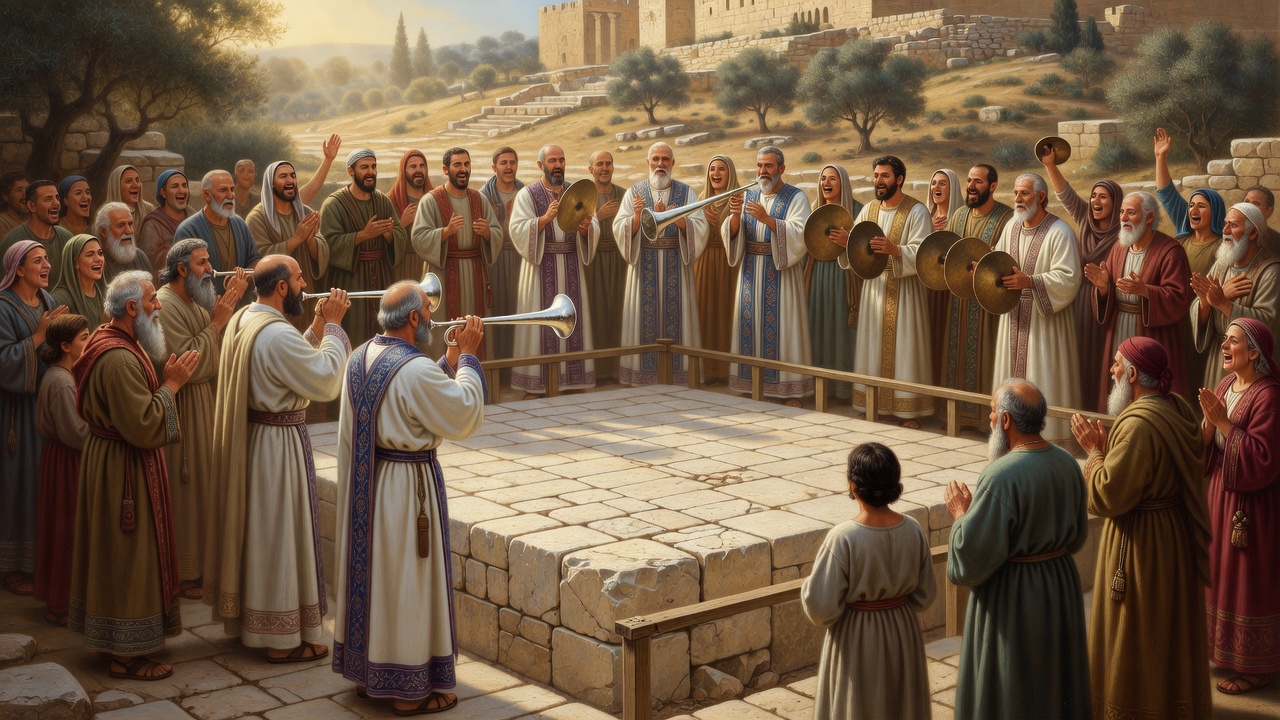
8And in the second year of their coming to the house of God in Jerusalem, in the second month, began Zorobabel the son of Salathiel, and Jesus the son of Josedec, and the rest of their brethren the priests and the Levites, and all who came from the captivity to Jerusalem, and they appointed the Levites, from twenty years old and upward, over the workmen in the house of the Lord. 9And Jesus and his sons and his brethren stood, Cadmiel and his sons the sons of Juda, over them that wrought the works in the house of God: the sons of Enadad, their sons and their brethren the Levites. 10And they laid a foundation for building the house of the Lord: and the priests in their robes stood with trumpets and the Levites the sons of Asaph with cymbals, to praise the Lord, according to the order of David king of Israel. 11And they answered each other with praise and thanksgiving to the Lord, saying, For it is good, for his mercy to Israel endures for ever. And all the people shouted with a loud voice to praise the Lord at the laying the foundation of the house of the Lord. 12But many of the priests and the Levites, and the elder men, heads of families, who had seen the former house on its foundation, and who saw this house with their eyes, wept with a loud voice: but the multitude shouted with joy to raise a song. 13And the people did not distinguish the voice of the glad shout from the voice of the weeping of the people: for the people shouted with a loud voice, and the voice was heard even from afar off.
Did you know?
Rebuilding the Altar and Temple Foundation
- The returned exiles restored sacrificial worship on the temple mount before beginning major construction. Under Zerubbabel and the priest Jeshua, they rebuilt the altar on its original site to resume daily offerings and celebrate the Feast of Tabernacles before laying the temple foundation.Sources: the Bible text itself · Zerubbabel · Joshua
- To secure timber for the rebuilding effort, the community paid masons and carpenters, and sent food, drink, and oil to Tyre and Sidon to transport cedar logs from Lebanon by sea to the port of Joppa, as permitted by Cyrus, king of Persia.Sources: the Bible text itself · Lebanon · Joppa · Cyrus
- Laying the foundation of the house of the Lord triggered intense, mixed reactions. While many shouted joyfully to the accompaniment of trumpets and cymbals, older priests, Levites, and family heads who remembered the first temple wept aloud.Sources: the Bible text itself
Notes written with AI assistance from open sources (Theographic Bible Metadata, CC BY-SA 4.0; Easton’s Bible Dictionary, public domain) and reviewed before publishing.
Places in this chapter
- Jerusalem · 31.777, 35.234 · verses 1, 8
- Great Sea · Today: Mediterranean Sea · 31.805, 34.170 · verse 7
- Joppa · Today: Jaffa · 32.054, 34.753 · verse 7
- Lebanon · 33.540, 35.584 · verse 7
- Persia · 34.806, 48.516 · verse 7
- Sidon · Today: Sandikli archaeological site in Sidon · 33.561, 35.372 · verse 7
- Tyre · 33.271, 35.196 · verse 7
Only places identified with high confidence are shown (90% or more according to the scholarly sources compiled by OpenBible). Period map: DARE (Digital Atlas of the Roman Empire), CC BY 4.0; modern map: © OpenStreetMap contributors; places: OpenBible.info (CC BY 4.0).
Credits and license for this translation
LXX2012: Septuagint in American English 2012
The Septuagint with Apocrypha, translated from Greek to English by Sir Lancelot C. L. Brenton and published in 1885, with some language updates (American English)
Public Domain
Language: English
Dialect (if applicable): American
Language in English: English
Translation by:
Sir Lancelot Charles Lee Brenton
Michael Paul Johnson
LXX2012: Septuagint in English 2012
This is a translation of the Old Testament and Apocrypha/Deuterocanon from Hebrew to Greek to 19th Century British English, with some updates of spelling and word usage to contemporary American English. The original English translation was done by Sir Lancelot Charles Lee Brenton and published by Samuel Bagster & Sons, Ltd., in London in 1851. It has entered the Public Domain due to the passage of sufficient time. In the process of scanning and typing the text, the original poetry and prose formatting, as well as peripheral material like introductions and notes, have been omitted.
This edition of the Septuagint has some language updates. Brenton's word order and punctuation has been mostly retained, meaning that quotation marks are not used, and sentences within quotes may not start with capital letters, as was standard usage in 1851. Names transliterated from Greek to those transliterated from Hebrew in the common English Bibles often differ. These language updates are dedicated to the Public Domain by the author of those edits, Michael Paul Johnson. Therefore this edition may be freely copied, published, etc.
Before considering making changes to the text of this work, I recommend that you consult with God, because this is really His Book.
If you find errors in the text, please report them so that we can correct them.
Donations to help with the expenses of operating this web site and thus help others have free access to the Word of God may be made to us, but are not required. Please see http://MLJohnson.org/partner/ for more about that.
Section headings adapted from the Berean Standard Bible (public domain); they are not part of this translation’s text.
Source: http://ebible.org/eng-lxx2012/ · eBible.org