Ezra 10
LXX2012: Septuagint in American English 2012 · Tap a verse to see its cross-references.
Shecaniah’s Encouragement
1So when Esdras had prayed, and when he had confessed, weeping and praying before the house of God, a very great assembly of Israel came together to him, men and women and youths; for the people wept, and wept aloud. 2And Sechenias the son of Jeel, of the sons of Elam, answered and said to Esdras, We have broken covenant with our God, and have taken strange wives of the nations of the land: yet now there is patience of hope to Israel concerning this thing. 3Now then let us make a covenant with our God, to put away all the wives, and their offspring, as you shall advise: 4arise, and alarm them with the commands of our God; and let it be done according to the law. Rise up, for the matter is upon you; and we are with you: be strong and do. 5Then Esdras arose, and caused the rulers, the priests, and Levites, and all Israel, to swear that they would do according to this word: and they swore.
The People’s Confession of Sin
6And Esdras rose up from before the house of God, and went to the treasury of Joanan the son of Elisub; he even went there: he ate no bread, and drank no water; for he mourned over the unfaithfulness of them of the captivity. 7And they made proclamation throughout Juda and Jerusalem to all the children of the captivity, that they should assemble at Jerusalem, saying, 8Every one who shall not arrive within three days, as is the counsel of the rulers and the elders, all his substance shall be forfeited, and he shall be separated from the congregation of the captivity. 9So all the men of Juda and Benjamin assembled at Jerusalem within the three days. This was the ninth month: on the twentieth day of the month all the people sat down in the street of the house of the Lord, because of their alarm concerning the word, and because of the storm. 10And Esdras the priest arose, and said to them, You⌃ have broken covenant, and have taken strange wives, to add to the trespass of Israel. 11Now therefore give praise to the Lord God of our fathers, and do that which is pleasing in his sight: and separate yourselves from the peoples of the land, and from the strange wives. 12Then all the congregation answered and said, This your word is powerful upon us to do it. 13But the people is numerous, and the season is stormy, and there is no power to stand without, and the work is more than enough for one day or for two; for we have greatly sinned in this matter. 14Let now our rulers stand, and for all those in our cities who have taken strange wives, let them come at appointed times, and with them elders from every several city, and judges, to turn away the fierce wrath of our God from us concerning this matter. 15Only Jonathan the son of Asael, and Jazias the son of Thecoe were with me concerning this; and Mesollam, and Sabbathai the Levite helped them. 16And the children of the captivity did thus: and Esdras the priest, and heads of families according to their house were separated, and all by their names, for they returned in the first day of the tenth month to search out the matter. 17And they made an end with all the men who had taken strange wives by the first day of the first month.
Those Guilty of Intermarriage
18And there were found some of the sons of the priests who had taken strange wives: of the sons of Jesus the son of Josedec, and his brethren; Maasia, and Eliezer, and Jarib, and Gadalia. 19And they pledged themselves to put away their wives, and offered a ram of the flock for a trespass-offering because of their trespass. 20And of the sons of Emmer; Anani, and Zabdia. 21And of the sons of Eram; Masael, and Elia, and Samaia, and Jeel, and Ozia. 22And of the sons of Phasur; Elionai, Maasia, and Ismael, and Nathanael, and Jozabad, and Elasa. 23And of the Levites; Jozabad, and Samu, and Colia (he is Colitas,) and Phetheia, and Judas, and Eliezer. 24And of the singers; Elisab: and of the porters; Solmen, and Telmen, and Oduth. 25Also of Israel: of the sons of Phoros; Ramia, and Azia, and Melchia, and Meamin, and Eleazar, and Asabia, and Banaia. 26And of the sons of Helam; Matthania, and Zacharia, and Jaiel, and Abdia, and Jarimoth, and Elia. 27And of the sons of Zathua; Elionai, Elisub, Matthanai, and Armoth, and Zabad, and Oziza. 28And of the sons of Babei; Joanan, Anania, and Zabu, and Thali. 29And of the sons of Banui; Mosollam, Maluch, Adaias, Jasub, and Saluia, and Remoth. 30And of the sons of Phaath Moab; Edne, and Chalel, and Banaia, Maasia, Matthania, Beseleel, and Banui, and Manasse. 31And of the sons of Eram; Eliezer, Jesia, Melchia, Samaias, Semeon, 32Benjamin, Baluch, Samaria. 33And of the sons of Asem; Metthania, Matthatha, Zadab, Eliphalet, Jerami, Manasse, Semei. 34And of the sons of Bani; Moodia, Amram, Uel, 35Banaia, Badaia, Chelkia, 36Uvania, Marimoth, Eliasiph, 37Matthania, Matthanai: 38and so did the children of Banui, and the children of Semei, 39and Selemia, and Nathan, and Adaia, 40Machadnabu, Sesei, Sariu, 41Ezriel, and Selemia, and Samaria, 42and Sellum, Amaria, Joseph. 43Of the sons of Nabu; Jael, Matthanias, Zabad, Zebennas, Jadai, and Joel, and Banaia. 44All these had taken strange wives, and had begotten sons of them.
Did you know?
The Assembly and the Oath of Separation
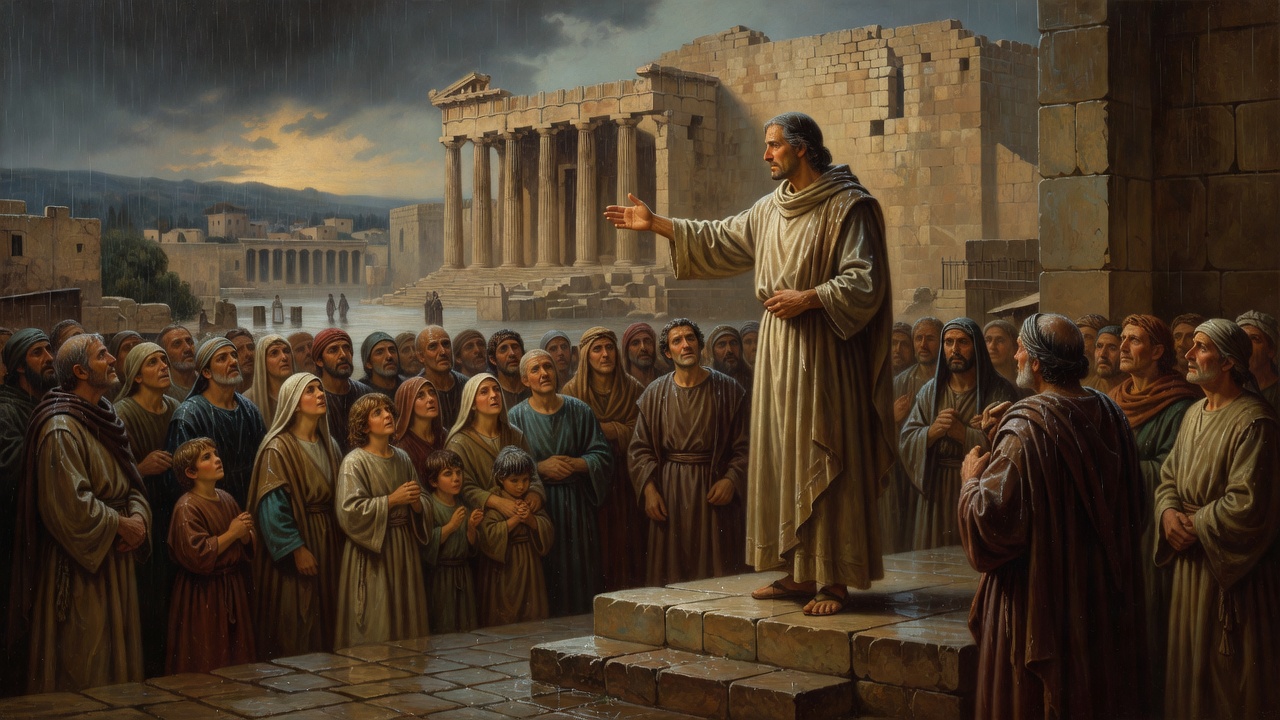
- To address the issue of intermarriage, the leaders issued a proclamation requiring all returned exiles in Judah and Benjamin to gather in Jerusalem within three days, under penalty of property forfeiture and expulsion from the community. When they gathered in the open square before the house of God, the people were trembling both from the gravity of the situation and from the heavy rain.Sources: the Bible text itself · Jerusalem
- Because the large crowd could not remain outdoors during the winter rainy season, the community organized a formal inquiry. Ezra and appointed heads of families investigated the cases town by town over a period of three full months, from the first day of the tenth month to the first day of the first month.Sources: the Bible text itself · Ezra
- The chapter and the book conclude with an itemized registry of over one hundred men who had taken foreign wives. The list demonstrates that intermarriage had touched all levels of post-exilic society, including descendants of the high priestly line, Levites, temple singers, gatekeepers, and ordinary citizens.Sources: the Bible text itself
Notes written with AI assistance from open sources (Theographic Bible Metadata, CC BY-SA 4.0; Easton’s Bible Dictionary, public domain) and reviewed before publishing.
Places in this chapter
Only places identified with high confidence are shown (90% or more according to the scholarly sources compiled by OpenBible). Period map: DARE (Digital Atlas of the Roman Empire), CC BY 4.0; modern map: © OpenStreetMap contributors; places: OpenBible.info (CC BY 4.0).
Credits and license for this translation
LXX2012: Septuagint in American English 2012
The Septuagint with Apocrypha, translated from Greek to English by Sir Lancelot C. L. Brenton and published in 1885, with some language updates (American English)
Public Domain
Language: English
Dialect (if applicable): American
Language in English: English
Translation by:
Sir Lancelot Charles Lee Brenton
Michael Paul Johnson
LXX2012: Septuagint in English 2012
This is a translation of the Old Testament and Apocrypha/Deuterocanon from Hebrew to Greek to 19th Century British English, with some updates of spelling and word usage to contemporary American English. The original English translation was done by Sir Lancelot Charles Lee Brenton and published by Samuel Bagster & Sons, Ltd., in London in 1851. It has entered the Public Domain due to the passage of sufficient time. In the process of scanning and typing the text, the original poetry and prose formatting, as well as peripheral material like introductions and notes, have been omitted.
This edition of the Septuagint has some language updates. Brenton's word order and punctuation has been mostly retained, meaning that quotation marks are not used, and sentences within quotes may not start with capital letters, as was standard usage in 1851. Names transliterated from Greek to those transliterated from Hebrew in the common English Bibles often differ. These language updates are dedicated to the Public Domain by the author of those edits, Michael Paul Johnson. Therefore this edition may be freely copied, published, etc.
Before considering making changes to the text of this work, I recommend that you consult with God, because this is really His Book.
If you find errors in the text, please report them so that we can correct them.
Donations to help with the expenses of operating this web site and thus help others have free access to the Word of God may be made to us, but are not required. Please see http://MLJohnson.org/partner/ for more about that.
Section headings adapted from the Berean Standard Bible (public domain); they are not part of this translation’s text.
Source: http://ebible.org/eng-lxx2012/ · eBible.org