Ezekiel 33
LXX2012: Septuagint in American English 2012 · Tap a verse to see its cross-references.
Ezekiel the Watchman for Israel
1And the word of the Lord came to me, saying, 2Son of man, speak to the children of your people, and you shall say to them, On whatever land I shall bring a sword, and the people of the land take one man of them, and set him for their watchman: 3and he shall see the sword coming upon the land, and blow the trumpet, and sound an alarm to the people; 4and he that hears the sound of the trumpet shall hear indeed, and yet not take heed, and the sword shall come upon him, and overtake him, his blood shall be upon his own head. 5Because he heard the sound of the trumpet, and took no heed, his blood shall be upon him: but the other, because he took heed, has delivered his soul. 6But if the watchman see the sword coming, and do not sound the trumpet, and the people do not watch; and the sword come, and take a soul from among them, that soul is taken because of its iniquity; but the blood thereof will I require at the watchman's hand. 7And you, son of man, I have set you as a watchman to the house of Israel, and you shall hear a word from my mouth. 8When I say to the sinner, You shall surely die; if you speak not to warn the wicked from his way, the wicked himself shall die in his iniquity; but his blood will I require at your hand. 9But if you forewarn the wicked of his way to turn from it, and he turn not from his way, he shall die in his ungodliness; but you have delivered your own soul.
The Message of the Watchman
10And you, son of man, say to the house of Israel; Thus have you⌃ spoken, saying, Our errors, and our iniquities weigh upon us, and we pine away in them, and how then shall we live? 11Say to them, Thus says the Lord; As I live, I desire not the death of the ungodly, as that the ungodly should turn from his way and live: turn you⌃ heartily from your way; for why will you⌃ die, O house of Israel? 12Say to the children of your people, The righteousness of the righteous shall not deliver him, in the day wherein he errs: and the iniquity of the ungodly shall not harm him, in the day wherein he turns from his iniquity, but the righteous erring shall not be able to deliver himself. 13When I say to the righteous, You shall live; and he trusts in his righteousness, and shall commit iniquity, none of his righteousnesses shall be remembered; in his unrighteousness which he has wrought, in it shall he die. 14And when I say to the ungodly, You shall surely die; and he shall turn from his sin, and do judgment and justice, 15and return the pledge, and repay that which he has robbed, and walk in the ordinances of life, so as to do no wrong; he shall surely live, and shall not die. 16None of his sins which he has committed shall be remembered: because he has wrought judgment and righteousness; by them shall he live. 17Yet the children of your people will say, The way of the Lord is not straight: whereas this their way is not straight. 18When the righteous turns away from his righteousness, and shall commit iniquities, then shall he die in them. 19And when the sinner turns from his iniquity, and shall do judgment and righteousness, he shall live by them. 20And this is that which you⌃ said, The way of the Lord is not straight. I will judge you, O house of Israel, every one for his ways.
Word of Jerusalem’s Fall
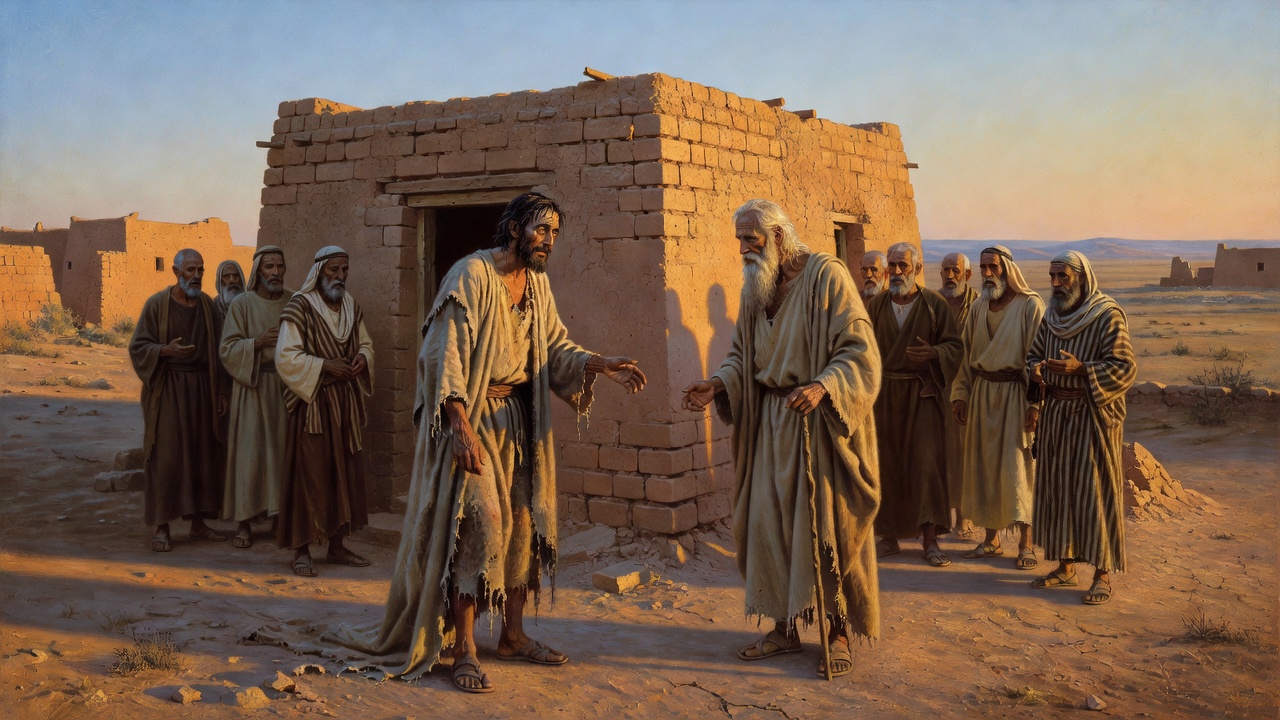
21And it came to pass in the tenth year of our captivity, in the twelfth month, on the fifth day of the month, that one that had escaped from Jerusalem came to me, saying, The city is taken. 22Now the hand of the Lord had come upon me in the evening, before he came; and he opened my mouth, when he came to me in the morning: and my mouth was open, it was no longer kept closed. 23And the word of the Lord came to me, saying, 24Son of man, they that inhabit the desolate places on the land of Israel say, Abram was one, and he possessed the land: and we are more numerous; to us the land is given for a possession. 27Therefore say to them, Thus says the Lord God, As I live, surely they that are in the desolate places shall fall by swords and they that are in the open plain shall be given for food to the wild beasts of the field, and them that are in the fortified cities and them that are in the caves I will kill with pestilence. 28And I will make the land desert, and the pride of her strength shall perish; and the mountains of Israel shall be made desolate by reason of no man passing through. 29And they shall know that I am the Lord; and I will make their land desert, and it shall be made desolate because of all their abominations which they have wrought. 30And as for you, son of man, the children of your people are they that speak concerning you by the walls, and in the porches of the houses, and they talk one to another, saying, Let us come together, and let us hear the words that proceed from the Lord. 31They approach you as a people comes together, and sit before you, and hear your words, but they will not do them: for there is falsehood in their mouth, and their heart goes after their pollutions. 32And you are to them as a sound of a sweet, well-tuned lute, and they will hear your words, but they will not do them. 33But whenever it shall come to pass, they will say, Behold, it is come: and they shall know that there was a prophet in the midst of them.
Did you know?
The Watchman and the Fall of Jerusalem
- In ancient times, a watchman stationed on a city wall was tasked with blowing a ram's horn to warn residents of an approaching enemy. Ezekiel was appointed as a spiritual watchman for Israel, charged with warning the people so that each individual would be held personally accountable before God for their response.Sources: the Bible text itself
- In the twelfth year of the Babylonian exile, a fugitive arrived from Jerusalem with the report that the city had fallen. The evening prior to the messenger's arrival, God ended Ezekiel's muteness, enabling him to speak freely once again to the community of exiles.Sources: the Bible text itself · Jerusalem
- Survivors living among the ruins in the land of Israel claimed their right to the land by appealing to Abraham, arguing that if one man inherited the land, they as a multitude certainly would. Ezekiel countered that their continued idolatry, bloodshed, and injustice disqualified them from possessing it.Sources: the Bible text itself · Abraham
Notes written with AI assistance from open sources (Theographic Bible Metadata, CC BY-SA 4.0; Easton’s Bible Dictionary, public domain) and reviewed before publishing.
Places in this chapter
- Jerusalem · 31.777, 35.234 · verse 21
Only places identified with high confidence are shown (90% or more according to the scholarly sources compiled by OpenBible). Period map: DARE (Digital Atlas of the Roman Empire), CC BY 4.0; modern map: © OpenStreetMap contributors; places: OpenBible.info (CC BY 4.0).
Credits and license for this translation
LXX2012: Septuagint in American English 2012
The Septuagint with Apocrypha, translated from Greek to English by Sir Lancelot C. L. Brenton and published in 1885, with some language updates (American English)
Public Domain
Language: English
Dialect (if applicable): American
Language in English: English
Translation by:
Sir Lancelot Charles Lee Brenton
Michael Paul Johnson
LXX2012: Septuagint in English 2012
This is a translation of the Old Testament and Apocrypha/Deuterocanon from Hebrew to Greek to 19th Century British English, with some updates of spelling and word usage to contemporary American English. The original English translation was done by Sir Lancelot Charles Lee Brenton and published by Samuel Bagster & Sons, Ltd., in London in 1851. It has entered the Public Domain due to the passage of sufficient time. In the process of scanning and typing the text, the original poetry and prose formatting, as well as peripheral material like introductions and notes, have been omitted.
This edition of the Septuagint has some language updates. Brenton's word order and punctuation has been mostly retained, meaning that quotation marks are not used, and sentences within quotes may not start with capital letters, as was standard usage in 1851. Names transliterated from Greek to those transliterated from Hebrew in the common English Bibles often differ. These language updates are dedicated to the Public Domain by the author of those edits, Michael Paul Johnson. Therefore this edition may be freely copied, published, etc.
Before considering making changes to the text of this work, I recommend that you consult with God, because this is really His Book.
If you find errors in the text, please report them so that we can correct them.
Donations to help with the expenses of operating this web site and thus help others have free access to the Word of God may be made to us, but are not required. Please see http://MLJohnson.org/partner/ for more about that.
Section headings adapted from the Berean Standard Bible (public domain); they are not part of this translation’s text.
Source: http://ebible.org/eng-lxx2012/ · eBible.org