Ezekiel 19
LXX2012: Septuagint in American English 2012 · Tap a verse to see its cross-references.
A Lament for the Princes of Israel
1Moreover do you take up a lamentation for the prince of Israel, 2and say, Why is your mother become a whelp in the midst of lions? in the midst of lions she has multiplied her whelps. 3And one of her whelps sprang forth; he became a lion, and learned to take prey, he devoured men. 4And the nations heard a report of him; he was caught in their pit, and they brought him into the land of Egypt in chains. 5And she saw that he was driven away from her, and her hope of him perished, and she took another of her whelps; she made him a lion. 6And he went up and down in the midst of lions, he became a lion, and learned to take prey, he devoured men. 7And he prowled in his boldness and laid waste their cities, and made the land desolate, and the fullness of it, by the voice of his roaring. 8Then the nations set upon him from the countries round about, and they spread their nets upon him: he was taken in their pit. 9And they put him in chains and in a cage, and he came to the king of Babylon; and he cast him into prison, that his voice should not be heard on the mountains of Israel. 10Your mother was as a vine and as a blossom on a pomegranate tree, planted by water: her fruit and her shoot abounded by reason of much water. 11And she became a rod for a tribe of princes, and was elevated in her bulk in the midst of other trees, and she saw her bulk in the multitude of her branches. 12But she was broken down in wrath, she was cast upon the ground, and the east wind dried up her choice branches: vengeance came upon them, and the rod of her strength was withered; fire consumed it. 13And now they have planted her in the wilderness, in a dry land. 14And fire is gone out of a rod of her choice boughs, and has devoured her; and there was no rod of strength in her. Her race is become a parable of lamentation, and it shall be for a lamentation.
Did you know?
A Lament for the Princes of Israel
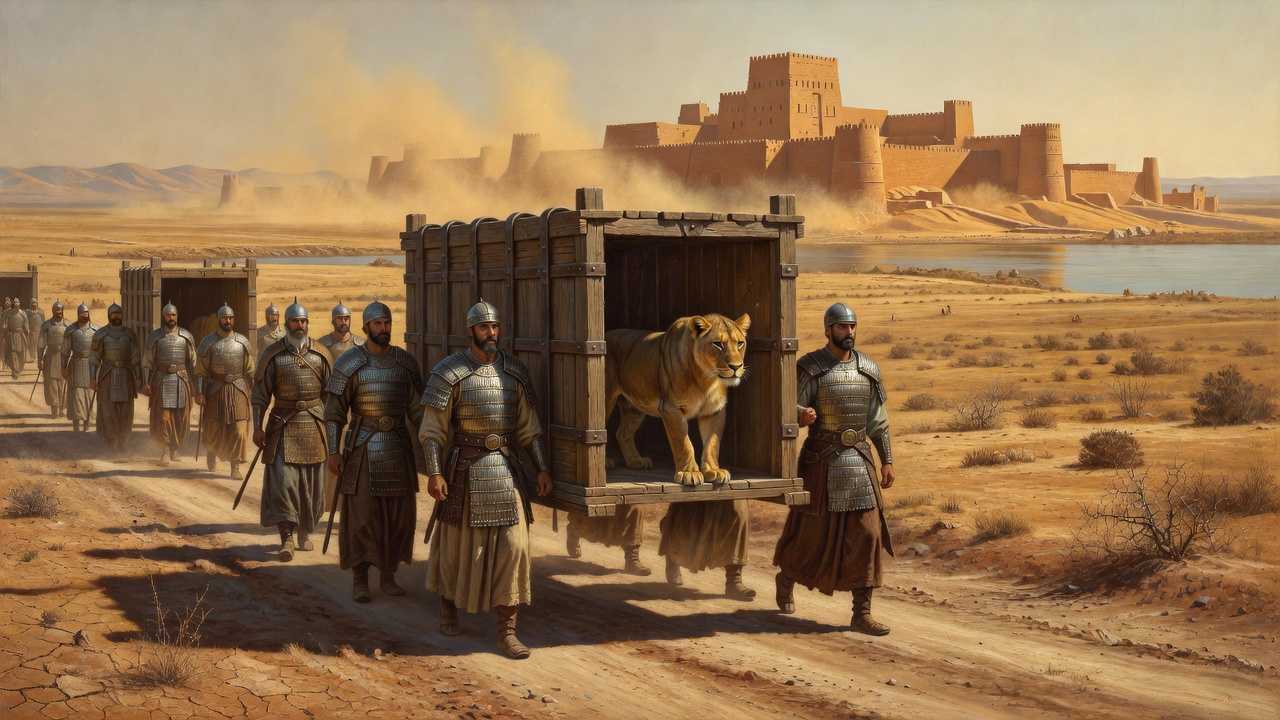
- Ezekiel frames this funeral song as an allegory of a mother lioness rearing her cubs. The first cub learns to tear prey but is captured with hooks and brought to Egypt, while the second cub is trapped in a net, placed in a cage, and led into captivity before the king of Babylon.Sources: the Bible text itself · Egypt · Babylon
- The second half of the lament compares the royal line to a flourishing vine planted beside abundant waters, bearing strong branches fit for rulers' scepters. It depicts the vine being uprooted in fury, scorched by the east wind, consumed by fire, and transplanted into a parched wilderness.Sources: the Bible text itself
Notes written with AI assistance from open sources (Theographic Bible Metadata, CC BY-SA 4.0; Easton’s Bible Dictionary, public domain) and reviewed before publishing.
Places in this chapter
Only places identified with high confidence are shown (90% or more according to the scholarly sources compiled by OpenBible). Period map: DARE (Digital Atlas of the Roman Empire), CC BY 4.0; modern map: © OpenStreetMap contributors; places: OpenBible.info (CC BY 4.0).
Credits and license for this translation
LXX2012: Septuagint in American English 2012
The Septuagint with Apocrypha, translated from Greek to English by Sir Lancelot C. L. Brenton and published in 1885, with some language updates (American English)
Public Domain
Language: English
Dialect (if applicable): American
Language in English: English
Translation by:
Sir Lancelot Charles Lee Brenton
Michael Paul Johnson
LXX2012: Septuagint in English 2012
This is a translation of the Old Testament and Apocrypha/Deuterocanon from Hebrew to Greek to 19th Century British English, with some updates of spelling and word usage to contemporary American English. The original English translation was done by Sir Lancelot Charles Lee Brenton and published by Samuel Bagster & Sons, Ltd., in London in 1851. It has entered the Public Domain due to the passage of sufficient time. In the process of scanning and typing the text, the original poetry and prose formatting, as well as peripheral material like introductions and notes, have been omitted.
This edition of the Septuagint has some language updates. Brenton's word order and punctuation has been mostly retained, meaning that quotation marks are not used, and sentences within quotes may not start with capital letters, as was standard usage in 1851. Names transliterated from Greek to those transliterated from Hebrew in the common English Bibles often differ. These language updates are dedicated to the Public Domain by the author of those edits, Michael Paul Johnson. Therefore this edition may be freely copied, published, etc.
Before considering making changes to the text of this work, I recommend that you consult with God, because this is really His Book.
If you find errors in the text, please report them so that we can correct them.
Donations to help with the expenses of operating this web site and thus help others have free access to the Word of God may be made to us, but are not required. Please see http://MLJohnson.org/partner/ for more about that.
Section headings adapted from the Berean Standard Bible (public domain); they are not part of this translation’s text.
Source: http://ebible.org/eng-lxx2012/ · eBible.org