Ezekiel 17
LXX2012: Septuagint in American English 2012 · Tap a verse to see its cross-references.
The Parable of Two Eagles and a Vine
1And the word of the Lord came to me, saying, 2Son of man, relate a tale, and speak a parable to the house of Israel: 3and you shall say, Thus says the Lord; A great eagle with large wings, spreading them out very far, with many claws, which has the design of entering into Libanus—and he took the choice branches of the cedar: 4he cropped off the ends of the tender twigs, and brought them into the land of Chanaan; he laid them up in a walled city. 5And he took of the seed of the land, and sowed it in a field planted by much water; he set it in a conspicuous place. 6And it sprang up, and became a weak and little vine, so that the branches thereof appeared upon it, and its roots were under it: and it became a vine, and put forth shoots, and sent forth its tendrils. 7And there was another great eagle, with great wings and many claws: and, behold, this vine bent itself round toward him, and her roots were turned towards him, and she sent forth her branches towards him, that he might water her together with the growth of her plantation. 8She thrives in a fair field by much water, to produce shoots and bear fruit, that she might become a great vine. 9Therefore say, Thus says the Lord; Shall it prosper? shall not the roots of her tender stem and her fruit be blighted? yes, all her early shoots shall be dried up, and that not by a mighty arm, nor by many people, to tear her up from her roots. 10And, behold, it thrives: shall it prosper? shall it not wither as soon as the east wind touches it? it shall be withered together with the growth of its shoots.
The Parable Explained
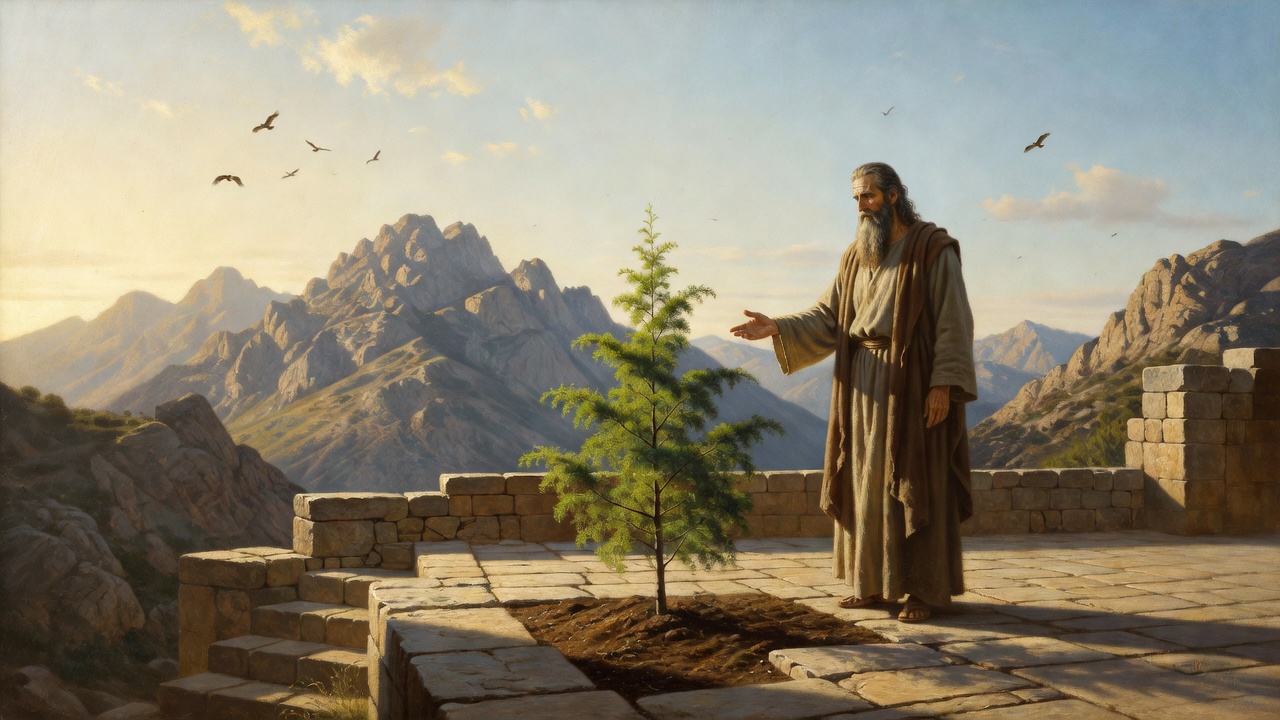
11Moreover the word of the Lord came to me saying, 12Son of man, say now to the provoking house, Know you⌃ not what these things were? say to them, Whenever the king of Babylon shall come against Jerusalem, then he shall take her king and her princes, and shall take them home to Babylon. 13And he shall take of the seed royal, and shall make a covenant with him, and shall bind him with an oath: and he shall take the princes of the land: 14that it may become a weak kingdom, so as never to lift itself up, that he may keep his covenant, and establish it. 15And if he shall revolt from him, to send his messengers into Egypt, that they may give him horses and much people; shall he prosper? shall he that acts as an adversary be preserved? and shall he that transgresses the covenant be preserved? 16As I live, says the Lord, verily in the place where the king is that made him king, who dishonored my oath, and who broke my covenant, shall he die with him in the midst of Babylon. 17And Pharaoh shall make war upon him not with a large force or great multitude, in throwing up a mound, and in building of forts, to cut off souls. 18Whereas he has profaned the oath so as to break the covenant, when, behold, I engage his hand, and he has done all these things to him, he shall not escape. 19Therefore say, Thus says the Lord; As I live, surely my oath which he has profaned, and my covenant which he has transgressed, I will even recompense it upon his head. 20And I will spread a net upon him, and he shall be caught in its snare. 21In every battle of his they shall fall by the sword, and I will scatter his remnant to every wind: and you⌃ shall know that I the Lord have spoken it. 22For thus says the Lord; I will even take of the choice branches of the cedar from the top thereof, I will crop off their hearts, and I will plant it on a high mountain: 23and I will hang it on a lofty mountain of Israel: yes, I will plant it, and it shall put forth shoots, and shall bear fruit, and it shall be a great cedar: and every bird shall rest beneath it, even every fowl shall rest under its shadow: its branches shall be restored. 24And all the trees of the field shall know that I am the Lord that bring low the high tree, and exalt the low tree, and wither the green tree, and cause the dry tree to flourish: I the Lord have spoken, and will do it.
Did you know?
The Parable of the Eagles and the Cedar
- Ezekiel presents a political allegory where the first great eagle represents the king of Babylon, who captured Jerusalem's royal leadership and established a vassal king under a solemn covenant. The second eagle represents Egypt and its Pharaoh, to whom the Judean ruler turned for cavalry and military assistance in defiance of his sworn allegiance.Sources: the Bible text itself · Babylon · Egypt · Pharaoh
- In the prophetic message, breaking a political vassal oath made under Babylon was treated not merely as diplomatic rebellion, but as spiritual treason against God, who regarded the sworn pledge as His own oath.Sources: the Bible text itself
- The chapter concludes with a reversal of human political schemes: God Himself promises to take a tender shoot from the top of the cedar and plant it upon the mountain heights of Israel, where it will grow into a majestic tree offering shelter to birds of every kind.Sources: the Bible text itself
Notes written with AI assistance from open sources (Theographic Bible Metadata, CC BY-SA 4.0; Easton’s Bible Dictionary, public domain) and reviewed before publishing.
Places in this chapter
- Lebanon · 33.540, 35.584 · verse 3
- Canaan · 32.767, 35.333 · verse 4
- Babylon · 32.543, 44.422 · verses 12, 14, 15, 16, 17, 20
- Jerusalem · 31.777, 35.234 · verses 12, 17
- Egypt · 30.129, 31.308 · verse 15
Only places identified with high confidence are shown (90% or more according to the scholarly sources compiled by OpenBible). Period map: DARE (Digital Atlas of the Roman Empire), CC BY 4.0; modern map: © OpenStreetMap contributors; places: OpenBible.info (CC BY 4.0).
Credits and license for this translation
LXX2012: Septuagint in American English 2012
The Septuagint with Apocrypha, translated from Greek to English by Sir Lancelot C. L. Brenton and published in 1885, with some language updates (American English)
Public Domain
Language: English
Dialect (if applicable): American
Language in English: English
Translation by:
Sir Lancelot Charles Lee Brenton
Michael Paul Johnson
LXX2012: Septuagint in English 2012
This is a translation of the Old Testament and Apocrypha/Deuterocanon from Hebrew to Greek to 19th Century British English, with some updates of spelling and word usage to contemporary American English. The original English translation was done by Sir Lancelot Charles Lee Brenton and published by Samuel Bagster & Sons, Ltd., in London in 1851. It has entered the Public Domain due to the passage of sufficient time. In the process of scanning and typing the text, the original poetry and prose formatting, as well as peripheral material like introductions and notes, have been omitted.
This edition of the Septuagint has some language updates. Brenton's word order and punctuation has been mostly retained, meaning that quotation marks are not used, and sentences within quotes may not start with capital letters, as was standard usage in 1851. Names transliterated from Greek to those transliterated from Hebrew in the common English Bibles often differ. These language updates are dedicated to the Public Domain by the author of those edits, Michael Paul Johnson. Therefore this edition may be freely copied, published, etc.
Before considering making changes to the text of this work, I recommend that you consult with God, because this is really His Book.
If you find errors in the text, please report them so that we can correct them.
Donations to help with the expenses of operating this web site and thus help others have free access to the Word of God may be made to us, but are not required. Please see http://MLJohnson.org/partner/ for more about that.
Section headings adapted from the Berean Standard Bible (public domain); they are not part of this translation’s text.
Source: http://ebible.org/eng-lxx2012/ · eBible.org