Exodus 31
LXX2012: Septuagint in American English 2012 · Tap a verse to see its cross-references.
Bezalel and Oholiab
1And the Lord spoke to Moses, saying, 2Behold, I have called by name Beseleel the son of Urias the son of Or, of the tribe of Juda. 3And I have filled him with a divine spirit of wisdom, and understanding, and knowledge, to invent in every work, 4and to frame works, to labor in gold, and silver, and brass, and blue, and purple, and spun scarlet, 5and works in stone, and for artificers' work in wood, to work at all works. 6And I have appointed him and Eliab the son of Achisamach of the tribe of Dan, and to every one understanding in heart I have given understanding; and they shall make all things as many as I have appointed you, — 7the tabernacle of witness, and the ark of the covenant, and the propitiatory that is upon it, and the furniture of the tabernacle, 8and the altars, and the table and all its furniture, 9and the pure candlestick and all its furniture, and the laver and its base, 10and Aaron's robes of ministry, and the robes of his sons to minister to me as priests, 11and the anointing oil and the compound incense of the sanctuary; according to all that I have commanded you shall they make them.
The Sign of the Sabbath
12And the Lord spoke to Moses, saying, 13Do you also charge the children of Israel, saying, Take heed and keep my sabbaths; for they are a sign with me and among you throughout your generations, that you⌃ may know that I am the Lord that sanctifies you. 14And you⌃ shall keep the sabbaths, because this is holy to the Lord for you; he that profanes it shall surely be put to death: every one who shall do a work on it, that soul shall be destroyed from the midst of his people. 15Six days you shall do works, but the seventh day is the sabbath, a holy rest to the Lord; every one who shall do a work on the seventh day shall be put to death. 16And the children of Israel shall keep the sabbaths, to observe them throughout their generations. 17It is a perpetual covenant with me and the children of Israel, it is a perpetual sign with me; for in six days the Lord made the heaven and the earth, and on the seventh day he ceased, and rested.
Moses Receives the Tablets
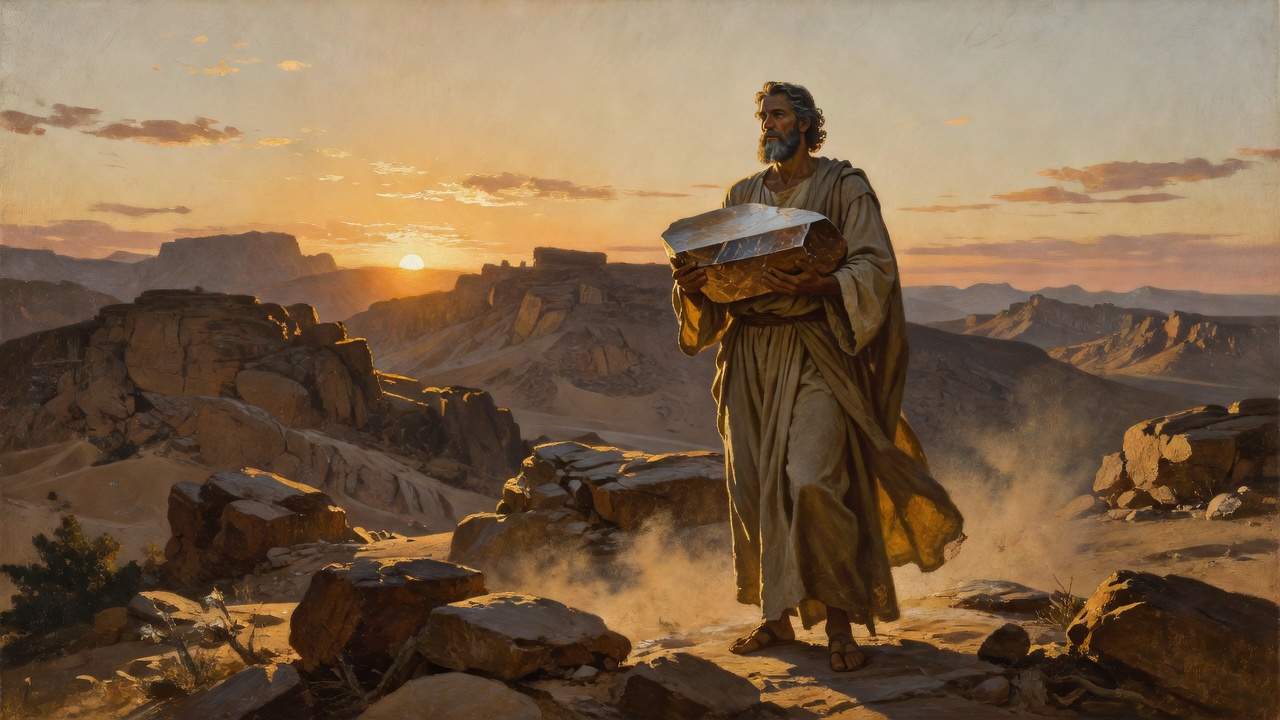
18And he gave to Moses when he left off speaking to him in mount Sina the two tables of testimony, tables of stone written upon with the finger of God.
Did you know?
Master Craftsmen and the Sabbath Sign
- Bezalel from the tribe of Judah and Oholiab from the tribe of Dan were chosen to oversee the construction of the Tabernacle and its sacred furnishings. Bezalel was endowed with craftsmanship in metals, stone carving, and wood, while Oholiab assisted him in crafting the required items and woven textiles.Sources: Bezaleel · Aholiab · the Bible text itself
- Immediately following the detailed instructions for building the sanctuary, God commanded the observance of the Sabbath. Defined as a permanent sign between God and Israel, the weekly day of complete rest echoed the six days of creation and the cessation of work on the seventh day.Sources: the Bible text itself
- At the conclusion of Moses' time on Mount Sinai, he was given the two tablets of the Testimony. These stone tablets contained the divine commandments and were described as inscribed directly by the finger of God.Sources: the Bible text itself · Mount Sinai
Notes written with AI assistance from open sources (Theographic Bible Metadata, CC BY-SA 4.0; Easton’s Bible Dictionary, public domain) and reviewed before publishing.
Credits and license for this translation
LXX2012: Septuagint in American English 2012
The Septuagint with Apocrypha, translated from Greek to English by Sir Lancelot C. L. Brenton and published in 1885, with some language updates (American English)
Public Domain
Language: English
Dialect (if applicable): American
Language in English: English
Translation by:
Sir Lancelot Charles Lee Brenton
Michael Paul Johnson
LXX2012: Septuagint in English 2012
This is a translation of the Old Testament and Apocrypha/Deuterocanon from Hebrew to Greek to 19th Century British English, with some updates of spelling and word usage to contemporary American English. The original English translation was done by Sir Lancelot Charles Lee Brenton and published by Samuel Bagster & Sons, Ltd., in London in 1851. It has entered the Public Domain due to the passage of sufficient time. In the process of scanning and typing the text, the original poetry and prose formatting, as well as peripheral material like introductions and notes, have been omitted.
This edition of the Septuagint has some language updates. Brenton's word order and punctuation has been mostly retained, meaning that quotation marks are not used, and sentences within quotes may not start with capital letters, as was standard usage in 1851. Names transliterated from Greek to those transliterated from Hebrew in the common English Bibles often differ. These language updates are dedicated to the Public Domain by the author of those edits, Michael Paul Johnson. Therefore this edition may be freely copied, published, etc.
Before considering making changes to the text of this work, I recommend that you consult with God, because this is really His Book.
If you find errors in the text, please report them so that we can correct them.
Donations to help with the expenses of operating this web site and thus help others have free access to the Word of God may be made to us, but are not required. Please see http://MLJohnson.org/partner/ for more about that.
Section headings adapted from the Berean Standard Bible (public domain); they are not part of this translation’s text.
Source: http://ebible.org/eng-lxx2012/ · eBible.org