Exodus 26
LXX2012: Septuagint in American English 2012 · Tap a verse to see its cross-references.
The Ten Curtains for the Tabernacle
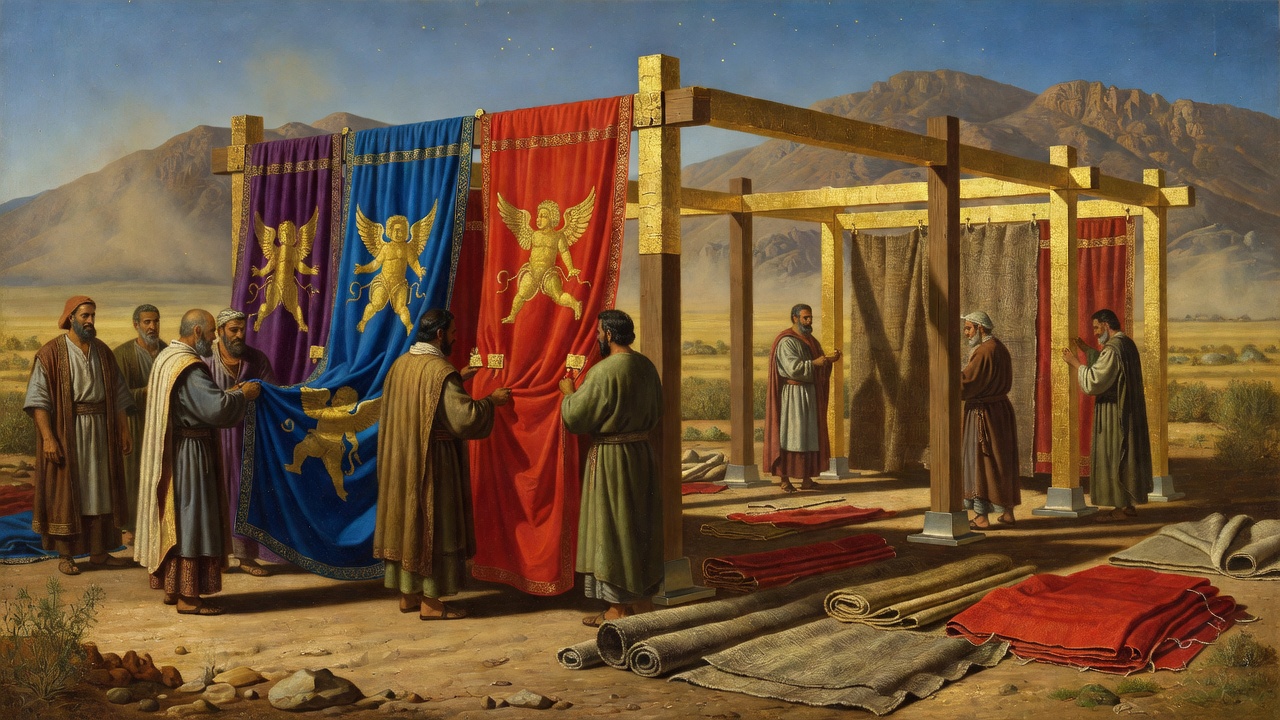
1And you shall make the tabernacle, ten curtains of fine linen spun, and blue and purple, and scarlet spun with cherubs; you shall make them with work of a weaver. 2The length of one curtain shall be eight and twenty cubits, and one curtain shall be the breadth of four cubits: there shall be the same measure to all the curtains. 3And the five curtains shall be joined one to another, and the other five curtains shall be closely connected the one with the other. 4And you shall make for them loops of blue on the edge of one curtain, on one side for the coupling, and so shall you make on the edge of the outer curtain for the second coupling. 5Fifty loops shall you make for one curtain, and fifty loops shall you make on the part of the curtain answering to the coupling of the second, opposite each other, corresponding to each other at each point. 6And you shall make fifty golden rings; and you shall join the curtains to each other with the rings, and it shall be one tabernacle.
The Eleven Curtains of Goat Hair
7And you shall make for a covering of the tabernacle skins with the hair on, you shall make them eleven skins. 8The length of one skin thirty cubits, and the breadth of one skin four cubits: there shall be the same measure to the eleven skins. 9And you shall join the five skins together, and the six skins together; and you shall double the sixth skin in front of the tabernacle. 10And you shall make fifty loops on the border of one skin, which is in the midst for the joinings; and you shall make fifty loops on the edge of the second skin that joins it. 11And you shall make fifty brazen rings; and you shall join the rings by the loops, and you shall join the skins, and they shall be one. 12And you shall fix at the end that which is over in the skins of the tabernacle; the half of the skin that is left shall you fold over, according to the overplus of the skins of the tabernacle; you shall fold it over behind the tabernacle. 13A cubit on this side, and a cubit on that side of that which remains of the skins, of the length of the skins of the tabernacle: it shall be folding over the sides of the tabernacle on this side and that side, that it may cover it. 14And you shall make for a covering of the tabernacle rams' skins dyed red, and blue skins as coverings above.
The Frames and Bases
15And you shall make the posts of the tabernacle of incorruptible wood. 16Of ten cubits shall you make one post, and the breadth of one post of a cubit and a half. 17Two joints shall you make in one post, answering the one to the other: so shall you do to all the posts of the tabernacle. 18And you shall make posts to the tabernacle, twenty posts on the north side. 19And you shall make to the twenty posts forty silver sockets; two sockets to one post on both its sides, and two sockets to the other post on both its sides. 20And for the next side, toward the south, twenty posts, 21and their forty silver sockets: two sockets to one post on both its sides, and two sockets to the other post on both its sides. 22And on the back of the tabernacle at the part which is toward the west you shall make six posts. 23And you shall make two posts on the corners of the tabernacle behind. 24And it shall be equal below, they shall be equal toward the same part from the heads to one joining; so shall you make to both the two corners, let them be equal. 25And there shall be eight posts, and their sixteen silver sockets; two sockets to one post on both its sides, and two sockets to the other post. 26And you shall make bars of incorruptible wood; five to one post on one side of the tabernacle, 27and five bars to one post on the second side of the tabernacle, and five bars to the hinder posts, on the side of the tabernacle toward the sea. 28And let the bar in the middle between the posts go through from the one side to the other side. 29And you shall gild the posts with gold; and you shall make golden rings, into which you shall introduce the bars, and you shall gild the bars with gold. 30And you shall set up the tabernacle according to the pattern showed you in the mount.
The Veil
31And you shall make a veil of blue and purple and scarlet woven, and fine linen spun: you shall make it cherubs in woven work. 32And you shall set it upon four posts of incorruptible wood overlaid with gold; and their tops shall be gold, and their four sockets shall be of silver. 33And you shall put the veil on the posts, and you shall carry in there within the veil the ark of the testimony; and the veil shall make a separation for you between the holy and the holy of holies. 34And you shall screen with the veil the ark of the testimony in the holy of holies. 35And you shall set the table outside the veil, and the candlestick opposite the table on the south side of the tabernacle; and you shall put the table on the north side of the tabernacle.
The Curtain for the Entrance
36And you shall make a screen for the door of the tabernacle of blue, and purple, and spun scarlet and fine linen spun, the work of the embroiderer. 37And you shall make for the veil five posts, and you shall gild them with gold; and their capitals shall be gold; and you shall cast for them five brazen sockets.
Did you know?
The Tabernacle: Coverings, Frame, and Veil
- Exodus 26 prescribes a layered covering for the tabernacle: ten curtains of finely spun linen, with blue, purple, and scarlet yarn and cherubim worked into them, joined by fifty gold clasps. Eleven goat-hair curtains, joined by bronze clasps, were to form the tent over it. A covering of ram skins dyed red was to go over the tent, and over that a covering of fine leather.Sources: the Bible text itself
- The upright frames were to be made of acacia wood, each ten cubits long and a cubit and a half wide, set on silver bases and overlaid with gold, with acacia crossbars likewise overlaid with gold. The tabernacle was to be set up according to the pattern shown on the mountain.Sources: the Bible text itself
- A veil of blue, purple, and scarlet yarn and finely spun linen, with cherubim worked into it, was to separate the Holy Place from the Most Holy Place. The Holy Place, one of the tabernacle's two sections, was twenty cubits long and ten in height and breadth; with no opening to admit light, it was illuminated by the golden candlestick and contained the table of showbread and the golden altar of incense. The temple was arranged in the same way, with a veil dividing its two sections.Sources: the Bible text itself · Holy Place
Notes written with AI assistance from open sources (Theographic Bible Metadata, CC BY-SA 4.0; Easton’s Bible Dictionary, public domain) and reviewed before publishing.
Credits and license for this translation
LXX2012: Septuagint in American English 2012
The Septuagint with Apocrypha, translated from Greek to English by Sir Lancelot C. L. Brenton and published in 1885, with some language updates (American English)
Public Domain
Language: English
Dialect (if applicable): American
Language in English: English
Translation by:
Sir Lancelot Charles Lee Brenton
Michael Paul Johnson
LXX2012: Septuagint in English 2012
This is a translation of the Old Testament and Apocrypha/Deuterocanon from Hebrew to Greek to 19th Century British English, with some updates of spelling and word usage to contemporary American English. The original English translation was done by Sir Lancelot Charles Lee Brenton and published by Samuel Bagster & Sons, Ltd., in London in 1851. It has entered the Public Domain due to the passage of sufficient time. In the process of scanning and typing the text, the original poetry and prose formatting, as well as peripheral material like introductions and notes, have been omitted.
This edition of the Septuagint has some language updates. Brenton's word order and punctuation has been mostly retained, meaning that quotation marks are not used, and sentences within quotes may not start with capital letters, as was standard usage in 1851. Names transliterated from Greek to those transliterated from Hebrew in the common English Bibles often differ. These language updates are dedicated to the Public Domain by the author of those edits, Michael Paul Johnson. Therefore this edition may be freely copied, published, etc.
Before considering making changes to the text of this work, I recommend that you consult with God, because this is really His Book.
If you find errors in the text, please report them so that we can correct them.
Donations to help with the expenses of operating this web site and thus help others have free access to the Word of God may be made to us, but are not required. Please see http://MLJohnson.org/partner/ for more about that.
Section headings adapted from the Berean Standard Bible (public domain); they are not part of this translation’s text.
Source: http://ebible.org/eng-lxx2012/ · eBible.org