Esther 6
LXX2012: Septuagint in American English 2012 · Tap a verse to see its cross-references.
Mordecai Is Honored
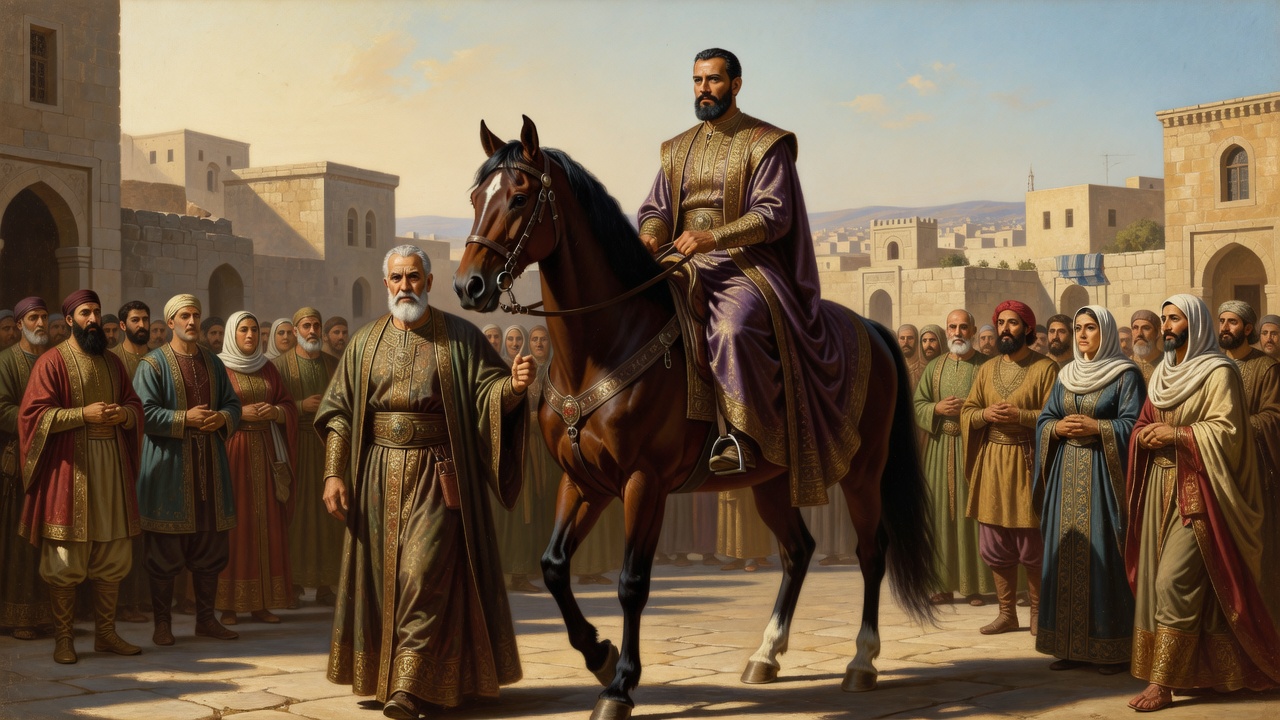
1But the Lord removed sleep from the king that night: and he told his servant to bring in the books, the registers of daily events, to read to him. 2And he found the records written concerning Mardochaeus, how he had told the king concerning the two chamberlains of the king, when they were keeping guard, and sought to lay hands on Artaxerxes. 3And the king said, What honor or favor have we done to Mardochaeus? And the king's servants said, You have not done anything to him. 4And while the king was enquiring about the kindness of Mardochaeus, behold, Aman was in the court. And the king said, Who is in the court? Now Aman was come in to speak to the king, that he should hang Mardochaeus on the gallows, which he had prepared. 5And the king's servants said, Behold, Aman stands in the court. And the king said, Call him. 6And the king said to Aman, What shall I do to the man whom I wish to honor? And Aman said within himself, Whom would the king honor but myself? 7and he said to the king, As for the man whom the king wishes to honor, 8let the king's servants bring the robe of fine linen which the king puts on, and the horse on which the king rides, 9and let him give it to one of the king's noble friends, and let him array the man whom the king loves; and let him mount him on the horse, and proclaim through the street of the city, saying, Thus shall it be done to every man whom the king honors. 10Then the king said to Aman, You have well said: so do to Mardochaeus the Jew, who waits in the palace, and let not a word of what you have spoken be neglected. 11So Aman took the robe and the horse, and arrayed Mardochaeus, and mounted him on the horse, and went through the street of the city, and proclaimed, saying, Thus shall it be to every man whom the king wishes to honor. 12And Mardochaeus returned to the palace: but Aman went home mourning, and having his head covered. 13And Aman related the events that had befallen him to Zosara his wife, and to his friends: and his friends and his wife said to him, If Mardochaeus be of the race of the Jews, and you have begun to be humbled before him, you will assuredly fall, and you will not be able to withstand him, for the living God is with him. 14While they were yet speaking, the chamberlains arrived, to hasten Aman to the banquet which Esther had prepared.
Did you know?
Mordecai Honored and Haman Humbled
- In the Persian court, official royal chronicles recorded daily events and notable services rendered to the crown. When King Ahasuerus suffered a sleepless night and ordered these records read to him, he realized that Mordecai had never received any reward or honor for uncovering the assassination plot organized by the doorkeepers Bigthana and Teresh.Sources: the Bible text itself · Bigthana · Teresh
- The honors Haman suggested—wearing a royal robe the king himself had worn and riding the king's horse led through the city square by a noble official—represented the highest public marks of Persian royal favor. Haman conceived these extravagant honors assuming they were intended for himself, only to be commanded to bestow every detail upon Mordecai.Sources: the Bible text itself · Haman
- Haman had arrived in the outer courtyard of the palace intending to ask the king to hang Mordecai on the gallows he had prepared. Instead, after being forced to parade Mordecai through the city in triumph, Haman returned home in grief, where his wife Zeresh and advisers predicted his complete downfall.Sources: the Bible text itself · Zeresh · Haman
Notes written with AI assistance from open sources (Theographic Bible Metadata, CC BY-SA 4.0; Easton’s Bible Dictionary, public domain) and reviewed before publishing.
Credits and license for this translation
LXX2012: Septuagint in American English 2012
The Septuagint with Apocrypha, translated from Greek to English by Sir Lancelot C. L. Brenton and published in 1885, with some language updates (American English)
Public Domain
Language: English
Dialect (if applicable): American
Language in English: English
Translation by:
Sir Lancelot Charles Lee Brenton
Michael Paul Johnson
LXX2012: Septuagint in English 2012
This is a translation of the Old Testament and Apocrypha/Deuterocanon from Hebrew to Greek to 19th Century British English, with some updates of spelling and word usage to contemporary American English. The original English translation was done by Sir Lancelot Charles Lee Brenton and published by Samuel Bagster & Sons, Ltd., in London in 1851. It has entered the Public Domain due to the passage of sufficient time. In the process of scanning and typing the text, the original poetry and prose formatting, as well as peripheral material like introductions and notes, have been omitted.
This edition of the Septuagint has some language updates. Brenton's word order and punctuation has been mostly retained, meaning that quotation marks are not used, and sentences within quotes may not start with capital letters, as was standard usage in 1851. Names transliterated from Greek to those transliterated from Hebrew in the common English Bibles often differ. These language updates are dedicated to the Public Domain by the author of those edits, Michael Paul Johnson. Therefore this edition may be freely copied, published, etc.
Before considering making changes to the text of this work, I recommend that you consult with God, because this is really His Book.
If you find errors in the text, please report them so that we can correct them.
Donations to help with the expenses of operating this web site and thus help others have free access to the Word of God may be made to us, but are not required. Please see http://MLJohnson.org/partner/ for more about that.
Section headings adapted from the Berean Standard Bible (public domain); they are not part of this translation’s text.
Source: http://ebible.org/eng-lxx2012/ · eBible.org