Ecclesiastes 3
LXX2012: Septuagint in American English 2012 · Tap a verse to see its cross-references.
To Everything There Is a Season
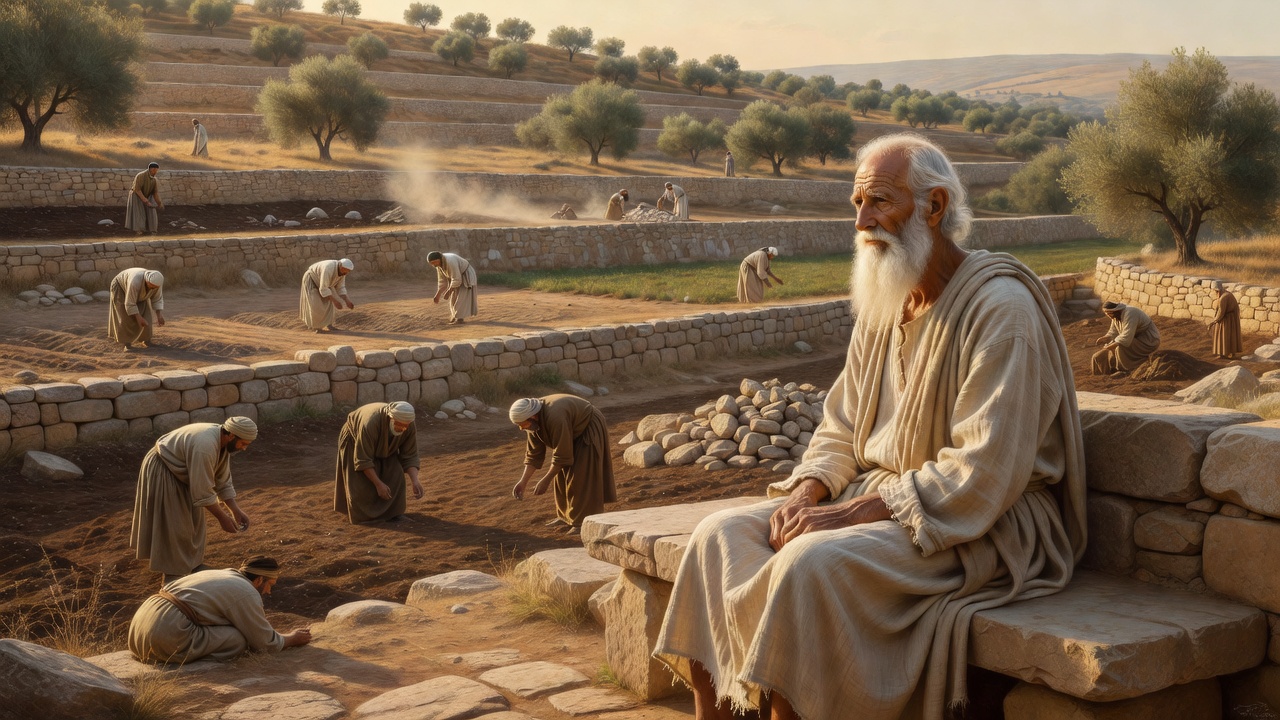
1To all things there is a time, and a season for every matter under heaven. 2A time of birth, and a time to die; a time to plant, and a time to pluck up what has been planted; 3a time to kill, and a time to heal; a time to pull down, and a time to build up; 4a time to weep, and a time to laugh; a time to lament, and a time to dance; 5a time to throw stones, and a time to gather stones together; a time to embrace, and a time to abstain from embracing; 6a time to seek, and a time to lose; a time to keep, and a time to cast away; 7a time to rend, and a time to sew; a time to be silent, and a time to speak; 8a time to love, and a time to hate; a time of war, and a time of peace.
God’s Works Remain Forever
9What advantage has he that works in those things wherein he labors? 10I have seen all the trouble, which God has given to the sons of men to be troubled with. 11All the things which he has made are beautiful in his time: he has also set the whole world in their heart, that man might not find out the work which God has wrought from the beginning even to the end. 12I know that there is no good in them, except for a man to rejoice, and to do good in his life. 13Also in the case of every man who shall eat and drink, and see good in all his labor, this is a gift of God. 14I know that whatever things God has done, they shall be for ever: it is impossible to add to it, and it is impossible to take away from it: and God has done it, that men may fear before him. 15That which has been is now; and whatever things are appointed to be have already been; and God will seek out that which is past.
From Dust to Dust
16And moreover I saw under the sun the place of judgment, there was the ungodly one; and the place of righteousness, there was the godly one. 17And I said in my heart, God will judge the righteous and the ungodly: for there is a time there for every action and for every work. 18I said in my heart, concerning the speech of the sons of man, God will judge them, and that to show that they are beasts. 19Also to them is the event of the sons of man, and the event of the brute; one event befalls them: as is the death of the one, so also the death of the other; and there is one breath to all: and what has the man more than the brute? nothing; for all is vanity. 20All go to one place; all were formed of the dust, and all will return to dust. 21And who has seen the spirit of the sons of man, whether it goes upward? and the spirit of the beast, whether it goes downward to the earth? 22And I saw that there was no good, but that wherein a man shall rejoice in his works, for it is his portion, for who shall bring him to see any thing of that which shall be after him?
Did you know?
A Time for Every Season
- The chapter opens with a famous poem of fourteen pairs of contrasting opposites, spanning birth and death, planting and uprooting, mourning and dancing, and war and peace. This literary structure illustrates the complete spectrum of human experience appointed under heaven.Sources: the Bible text itself
- The author observes that God has placed eternity in the human heart, yet mortals remain unable to fully comprehend what God does from beginning to end.Sources: the Bible text itself
- Reflecting on mortality, the text notes that both humans and beasts return to the dust. In light of this shared physical fate, the Teacher concludes that enjoying one's daily labor, food, and drink is a gift from God.Sources: the Bible text itself
Notes written with AI assistance from open sources (Theographic Bible Metadata, CC BY-SA 4.0; Easton’s Bible Dictionary, public domain) and reviewed before publishing.
Credits and license for this translation
LXX2012: Septuagint in American English 2012
The Septuagint with Apocrypha, translated from Greek to English by Sir Lancelot C. L. Brenton and published in 1885, with some language updates (American English)
Public Domain
Language: English
Dialect (if applicable): American
Language in English: English
Translation by:
Sir Lancelot Charles Lee Brenton
Michael Paul Johnson
LXX2012: Septuagint in English 2012
This is a translation of the Old Testament and Apocrypha/Deuterocanon from Hebrew to Greek to 19th Century British English, with some updates of spelling and word usage to contemporary American English. The original English translation was done by Sir Lancelot Charles Lee Brenton and published by Samuel Bagster & Sons, Ltd., in London in 1851. It has entered the Public Domain due to the passage of sufficient time. In the process of scanning and typing the text, the original poetry and prose formatting, as well as peripheral material like introductions and notes, have been omitted.
This edition of the Septuagint has some language updates. Brenton's word order and punctuation has been mostly retained, meaning that quotation marks are not used, and sentences within quotes may not start with capital letters, as was standard usage in 1851. Names transliterated from Greek to those transliterated from Hebrew in the common English Bibles often differ. These language updates are dedicated to the Public Domain by the author of those edits, Michael Paul Johnson. Therefore this edition may be freely copied, published, etc.
Before considering making changes to the text of this work, I recommend that you consult with God, because this is really His Book.
If you find errors in the text, please report them so that we can correct them.
Donations to help with the expenses of operating this web site and thus help others have free access to the Word of God may be made to us, but are not required. Please see http://MLJohnson.org/partner/ for more about that.
Section headings adapted from the Berean Standard Bible (public domain); they are not part of this translation’s text.
Source: http://ebible.org/eng-lxx2012/ · eBible.org