Deuteronomy 27
LXX2012: Septuagint in American English 2012 · Tap a verse to see its cross-references.
The Altar on Mount Ebal
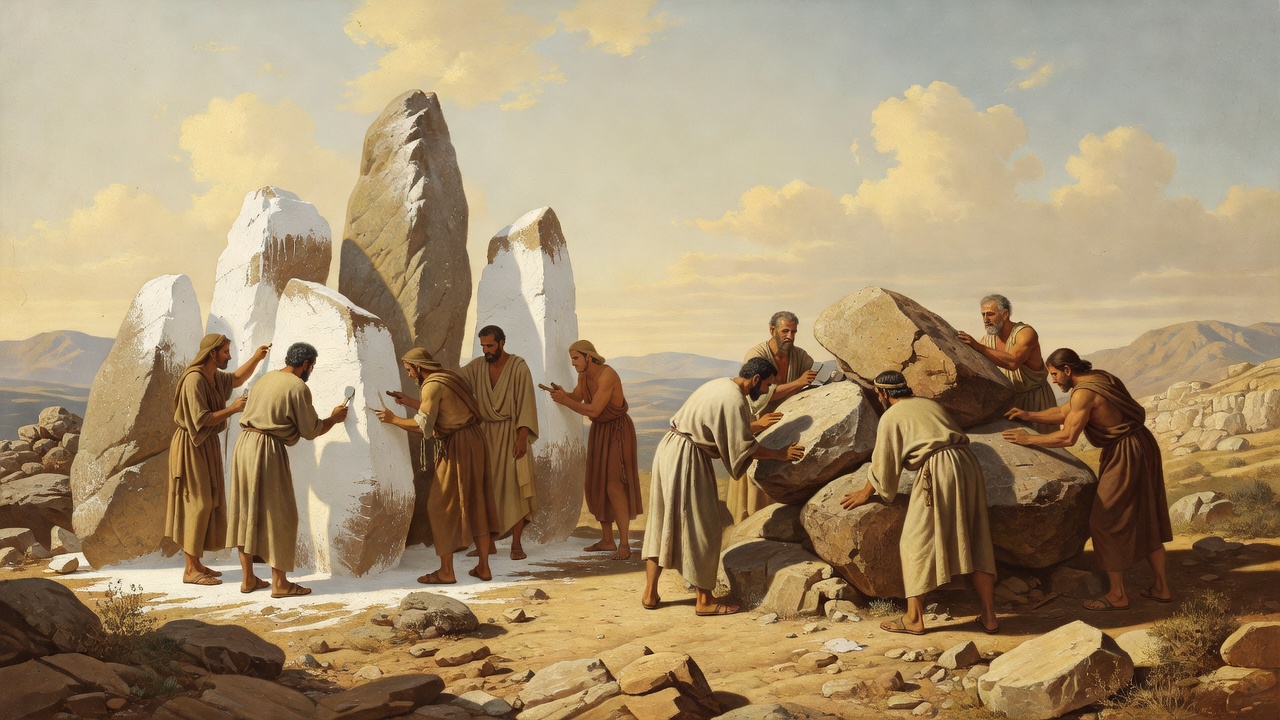
1And Moses and the elders of Israel commanded, saying, Keep all these commands, all that I command you this day. 2And it shall come to pass in the day when you⌃ shall cross over Jordan into the land which the Lord your God gives you, that you shall set up for yourself great stones, and shall plaster them with plaster. 3And you shall write on these stones all the words of this law, as soon as you⌃ have crossed Jordan, when you⌃ are entered into the land, which the Lord God of your fathers gives you, a land flowing with milk and honey, according as the Lord God of your fathers said to you. 4And it shall be as soon as you⌃ are gone over Jordan, you⌃ shall set up these stones, which I command you this day, on mount Gaebal, and you shall plaster them with plaster. 5And you shall build there an altar to the Lord your God, an altar of stones; you shall not lift up iron upon it. 6Of whole stones shall you build an altar to the Lord your God, and you shall offer upon it whole burnt offerings to the Lord your God. 7And you shall there offer a peace-offering; and you shall eat and be filled, and rejoice before the Lord your God. 8And you shall write upon the stones all this law very plainly. 9And Moses and the priests the Levites spoke to all Israel, saying, Be silent and hear, O Israel; this day you are become a people to the Lord your God. 10And you shall listen to the voice of the Lord your God, and shall do all his commands, and his ordinances, as many as I command you this day.
Curses Pronounced from Ebal
11And Moses charged the people on that day, saying, 12These shall stand to bless the people on mount Garizin having gone over Jordan; Symeon, Levi, Judas, Issachar, Joseph, and Benjamin. 13And these shall stand for cursing on mount Gaebal; Ruben, Gad, and Aser, Zabulon, Dan, and Nephthali. 14And the Levites shall answer and say to all Israel with a loud voice, 15Cursed is the man whoever shall make a graven or molten image, an abomination to the Lord, the work of the hands of craftsmen, and shall put it in a secret place: and all the people shall answer and say, So be it. 16Cursed is the man that dishonors his father or his mother: and all the people shall say, So be it. 17Cursed is he that removes his neighbor's landmarks: and all the people shall say, So be it. 18Cursed is he that makes the blind to wander in the way: and all the people shall say, So be it. 19Cursed is every one that shall pervert the judgment of the stranger, and orphan, and widow: and all the people shall say, So be it. 20Cursed is he that lies with his father's wife, because he has uncovered his father's skirt: and all the people shall say, So be it. 21Cursed is he that lies with any beast: and all the people shall say, So be it. 22Cursed is he that lies with his sister by his father or his mother: and all the people shall say, So be it. 23Cursed is he that lies with his daughter-in-law: and all the people shall say, So be it. Cursed is he that lies with his wife's sister: and all the people shall say, So be it. 24Cursed is he that smites his neighbor secretly: and all the people shall say, So be it. 25Cursed is he whoever shall have taken a bribe to kill an innocent man: and all the people shall say, So be it. 26Cursed is every man that continues not in all the words of this law to do them: and all the people shall say, So be it.
Did you know?
The Stones on Mount Ebal and the Curses of the Covenant
- Upon crossing the Jordan, the Israelites were commanded to erect large stones covered in plaster on Mount Ebal and write all the words of the law distinctly upon them. They were also instructed to build an altar there using only uncut stones untouched by any iron tools.Sources: the Bible text itself · Mount Ebal
- The twelve tribes were divided evenly between two facing mountains near Shechem: six tribes stood on Mount Gerizim to pronounce blessings, while the other six stood on Mount Ebal for the pronouncement of curses.Sources: the Bible text itself · Mount Ebal · Mount Gerizim
- The Levites recited a series of specific curses targeted largely at secret violations, such as hidden idolatry, moving boundary stones, mistreating the vulnerable, and concealed violence, to which the entire assembly responded by affirming 'Amen.'Sources: the Bible text itself
Notes written with AI assistance from open sources (Theographic Bible Metadata, CC BY-SA 4.0; Easton’s Bible Dictionary, public domain) and reviewed before publishing.
Places in this chapter
- Jordan · Today: Jordan River · 31.761, 35.558 · verses 2, 4, 12
- Mount Ebal · 32.234, 35.273 · verses 4, 13
- Mount Gerizim · 32.199, 35.273 · verse 12
Only places identified with high confidence are shown (90% or more according to the scholarly sources compiled by OpenBible). Period map: DARE (Digital Atlas of the Roman Empire), CC BY 4.0; modern map: © OpenStreetMap contributors; places: OpenBible.info (CC BY 4.0).
Credits and license for this translation
LXX2012: Septuagint in American English 2012
The Septuagint with Apocrypha, translated from Greek to English by Sir Lancelot C. L. Brenton and published in 1885, with some language updates (American English)
Public Domain
Language: English
Dialect (if applicable): American
Language in English: English
Translation by:
Sir Lancelot Charles Lee Brenton
Michael Paul Johnson
LXX2012: Septuagint in English 2012
This is a translation of the Old Testament and Apocrypha/Deuterocanon from Hebrew to Greek to 19th Century British English, with some updates of spelling and word usage to contemporary American English. The original English translation was done by Sir Lancelot Charles Lee Brenton and published by Samuel Bagster & Sons, Ltd., in London in 1851. It has entered the Public Domain due to the passage of sufficient time. In the process of scanning and typing the text, the original poetry and prose formatting, as well as peripheral material like introductions and notes, have been omitted.
This edition of the Septuagint has some language updates. Brenton's word order and punctuation has been mostly retained, meaning that quotation marks are not used, and sentences within quotes may not start with capital letters, as was standard usage in 1851. Names transliterated from Greek to those transliterated from Hebrew in the common English Bibles often differ. These language updates are dedicated to the Public Domain by the author of those edits, Michael Paul Johnson. Therefore this edition may be freely copied, published, etc.
Before considering making changes to the text of this work, I recommend that you consult with God, because this is really His Book.
If you find errors in the text, please report them so that we can correct them.
Donations to help with the expenses of operating this web site and thus help others have free access to the Word of God may be made to us, but are not required. Please see http://MLJohnson.org/partner/ for more about that.
Section headings adapted from the Berean Standard Bible (public domain); they are not part of this translation’s text.
Source: http://ebible.org/eng-lxx2012/ · eBible.org