Deuteronomy 17
LXX2012: Septuagint in American English 2012 · Tap a verse to see its cross-references.
Detestable Sacrifices
1You shall not sacrifice to the Lord your God a calf or a sheep, in which there is a blemish, or any evil thing; for it is an abomination to the Lord your God.
Purge the Idolater
2And if there should be found in any one of your cities, which the Lord your God gives you, a man or a woman who shall do that which is evil before the Lord your God, so as to transgress his covenant, 3and they should go and serve other gods, and worship them, the sun, or the moon, or any of the host of heaven, which he commanded you not to do, 4and it be told you, and you shall have enquired diligently, and, behold, the thing really took place, this abomination has been done in Israel; 5then shall you bring out that man, or that woman, and you⌃ shall stone them with stones, and they shall die. 6He shall die on the testimony of two or three witnesses; a man who is put to death shall not be put to death for one witness. 7And the hand of the witnesses shall be upon him among the first to put him to death, and the hand of the people at the last; so shall you remove the evil one from among yourselves.
Courts of Law
8And if a matter shall be too hard for you in judgment, between blood and blood, and between cause and cause, and between stroke and stroke, and between contradiction and contradiction, matters of judgment in your cities; 9then you shall arise and go up to the place which the Lord your God shall choose, and you shall come to the priests the Levites, and to the judge who shall be in those days, and they shall search out the matter and report the judgment to you. 10And you shall act according to the thing which they shall report to you out of the place which the Lord your God shall choose, and you shall observe to do all whatever shall have been by law appointed to you. 11You shall do according to the law and to the judgment which they shall declare to you: you shall not swerve to the right hand or to the left from any sentence which they shall report to you. 12And the man whoever shall act in haughtiness, so as not to listen to the priest who stands to minister in the name of the Lord your God, or the judge who shall preside in those days, that man shall die, and you shall remove the evil one out of Israel. 13And all the people shall hear and fear, and shall no more commit impiety.
Guidelines for a King
14And when you shall enter into the land which the Lord your God gives you, and shall inherit it and dwell in it, and shall say, I will set a ruler over me, as also the other nations round about me; 15you shall surely set over you the ruler whom the Lord God shall choose: of your brethren you shall set over you a ruler; you shall not have power to set over you a stranger, because he is not your brother. 16For he shall not multiply to himself horses, and he shall by no means turn the people back to Egypt, lest he should multiply to himself horses; for the Lord said, You⌃ shall not any more turn back by that way. 17And he shall not multiply to himself wives, lest his heart turn away; and he shall not greatly multiply to himself silver and gold. 18And when he shall be established in his government, then shall he write for himself this repetition of the law into a book by the hands of the priests the Levites; 19and it shall be with him, and he shall read in it all the days of his life, that he may learn to fear the Lord your God, and to keep all these commandments, and to observe these ordinances: 20that his heart be not lifted up above his brethren, that he depart not from the commandments on the right hand or on the left; that he and his sons may reign long in his dominion among the children of Israel.
Did you know?
Justice and the Law of the King
- Legal matters required rigorous standards of evidence, mandating at least two or three witnesses for a capital conviction, with the witnesses required to cast the first stones. Difficult legal disputes over bloodshed, civil lawsuits, or assaults were escalated to a central tribunal composed of the Levitical priests and the presiding judge.Sources: the Bible text itself
- Anticipating Israel's desire for a monarchy, the text establishes strict boundaries for a king: he had to be a fellow Israelite and was prohibited from accumulating vast numbers of horses, sending people back to Egypt for trade, taking many wives, or hoarding excessive silver and gold.Sources: the Bible text itself · Egypt
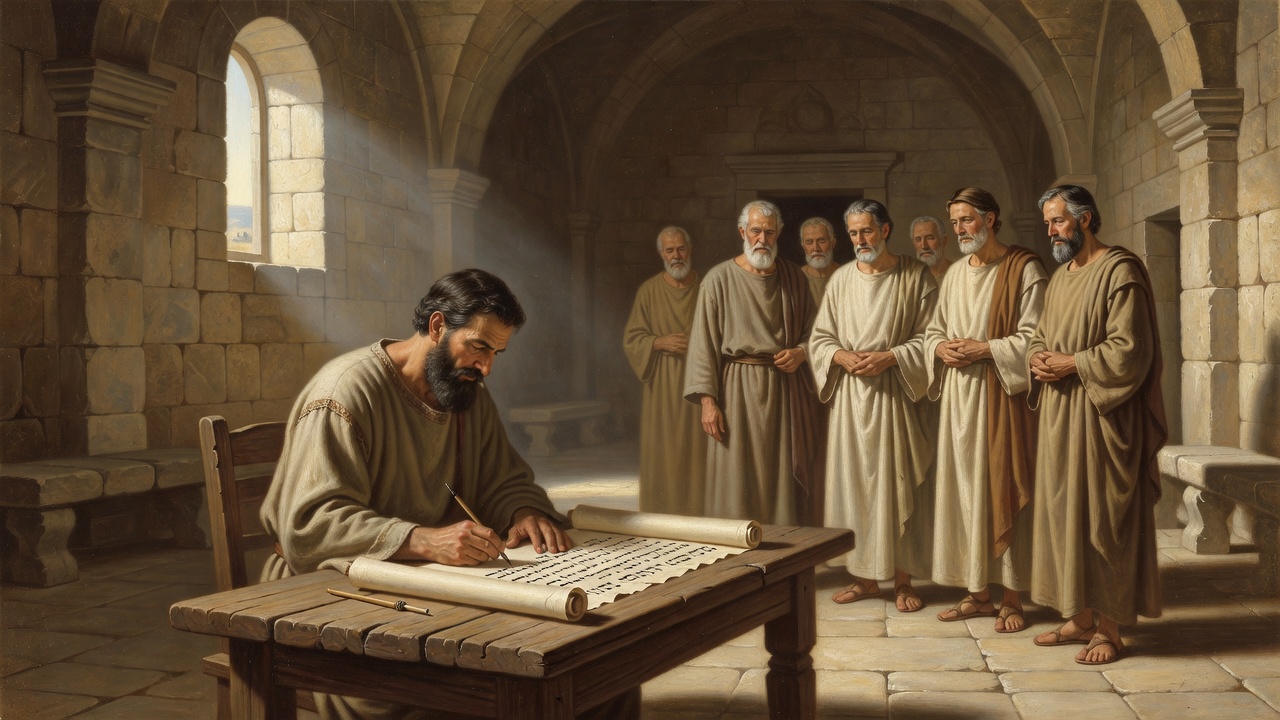
- Upon taking the throne, an Israelite king was required to write his own personal copy of the law on a scroll in the presence of the Levitical priests. He was instructed to read it daily throughout his life so that he would remain obedient to God and not view himself as superior to his countrymen.Sources: the Bible text itself
Notes written with AI assistance from open sources (Theographic Bible Metadata, CC BY-SA 4.0; Easton’s Bible Dictionary, public domain) and reviewed before publishing.
Places in this chapter
- Egypt · 30.129, 31.308 · verse 16
Only places identified with high confidence are shown (90% or more according to the scholarly sources compiled by OpenBible). Period map: DARE (Digital Atlas of the Roman Empire), CC BY 4.0; modern map: © OpenStreetMap contributors; places: OpenBible.info (CC BY 4.0).
Credits and license for this translation
LXX2012: Septuagint in American English 2012
The Septuagint with Apocrypha, translated from Greek to English by Sir Lancelot C. L. Brenton and published in 1885, with some language updates (American English)
Public Domain
Language: English
Dialect (if applicable): American
Language in English: English
Translation by:
Sir Lancelot Charles Lee Brenton
Michael Paul Johnson
LXX2012: Septuagint in English 2012
This is a translation of the Old Testament and Apocrypha/Deuterocanon from Hebrew to Greek to 19th Century British English, with some updates of spelling and word usage to contemporary American English. The original English translation was done by Sir Lancelot Charles Lee Brenton and published by Samuel Bagster & Sons, Ltd., in London in 1851. It has entered the Public Domain due to the passage of sufficient time. In the process of scanning and typing the text, the original poetry and prose formatting, as well as peripheral material like introductions and notes, have been omitted.
This edition of the Septuagint has some language updates. Brenton's word order and punctuation has been mostly retained, meaning that quotation marks are not used, and sentences within quotes may not start with capital letters, as was standard usage in 1851. Names transliterated from Greek to those transliterated from Hebrew in the common English Bibles often differ. These language updates are dedicated to the Public Domain by the author of those edits, Michael Paul Johnson. Therefore this edition may be freely copied, published, etc.
Before considering making changes to the text of this work, I recommend that you consult with God, because this is really His Book.
If you find errors in the text, please report them so that we can correct them.
Donations to help with the expenses of operating this web site and thus help others have free access to the Word of God may be made to us, but are not required. Please see http://MLJohnson.org/partner/ for more about that.
Section headings adapted from the Berean Standard Bible (public domain); they are not part of this translation’s text.
Source: http://ebible.org/eng-lxx2012/ · eBible.org