2 Kings 16
LXX2012: Septuagint in American English 2012 · Tap a verse to see its cross-references.
Ahaz Reigns in Judah
1In the seventeenth year of Phakee son of Romelias began Achaz the son of Joatham king of Juda to reign. 2Twenty years old was Achaz when he began to reign, and he reigned sixteen years in Jerusalem; and he did not that which was right in the eyes of the Lord his God faithfully, as David his father had done. 3And he walked in the way of the kings of Israel, yes, he made his son to pass through the fire, according to the abominations of the heathen whom the Lord cast out from before the children of Israel. 4And he sacrificed and burnt incense on the high places, and upon the hills, and under every shady tree. 5Then went up Raasson king of Syria and Phakee son of Romelias king of Israel against Jerusalem to war, and besieged Achaz, but could not prevail against him. 6At that time Raasson king of Syria recovered Aelath to Syria, and drove out the Jews from Aelath, and the Idumeans came to Aelath, and lived there until this day. 7And Achaz sent messengers to Thalgath-phellasar king of the Assyrians, saying, I am your servant and your son: come up, deliver me out of the hand of the king of Syria, and out of the hand of the king of Israel, who are rising up against me. 8And Achaz took the silver and the gold that was found in the treasures of the house of the Lord, and of the king's house, and sent gifts to the king. 9And the king of the Assyrians listened to him: and the king of the Assyrians went up to Damascus and took it, and removed the inhabitants, and killed king Raasson.
The Idolatry of Ahaz
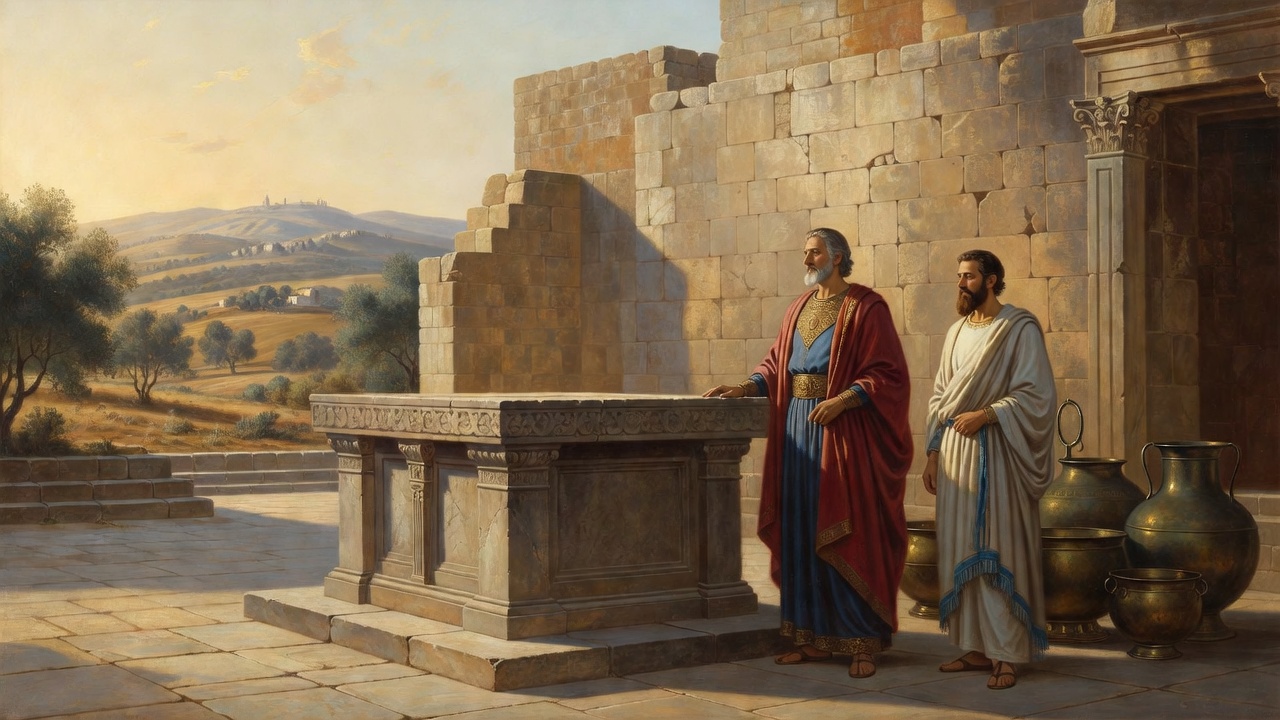
10And king Achaz went to Damascus to meet Thalgath-phellasar king of the Assyrians at Damascus; and he saw an altar at Damascus. And king Achaz sent to Urias the priest the pattern of the altar, and its proportions, and all its workmanship. 11And Urias the priest built the altar, according to all the directions which king Achaz sent from Damascus. 12And the king saw the altar, and went up to it, 13and offered his whole burnt offering, and his meat-offering, and his drink-offering, and poured out the blood of his peace-offerings on the brazen altar that was before the Lord. 14And he brought forward the one before the house of the Lord from between the altar and the house of the Lord, and he set it openly by the side of the altar northwards. 15And king Achaz charged Urias the priest, saying, Offer upon the great altar the whole burnt offering in the morning and the meat-offering in the evening, and the whole burnt offering of the king, and his meat-offering, and the whole burnt offering of all the people, and their meat-offering, and their drink-offering; and you shall pour all the blood of the whole burnt offering, and all the blood of any other sacrifice upon it: and the brazen altar shall be for me in the morning. 16And Urias the priest did according to all that king Achaz commanded him. 17And king Achaz cut off the borders of the bases, and removed the laver from off them, and took down the sea from the brazen oxen that were under it, and set it upon a base of stone. 18And he made a base for the throne in the house of the Lord, and he turned the king's entrance without in the house of the Lord because of the king of the Assyrians. 19And the rest of the acts of Achaz, even all that he did, are not these written in the book of the chronicles of the kings of Juda? 20And Achaz slept with his fathers, and was buried in the city of David: and Ezekias his son reigned in his stead.
Did you know?
The Reign of Ahaz and the Assyrian Alliance
- Facing a military coalition led by King Rezin of Damascus and King Pekah of Israel, King Ahaz stripped silver and gold from the temple and palace treasuries to secure the intervention of Tiglath-pileser, king of Assyria. The Assyrians responded by capturing Damascus, executing Rezin, and deporting its population to Kir.Sources: the Bible text itself · Ahaz · Rezin · Kir
- While visiting Tiglath-pileser in Damascus, Ahaz was impressed by an altar there and sent detailed architectural plans to Uriah the priest in Jerusalem. Uriah constructed the replica in the temple courtyard before the king returned, where it took over the central sacrificial duties from the original bronze altar.Sources: the Bible text itself · Urijah · Damascus
Notes written with AI assistance from open sources (Theographic Bible Metadata, CC BY-SA 4.0; Easton’s Bible Dictionary, public domain) and reviewed before publishing.
Places in this chapter
- Jerusalem · 31.777, 35.234 · verses 2, 5
- Syria · Today: Aram · 33.511, 36.306 · verses 5, 6, 7
- Edom · 30.746, 35.604 · verse 6
- Assyria · 36.359, 43.153 · verses 7, 8, 9, 10, 18
- Damascus · 33.511, 36.306 · verses 9, 10, 11, 12
- City of David · 31.774, 35.236 · verse 20
Only places identified with high confidence are shown (90% or more according to the scholarly sources compiled by OpenBible). Period map: DARE (Digital Atlas of the Roman Empire), CC BY 4.0; modern map: © OpenStreetMap contributors; places: OpenBible.info (CC BY 4.0).
Credits and license for this translation
LXX2012: Septuagint in American English 2012
The Septuagint with Apocrypha, translated from Greek to English by Sir Lancelot C. L. Brenton and published in 1885, with some language updates (American English)
Public Domain
Language: English
Dialect (if applicable): American
Language in English: English
Translation by:
Sir Lancelot Charles Lee Brenton
Michael Paul Johnson
LXX2012: Septuagint in English 2012
This is a translation of the Old Testament and Apocrypha/Deuterocanon from Hebrew to Greek to 19th Century British English, with some updates of spelling and word usage to contemporary American English. The original English translation was done by Sir Lancelot Charles Lee Brenton and published by Samuel Bagster & Sons, Ltd., in London in 1851. It has entered the Public Domain due to the passage of sufficient time. In the process of scanning and typing the text, the original poetry and prose formatting, as well as peripheral material like introductions and notes, have been omitted.
This edition of the Septuagint has some language updates. Brenton's word order and punctuation has been mostly retained, meaning that quotation marks are not used, and sentences within quotes may not start with capital letters, as was standard usage in 1851. Names transliterated from Greek to those transliterated from Hebrew in the common English Bibles often differ. These language updates are dedicated to the Public Domain by the author of those edits, Michael Paul Johnson. Therefore this edition may be freely copied, published, etc.
Before considering making changes to the text of this work, I recommend that you consult with God, because this is really His Book.
If you find errors in the text, please report them so that we can correct them.
Donations to help with the expenses of operating this web site and thus help others have free access to the Word of God may be made to us, but are not required. Please see http://MLJohnson.org/partner/ for more about that.
Section headings adapted from the Berean Standard Bible (public domain); they are not part of this translation’s text.
Source: http://ebible.org/eng-lxx2012/ · eBible.org