2 Chronicles 28
LXX2012: Septuagint in American English 2012 · Tap a verse to see its cross-references.
Ahaz Reigns in Judah
1Achaz was five and twenty years old when he began to reign, and he reigned sixteen years in Jerusalem: and he did not that which was right in the sight of the Lord, as David his father. 2But he walked in the ways of the kings of Israel, for he made graven images. 3And he sacrificed to their idols in the valley of Benennom, and passed his children through the fire, according to the abominations of the heathen, whom the Lord cast out from before the children of Israel. 4And he burnt incense upon the high places, and upon the roofs, and under every shady tree.
Aram Defeats Judah
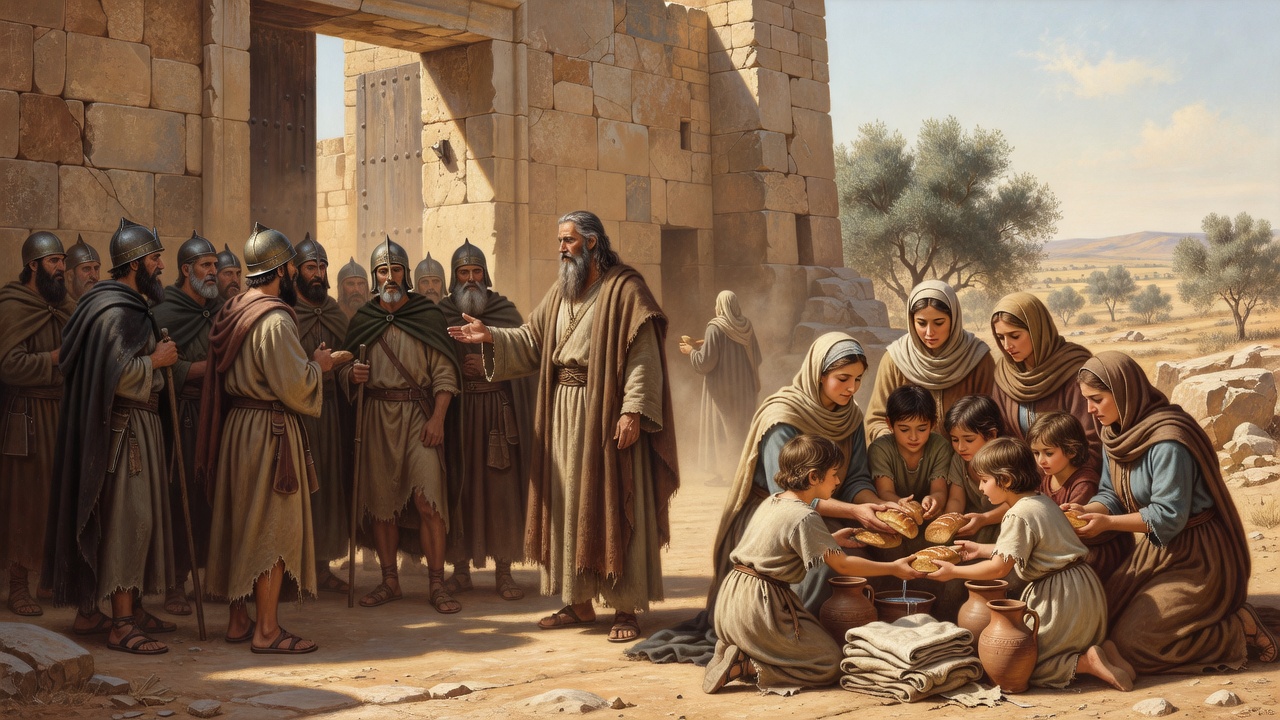
5And the Lord his God delivered him into the hand of the king of Syria; and he struck him, and took captive of them a great band of prisoners, and carried him to Damascus. Also God delivered him into the hands of the king of Israel, who struck him with a great slaughter. 6And Phakee the son of Romelias king of Israel, killed in Juda in one day one hundred and twenty thousand mighty men; because they had forsaken the Lord God of their fathers. 7And Zechri, a mighty man of Ephraim, killed Maasias the king's son, and Ezrican the chief of his house, and Elcana the king's deputy. 8And the children of Israel took captive of their brethren three hundred thousand, women, and sons, and daughters, and they spoiled them of much property, and brought the spoils to Samaria. 9And there was there a prophet of the Lord, his name was Oded: and he went out to meet the host that were coming to Samaria, and said to them, Behold, the wrath of the Lord God of your fathers is upon Juda, and he has delivered them into your hands, and you⌃ have slain them in wrath, and it has reached even to heaven. 10And now you⌃ talk of keeping the children of Juda and Jerusalem for servants and handmaidens. Behold, am I not with you to testify for the Lord your God? 11And now listen to me, and restore the prisoners of your brethren whom you⌃ have taken: for the fierce anger of the Lord is upon you. 12And the chiefs of the sons of Ephraim rose up, Udias the son of Joanas, and Barachias the son of Mosolamoth, and Ezekias the son of Sellem, and Amasias the son of Eldai, against those that came from the war, 13and said to them, You⌃ shall not bring in hither the prisoners to us, for whereas sin against the Lord is upon us, you⌃ mean to add to our sins, and to our trespass: for our sin is great, and the fierce anger of the Lord is upon Israel. 14So the warriors left the prisoners and the spoils before the princes and all the congregation. 15And the men who were called by name rose up, and took hold of the prisoners, and clothed all the naked from the spoils, and gave them garments and shoes, and gave them food to eat, and oil to anoint themselves with, and they helped also every one that was weak with asses, and placed them in Jericho, the city of palm-trees, with their brethren; and they returned to Samaria.
The Idolatry of Ahaz
16At that time king Achaz sent to the king of Assyria to help him, and on this occasion, 17because the Idumeans had attacked him, and struck Juda, and taken a number of prisoners. 18Also the Philistines had made an attack on the cities of the plain country, and the cities of the south of Juda, and taken Baethsamys, and the things in the house of the Lord, and the things in the house of the king, and of the princes: and they gave to the king Aelon, and Galero, and Socho and her villages, and Thamna and her villages, and Gamzo and her villages: and they lived there. 19For the Lord humbled Juda because of Achaz king of Juda, because he grievously departed from the Lord. 20And there came against him Thalgaphellasar king of Assyria, and he afflicted him. 21And Achaz took the things that were in the house of the Lord, and the things in the house of the king, and of the princes, and gave them to the king of Assyria: but he was no help to him, 22but only troubled him in his affliction: and he departed yet more from the Lord, and king Achaz said, 23I will seek after the gods of Damascus that strike me. And he said, Forasmuch as the gods of the king of Syria themselves strengthen them, therefore will I sacrifice to them, and they will help me. But they became a stumbling block to him, and to all Israel. 24And Achaz removed the vessels of the house of the Lord, and cut them in pieces, and shut the doors of the house of the Lord, and made to himself altars in every corner in Jerusalem: 25and in each several city in Juda he made high places to burn incense to strange gods: and they provoked the Lord God of their fathers. 26And the rest of his acts, and his deeds, the first and the last, behold, they are written in the book of the kings of Juda and Israel. 27And Achaz slept with his fathers, and was buried in the city of David; for they did not bring him into the sepulchres of the kings of Israel: and Ezekias his son reigned in his stead.
Did you know?
The Reign and Crises of King Ahaz
- After the northern kingdom of Israel defeated Judah and brought 200,000 captives to Samaria, a prophet named Oded and several Ephraimite leaders intervened. Reminding the army that the captives were their kinsmen, they refused to enslave them, provided them with food, clothes, and donkeys, and escorted them safely back to Jericho.Sources: the Bible text itself
- Pressured by invasions from Aram, Israel, Edom, and the Philistines, King Ahaz sent tribute taken from the temple and royal palace to King Tiglath-pileser of Assyria. Rather than providing lasting support, the Assyrian alliance brought further distress to Judah.Sources: the Bible text itself · Ahaz
- Following military defeats against Damascus, Ahaz began sacrificing to the gods of Aram, reasoning that they had helped his enemies. He went on to cut apart the temple furnishings, shut the doors of the house of the LORD, and erect pagan altars on every street corner of Jerusalem.Sources: the Bible text itself · Ahaz · Damascus
Notes written with AI assistance from open sources (Theographic Bible Metadata, CC BY-SA 4.0; Easton’s Bible Dictionary, public domain) and reviewed before publishing.
Places in this chapter
- Jerusalem · 31.777, 35.234 · verses 1, 10, 24, 27
- Valley of Hinnom · Today: Hinnom Valley · 31.769, 35.228 · verse 3
- Damascus · 33.511, 36.306 · verses 5, 23
- Syria · Today: Aram · 33.511, 36.306 · verses 5, 23
- Samaria · 32.276, 35.195 · verses 8, 9, 15
- City of Palms · Today: Tell es Sultan · 31.872, 35.445 · verse 15
- Jericho · Today: Tell es Sultan · 31.872, 35.445 · verse 15
- Assyria · 36.359, 43.153 · verses 16, 20, 21
- Edom · 30.746, 35.604 · verse 17
- Negeb · 31.245, 34.841 · verse 18
- Shephelah · 31.692, 34.875 · verse 18
- Socoh · Today: Tel Socho · 31.682, 34.975 · verse 18
Only places identified with high confidence are shown (90% or more according to the scholarly sources compiled by OpenBible). Period map: DARE (Digital Atlas of the Roman Empire), CC BY 4.0; modern map: © OpenStreetMap contributors; places: OpenBible.info (CC BY 4.0).
Credits and license for this translation
LXX2012: Septuagint in American English 2012
The Septuagint with Apocrypha, translated from Greek to English by Sir Lancelot C. L. Brenton and published in 1885, with some language updates (American English)
Public Domain
Language: English
Dialect (if applicable): American
Language in English: English
Translation by:
Sir Lancelot Charles Lee Brenton
Michael Paul Johnson
LXX2012: Septuagint in English 2012
This is a translation of the Old Testament and Apocrypha/Deuterocanon from Hebrew to Greek to 19th Century British English, with some updates of spelling and word usage to contemporary American English. The original English translation was done by Sir Lancelot Charles Lee Brenton and published by Samuel Bagster & Sons, Ltd., in London in 1851. It has entered the Public Domain due to the passage of sufficient time. In the process of scanning and typing the text, the original poetry and prose formatting, as well as peripheral material like introductions and notes, have been omitted.
This edition of the Septuagint has some language updates. Brenton's word order and punctuation has been mostly retained, meaning that quotation marks are not used, and sentences within quotes may not start with capital letters, as was standard usage in 1851. Names transliterated from Greek to those transliterated from Hebrew in the common English Bibles often differ. These language updates are dedicated to the Public Domain by the author of those edits, Michael Paul Johnson. Therefore this edition may be freely copied, published, etc.
Before considering making changes to the text of this work, I recommend that you consult with God, because this is really His Book.
If you find errors in the text, please report them so that we can correct them.
Donations to help with the expenses of operating this web site and thus help others have free access to the Word of God may be made to us, but are not required. Please see http://MLJohnson.org/partner/ for more about that.
Section headings adapted from the Berean Standard Bible (public domain); they are not part of this translation’s text.
Source: http://ebible.org/eng-lxx2012/ · eBible.org