1 Kings 1
LXX2012: Septuagint in American English 2012 · Tap a verse to see its cross-references.

About this book
About 1 Kings
- Easton's Bible Dictionary (1897) treats the authorship of the books of Kings as uncertain. A tradition that Jeremiah wrote them is, in Easton's view, supported by passages almost identical with parts of Jeremiah and by events Jeremiah knew personally, yet Easton thinks it more probable that Ezra, after the Captivity, compiled the books from earlier documents, perhaps written by David, Solomon, Nathan, Gad, and Iddo. Easton dates the composition between 561 B.C., when Jehoiachin was released from captivity by Evil-merodach, and 538 B.C., the decree of Cyrus.Sources: Easton: Kings, The Books of
- Easton says these books contain the annals of the kingdom from Solomon's accession until Nebuchadnezzar and the Babylonians subdued it, a period he estimates at about 453 years. 1 Kings opens while David is dying: Adonijah, his fourth son, who had become heir-apparent to the throne after the deaths of Amnon and Absalom, has himself proclaimed king, but Nathan and Bathsheba persuade David to enthrone Solomon at once. Solomon, David's son by Bathsheba, whose history is recorded in 1 Kings 1-11, came to the throne, Easton suggests, at about sixteen or eighteen.Sources: Easton: Kings, The Books of · Adonijah · Solomon
- In the Hebrew Scriptures the two books of Kings originally formed one book; the Septuagint first divided them and, with the Vulgate, numbers them as the third and fourth books of Kings, the books of Samuel being the first and second. Easton notes that Chronicles gives greater prominence to the priestly or Levitical office, while Kings gives greater prominence to the royal office, and that in the threefold division of the Scriptures by the Jews these books are ranked among the Prophets. The narrative points to earlier sources: the book of the acts of Solomon and the chronicles of the kings of Judah and of Israel.Sources: Easton: Kings, The Books of
- After Solomon's death the ten tribes revolted and invited Jeroboam, son of Nebat, to be their king; Easton calls him the first king of those tribes and dates his reign from 976 to 945 B.C. He had fled to Egypt under the protection of Shishak I, and later moved his residence from Shechem, his first capital, to Tirzah, which remained the chief residence of Israel's kings until Omri bought the hill of Shomeron from Shemer for two talents of silver and built Samaria. The later narrative includes Ahab, Omri's son and the seventh king of Israel, whose wife was Jezebel: to the calf worship introduced by Jeroboam he added the worship of Baal, and he was severely admonished by the prophet Elijah.Sources: Jeroboam · Tirzah · Samaria · Ahab
Notes written with AI assistance from open sources (Theographic Bible Metadata, CC BY-SA 4.0; Easton’s Bible Dictionary, public domain) and reviewed before publishing.
Abishag Cares for David
1And king David was old and advanced in days, and they covered him with clothes, and he was not warmed. 2And his servants said, Let them seek for the king a young virgin, and she shall wait on the king, and cherish him, and lie with him, and my lord the king shall be warmed. 3So they sought for a fair damsel out of all the coasts of Israel; and they found Abisag the Somanite, and they brought her to the king. 4And the damsel was extremely beautiful, and she cherished the king, and ministered to him, but the king knew her not.
Adonijah Usurps the Kingdom
5And Adonias the son of Aggith exalted himself, saying, I will be king; and he prepared for himself chariots and horses, and fifty men to run before him. 6And his father never at any time checked him, saying, Why have you done thus? and he was also very handsome in appearance, and his mother bore him after Abessalom. 7And he conferred with Joab the son of Saruia, and with Abiathar the priest, and they followed after Adonias. 8But Sadoc the priest, and Banaeas the son of Jodae, and Nathan the prophet, and Semei, and Resi, and the mighty men of David, did not follow Adonias. 9And Adonias sacrificed sheep and calves and lambs by the stone of Zoelethi, which was near Rogel: and he called all his brethren, and all the adult men of Juda, servants of the king. 10But Nathan the prophet, and Banaeas, and the mighty men, and Solomon his brother, he did not call.
Nathan and Bathsheba before David
11And Nathan spoke to Bersabee the mother of Solomon, saying, Have you not heard that Adonias the son of Aggith reigns, and our lord David knows it not? 12And now come, let me, I pray, give you counsel, and you shall rescue your life, and the life of your son Solomon. 13Haste, and go in to king David, and you shall speak to him, saying, Have not you, my lord, O king, sworn to your handmaid, saying, Your son Solomon shall reign after me, and he shall sit upon my throne? why then does Adonias reign? 14And behold, while you are still speaking there with the king, I also will come in after you, and will confirm your words. 15So Bersabee went in to the king into the chamber: and the king was very old, and Abisag the Somanite was ministering to the king. 16And Bersabee bowed, and did obeisance to the king; and the king said, What is your request? 17And she said, My lord, you did swear by the Lord your God to your handmaid, saying, Your son Solomon shall reign after me, and shall sit upon my throne. 18And now, behold, Adonias reigns, and you, my lord, O king, know it not. 19And he has sacrificed calves and lambs and sheep in abundance, and has called all the king's sons, and Abiathar the priest and Joab the commander-in-chief of the host; but Solomon your servant he has not called. 20And you, my lord, O king, —the eyes of all Israel are upon you, to tell them who shall sit upon the throne of my lord the king after him. 21And it shall come to pass, when my lord the king shall sleep with his fathers, that I and Solomon my son shall be offenders. 22And behold, while she was yet talking with the king, Nathan the prophet came. And it was reported to the king, 23Behold, Nathan the prophet is here: and he came in to the king's presence, and did obeisance to the king with his face to the ground. 24And Nathan said, My lord, O king, did you say, Adonias shall reign after me, and he shall sit upon my throne? 25For he has gone down today, and has sacrificed calves and lambs and sheep in abundance, and has called all the king's sons, and the chiefs of the army, and Abiathar the priest; and, behold, they are eating and drinking before him, and they said, Long live king Adonias. 26But he has not invited me your servant, and Sadoc the priest, and Banaeas the son of Jodae, and Solomon your servant. 27Has this matter happened by the authority of my lord the king, and have you not made known to your servant who shall sit upon the throne of my lord the king after him?
David Renews His Oath to Bathsheba
28And king David answered and said, Call me Bersabee: and she came in before the king, and stood before him. 29And the king swore, and said, As the Lord lives who redeemed my soul out of all affliction, 30as I swore to you by the Lord God of Israel, saying, Solomon your son shall reign after me, and he shall sit upon my throne in my stead, so will I do this day. 31And Bersabee bowed with her face to the ground, and did obeisance to the king, and said, Let my lord king David live for ever.
Solomon Anointed King
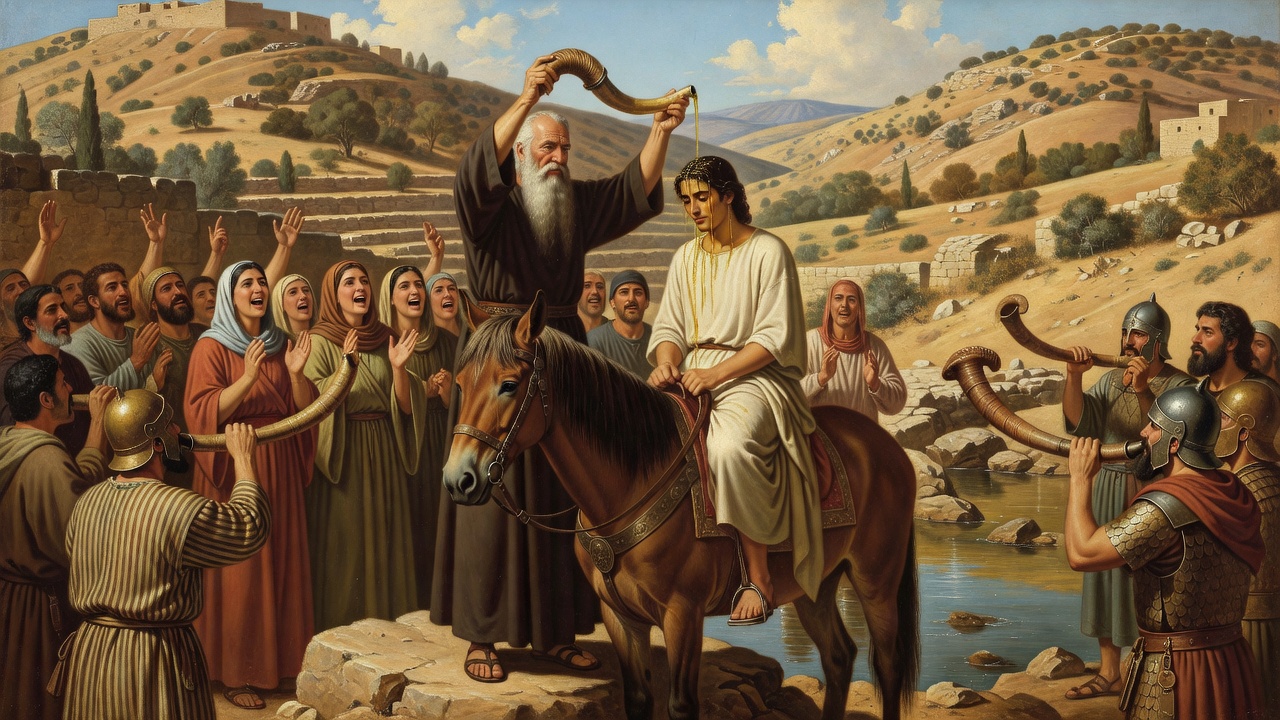
32And king David said, Call me Sadoc the priest, and Nathan the prophet, and Banaeas the son of Jodae: and they came in before the king. 33And the king said to them, Take the servants of your lord with you, and mount my son Solomon upon my own mule, and bring him down to Gion. 34And there let Sadoc the priest and Nathan the prophet anoint him to be king over Israel, and do you⌃ sound the trumpet, and you⌃ shall say, Let king Solomon live. 35And he shall sit upon my throne, and reign in my stead: and I have given charge that he should be for a prince over Israel and Juda. 36And Banaeas the son of Jodae answered the king and said, So let it be: may the Lord God of my lord the king confirm it. 37As the Lord was with my lord the king, so let him be with Solomon, and let him exalt his throne beyond the throne of my lord king David. 38And Sadoc the priest went down, and Nathan the prophet, and Banaeas son of Jodae, and the Cherethite, and the Phelethite, and they mounted Solomon upon the mule of king David, and led him away to Gion. 39And Sadoc the priest took the horn of oil out of the tabernacle, and anointed Solomon, and blew the trumpet; and all the people said, Let king Solomon live. 40And all the people went up after him, and they danced in choirs, and rejoiced with great joy, and the earth quaked with their voice.
Adonijah Learns of Solomon’s Kingship
41And Adonias and all his guests heard, and they had just left off eating: and Joab heard the sound of the trumpet, and said, What means the voice of the city in tumult? 42While he was yet speaking, behold, Jonathan the son of Abiathar the priest came in: and Adonias said, Come in, for you are a mighty man, and you come to bring glad tidings. 43And Jonathan answered and said, Verily our lord king David has made Solomon king: 44and the king has sent with him Sadoc the priest, and Nathan the prophet, and Banaeas the son of Jodae, and the Cherethite, and the Phelethite, and they have mounted him on the king's mule; 45and Sadoc the priest and Nathan the prophet have anointed him in Gion, and have gone up thence rejoicing, and the city resounded: this is the sound which you⌃ have heard. 46And Solomon is seated upon the throne of the kingdom. 47And the servants of the king have gone in to bless our lord king David, saying, God make the name of Solomon better than your name, and make his throne greater than your throne; and the king worshipped upon his bed. 48Moreover thus said the king, Blessed be the Lord God of Israel, who has this day appointed one of my seed sitting on my throne, and my eyes see it. 49And all the guests of Adonias were dismayed, and every man went his way. 50And Adonias feared because of Solomon, and arose, and departed, and laid hold on the horns of the altar. 51And it was reported to Solomon, saying, Behold, Adonias fears king Solomon, and holds the horns of the altar, saying, Let Solomon swear to me this day, that he will not kill his servant with the sword. 52And Solomon said, If he should be a valiant man, there shall not a hair of his fall to the ground; but if evil be found in him, he shall die. 53And king Solomon sent, and they brought him away from the altar; and he went in and did obeisance to king Solomon: and Solomon said to him, Go to your house.
Did you know?
The Succession to David's Throne
- As David's oldest surviving son after the deaths of Amnon and Absalom, Adonijah claimed the royal succession, backed by the military commander Joab and the high priest Abiathar. However, David chose his younger son Solomon, who was supported by the prophet Nathan, the priest Zadok, and the royal bodyguard under Benaiah.Sources: Adonijah · Solomon · the Bible text itself
- Riding the king's own mule was a decisive public declaration of royal authority. By David's explicit instruction, Solomon was escorted down to the spring of Gihon, where Zadok anointed him king with oil taken from the tabernacle to the sound of ram's horns and popular celebration.Sources: Gihon · Zadok · the Bible text itself
- Upon hearing of Solomon's public coronation, Adonijah fled in terror and sought asylum by taking hold of the horns of the sacrificial altar. Solomon granted him conditional clemency, sparing his life so long as he proved himself a worthy man.Sources: Adonijah · the Bible text itself
Notes written with AI assistance from open sources (Theographic Bible Metadata, CC BY-SA 4.0; Easton’s Bible Dictionary, public domain) and reviewed before publishing.
Places in this chapter
- Shunem · Today: Sulam · 32.606, 35.334 · verse 3
- Serpent’s Stone · Today: within 100 m of Bir Ayub · 31.767, 35.236 · verse 9
- Gihon · Today: Gihon Spring · 31.773, 35.236 · verses 33, 38, 44, 45
- Jerusalem · 31.777, 35.234 · verse 40
Only places identified with high confidence are shown (90% or more according to the scholarly sources compiled by OpenBible). Period map: DARE (Digital Atlas of the Roman Empire), CC BY 4.0; modern map: © OpenStreetMap contributors; places: OpenBible.info (CC BY 4.0).
Credits and license for this translation
LXX2012: Septuagint in American English 2012
The Septuagint with Apocrypha, translated from Greek to English by Sir Lancelot C. L. Brenton and published in 1885, with some language updates (American English)
Public Domain
Language: English
Dialect (if applicable): American
Language in English: English
Translation by:
Sir Lancelot Charles Lee Brenton
Michael Paul Johnson
LXX2012: Septuagint in English 2012
This is a translation of the Old Testament and Apocrypha/Deuterocanon from Hebrew to Greek to 19th Century British English, with some updates of spelling and word usage to contemporary American English. The original English translation was done by Sir Lancelot Charles Lee Brenton and published by Samuel Bagster & Sons, Ltd., in London in 1851. It has entered the Public Domain due to the passage of sufficient time. In the process of scanning and typing the text, the original poetry and prose formatting, as well as peripheral material like introductions and notes, have been omitted.
This edition of the Septuagint has some language updates. Brenton's word order and punctuation has been mostly retained, meaning that quotation marks are not used, and sentences within quotes may not start with capital letters, as was standard usage in 1851. Names transliterated from Greek to those transliterated from Hebrew in the common English Bibles often differ. These language updates are dedicated to the Public Domain by the author of those edits, Michael Paul Johnson. Therefore this edition may be freely copied, published, etc.
Before considering making changes to the text of this work, I recommend that you consult with God, because this is really His Book.
If you find errors in the text, please report them so that we can correct them.
Donations to help with the expenses of operating this web site and thus help others have free access to the Word of God may be made to us, but are not required. Please see http://MLJohnson.org/partner/ for more about that.
Section headings adapted from the Berean Standard Bible (public domain); they are not part of this translation’s text.
Source: http://ebible.org/eng-lxx2012/ · eBible.org