Jonah 4
King James Version + Apocrypha · Tap a verse to see its cross-references.
Jonah’s Anger at the LORD’s Compassion
1But it displeased Jonah exceedingly, and he was very angry. 2And he prayed unto the LORD, and said, I pray thee, O LORD, was not this my saying, when I was yet in my country? Therefore I fled before unto Tarshish: for I knew that thou art a gracious God, and merciful, slow to anger, and of great kindness, and repentest thee of the evil. 3Therefore now, O LORD, take, I beseech thee, my life from me; for it is better for me to die than to live.
4¶ Then said the LORD, Doest thou well to be angry?
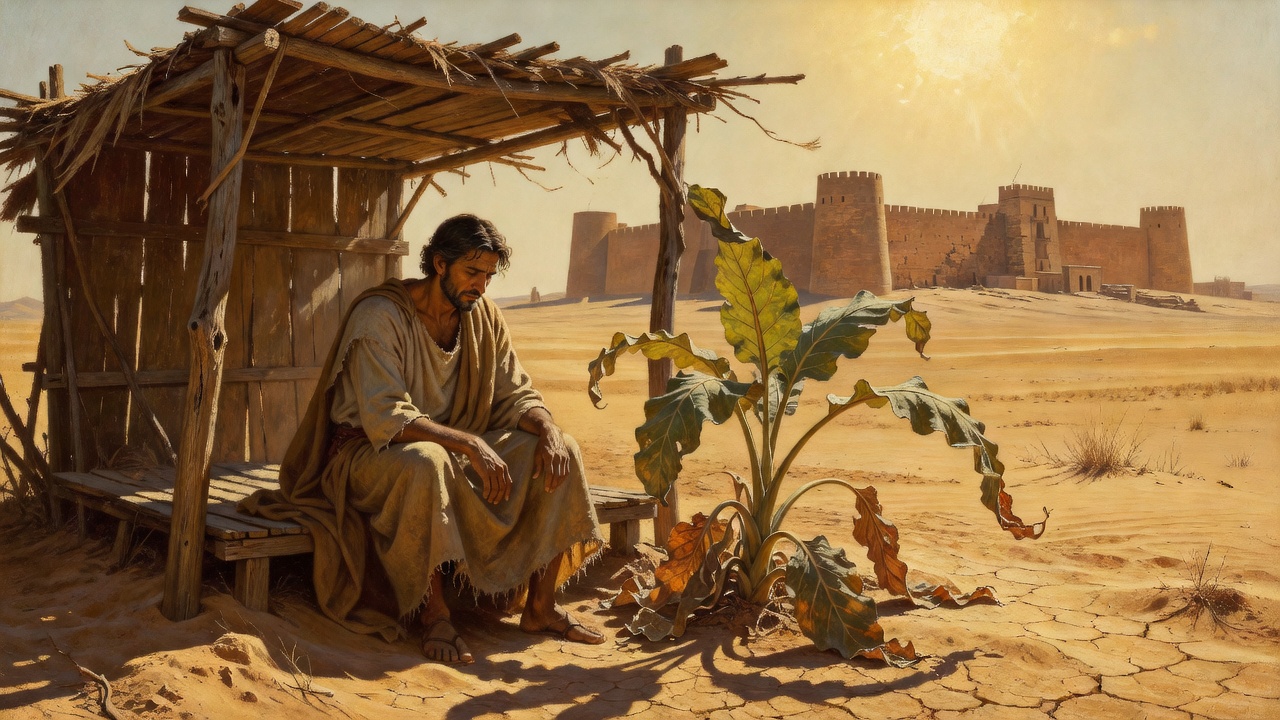
5So Jonah went out of the city, and sat on the east side of the city, and there made him a booth, and sat under it in the shadow, till he might see what would become of the city. 6And the LORD God prepared a gourd, and made it to come up over Jonah, that it might be a shadow over his head, to deliver him from his grief. So Jonah was exceeding glad of the gourd. 7But God prepared a worm when the morning rose the next day, and it smote the gourd that it withered. 8And it came to pass, when the sun did arise, that God prepared a vehement east wind; and the sun beat upon the head of Jonah, that he fainted, and wished in himself to die, and said, It is better for me to die than to live. 9And God said to Jonah, Doest thou well to be angry for the gourd? And he said, I do well to be angry, even unto death. 10Then said the LORD, Thou hast had pity on the gourd, for the which thou hast not laboured, neither madest it grow; which came up in a night, and perished in a night: 11And should not I spare Nineveh, that great city, wherein are more than sixscore thousand persons that cannot discern between their right hand and their left hand; and also much cattle?
Did you know?
Jonah's Anger and God's Compassion
- Jonah admits that he originally attempted to flee toward Tarshish precisely because he knew God is gracious, compassionate, slow to anger, and relents from sending disaster. His distress arose when God chose to spare Nineveh rather than destroy it.Sources: the Bible text itself · Tarshish
- Nineveh, the flourishing capital of the Assyrian empire, is described at the conclusion of the book as home to more than 120,000 people who cannot discern between their right and left hand, along with many cattle. God highlights this massive population to contrast divine compassion with Jonah's concern for a single withered plant.Sources: the Bible text itself · Nineveh
Notes written with AI assistance from open sources (Theographic Bible Metadata, CC BY-SA 4.0; Easton’s Bible Dictionary, public domain) and reviewed before publishing.
Places in this chapter
- Nineveh · 36.359, 43.153 · verse 11
Only places identified with high confidence are shown (90% or more according to the scholarly sources compiled by OpenBible). Period map: DARE (Digital Atlas of the Roman Empire), CC BY 4.0; modern map: © OpenStreetMap contributors; places: OpenBible.info (CC BY 4.0).
Credits and license for this translation
King James Version + Apocrypha
The King James Version or Authorized Version of the Holy Bible, using the standardized text of 1769, with Apocrypha/Deuterocanon
Public Domain
Language: English
Dialect: archaic British
Letters patent issued by King James with no expiration date means that to print this translation in the United Kingdom or import printed copies into the UK, you need permission. Currently, the Cambridge University Press, the Oxford University Press, and Collins have the exclusive right to print this Bible translation in the UK. This royal decree has no effect outside of the UK, where this work is firmly in the Public Domain. Please see http://www.cambridge.org/about-us/who-we-are/queens-printers-patent and https://en.wikipedia.org/wiki/King_James_Version#Copyright_status for more information.
This free text of the King James Version of the Holy Bible is brought to you courtesy of the Crosswire Bible Society and eBible.org .
2026-09-26
Section headings adapted from the Berean Standard Bible (public domain); they are not part of this translation’s text.
Source: http://ebible.org/eng-kjv/ · eBible.org