Psalms 48
American Standard Version (1901) · Tap a verse to see its cross-references.
A Song; a Psalm of the sons of Korah.
Broken Bondage
1Great is Jehovah, and greatly to be praised,
In the city of our God, in his holy mountain.
2Beautiful in elevation, the joy of the whole earth,
Is mount Zion, on the sides of the north,
The city of the great King.
3God hath made himself known in her palaces for a refuge.
4For, lo, the kings assembled themselves,
They passed by together.
5They saw it, then were they amazed;
They were dismayed, they hasted away.
6Trembling took hold of them there,
Pain, as of a woman in travail.
7With the east wind
Thou breakest the ships of Tarshish.
8As we have heard, so have we seen
In the city of Jehovah of hosts, in the city of our God:
God will establish it for ever. [Selah
9We have thought on thy lovingkindness, O God,
In the midst of thy temple.
10As is thy name, O God,
So is thy praise unto the ends of the earth:
Thy right hand is full of righteousness.
11Let mount Zion be glad,
Let the daughters of Judah rejoice,
Because of thy judgments.
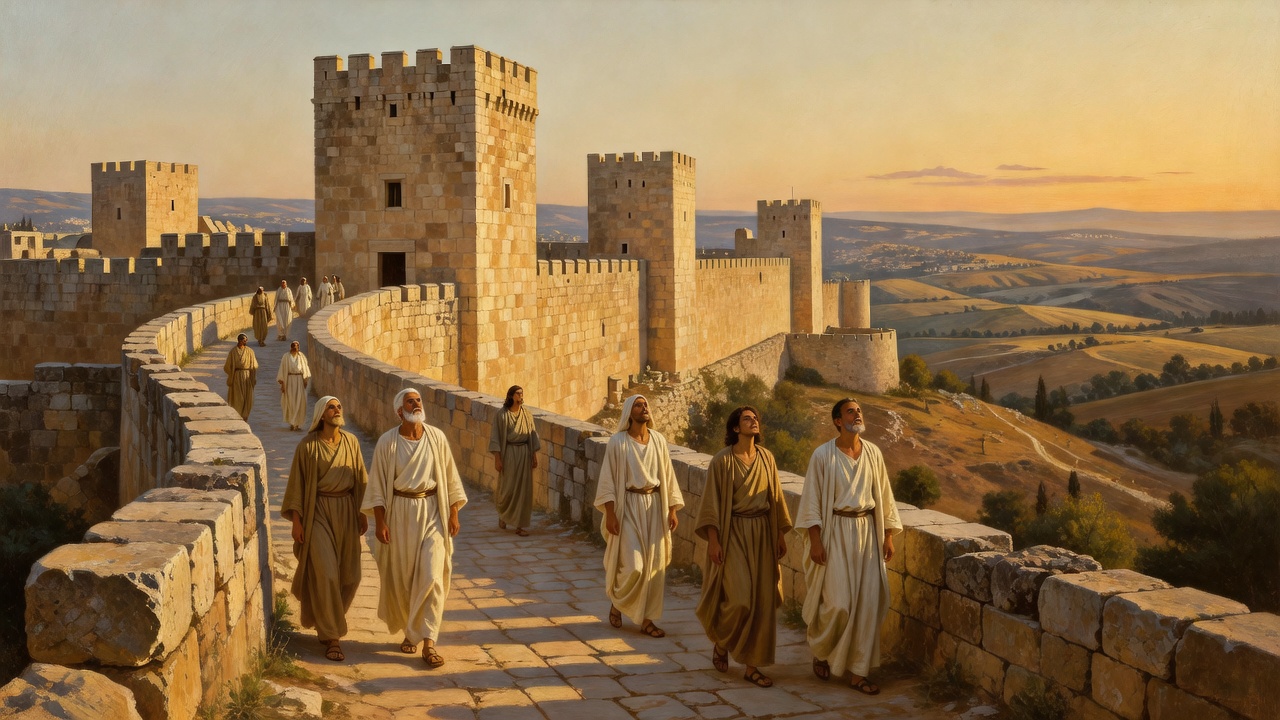
12Walk about Zion, and go round about her;
Number the towers thereof;
13Mark ye well her bulwarks;
Consider her palaces:
That ye may tell it to the generation following.
14For this God is our God for ever and ever:
He will be our guide even unto death.
Did you know?
Zion, the City of the Great King
- Mount Zion, originally the fortified southeastern hill of Jerusalem captured by David from the Jebusites, became known as the City of David and the site of his citadel. In Psalm 48, it is celebrated as God's holy mountain, elevated and fortified against advancing enemy kings.Sources: the Bible text itself · Mount Zion · Zion
- The psalm depicts God's power shattering enemy forces like an east wind wrecking the ships of Tarshish. Many scholars identify Tarshish with a distant Phoenician trading port in southwestern Spain, while other ancient traditions proposed locations such as Carthage or ports in the east.Sources: the Bible text itself · Tarshish
- Worshippers are invited to walk around the perimeter of Zion to inspect its ramparts, count its towers, and view its citadels. This survey of the city's defenses was meant to be recounted to future generations as a witness of God's steadfast protection.Sources: the Bible text itself
Notes written with AI assistance from open sources (Theographic Bible Metadata, CC BY-SA 4.0; Easton’s Bible Dictionary, public domain) and reviewed before publishing.
Places in this chapter
- Mount Zion · 31.772, 35.229 · verses 2, 11
- Zaphon · Today: Jebel Aqra · 35.953, 35.969 · verse 2
- Jerusalem · 31.777, 35.234 · verse 3
- Zion · Today: Jerusalem · 31.777, 35.234 · verse 12
Only places identified with high confidence are shown (90% or more according to the scholarly sources compiled by OpenBible). Period map: DARE (Digital Atlas of the Roman Empire), CC BY 4.0; modern map: © OpenStreetMap contributors; places: OpenBible.info (CC BY 4.0).
Credits and license for this translation
American Standard Version (1901)
The American Standard Version of the Holy Bible, first published in 1901.
Public Domain
Language: English
Dialect: Archaic American
This public domain Bible translation is brought to you courtesy of eBible.org.
If you would like to make a donation to help keep free Bible access like this going, please visit https://eBible.org/give.php .
2026-10-02
Section headings adapted from the Berean Standard Bible (public domain); they are not part of this translation’s text.
Source: http://ebible.org/eng-asv/ · eBible.org