Isaiah 62
American Standard Version (1901) · Tap a verse to see its cross-references.
Zion’s Salvation and New Name
1For Zion’s sake will I not hold my peace, and for Jerusalem’s sake I will not rest, until her righteousness go forth as brightness, and her salvation as a lamp that burneth. 2And the nations shall see thy righteousness, and all kings thy glory, and thou shalt be called by a new name, which the mouth of Jehovah shall name. 3Thou shalt also be a crown of beauty in the hand of Jehovah, and a royal diadem in the hand of thy God. 4Thou shalt no more be termed Forsaken; neither shall thy land any more be termed Desolate: but thou shalt be called Hephzi-bah, and thy land Beulah; for Jehovah delighteth in thee, and thy land shall be married. 5For as a young man marrieth a virgin, so shall thy sons marry thee; and as the bridegroom rejoiceth over the bride, so shall thy God rejoice over thee.
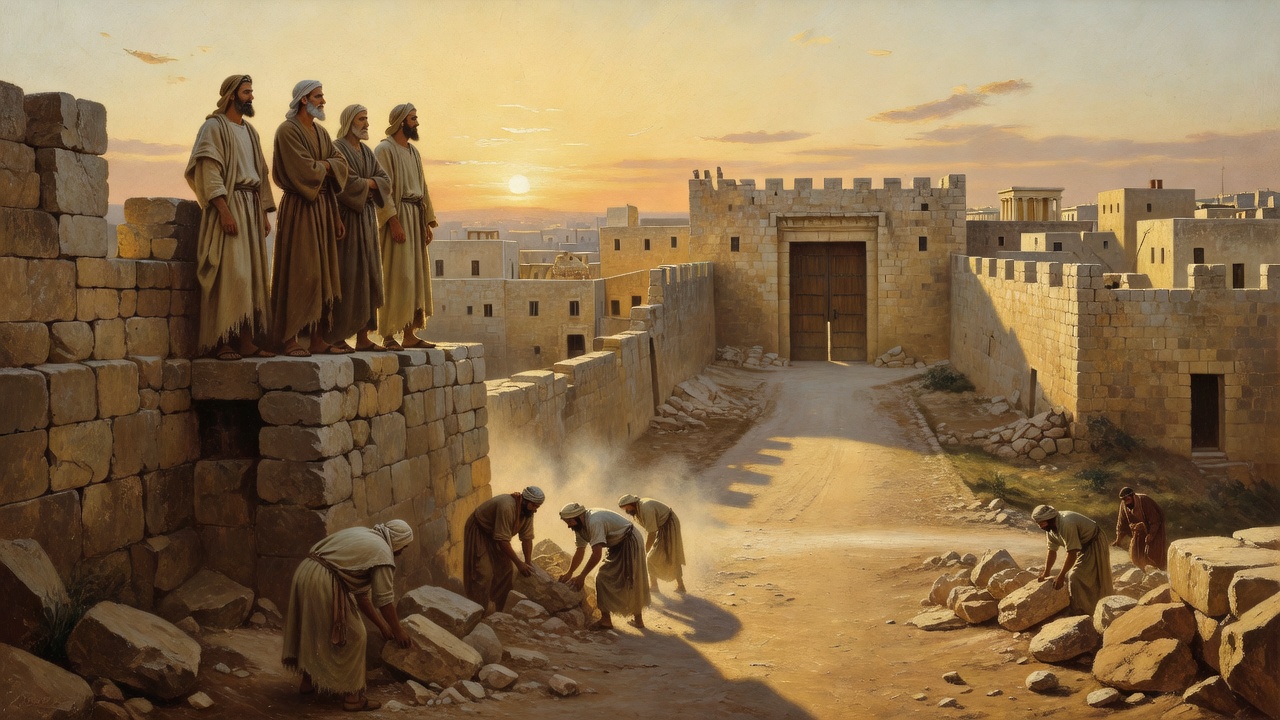
6I have set watchmen upon thy walls, O Jerusalem; they shall never hold their peace day nor night: ye that are Jehovah’s remembrancers, take ye no rest, 7and give him no rest, till he establish, and till he make Jerusalem a praise in the earth. 8Jehovah hath sworn by his right hand, and by the arm of his strength, Surely I will no more give thy grain to be food for thine enemies; and foreigners shall not drink thy new wine, for which thou hast labored: 9but they that have garnered it shall eat it, and praise Jehovah; and they that have gathered it shall drink it in the courts of my sanctuary.
10Go through, go through the gates; prepare ye the way of the people; cast up, cast up the highway; gather out the stones; lift up an ensign for the peoples. 11Behold, Jehovah hath proclaimed unto the end of the earth, Say ye to the daughter of Zion, Behold, thy salvation cometh; behold, his reward is with him, and his recompense before him. 12And they shall call them The holy people, The redeemed of Jehovah: and thou shalt be called Sought out, A city not forsaken.
Did you know?
The Restoration and Renaming of Jerusalem
- In this chapter, Jerusalem and Zion are promised new symbolic names that reflect a dramatic change in status. Rather than being known as Forsaken or Desolate, the city and its land are given names such as Hephzibah (meaning delight is in her) and Beulah (signifying a married land), portraying restoration through the imagery of a joyous wedding feast.Sources: the Bible text itself · Jerusalem · Zion
- The poem depicts continuous watchmen stationed atop the stone walls of Jerusalem who keep unceasing vigil day and night. Their role goes beyond standard military sentry duty, as they are instructed to persistently remind the LORD to establish the mountain city and make it the praise of the earth.Sources: the Bible text itself · Jerusalem
- The command to go through the city gates, clear stones, and build up a raised highway uses the ancient imagery of preparing a royal processional route to welcome returning people and signal salvation to surrounding nations.Sources: the Bible text itself
Notes written with AI assistance from open sources (Theographic Bible Metadata, CC BY-SA 4.0; Easton’s Bible Dictionary, public domain) and reviewed before publishing.
Places in this chapter
- Jerusalem · 31.777, 35.234 · verses 1, 5, 6, 7, 8, 12
- Zion · Today: Jerusalem · 31.777, 35.234 · verses 1, 11
Only places identified with high confidence are shown (90% or more according to the scholarly sources compiled by OpenBible). Period map: DARE (Digital Atlas of the Roman Empire), CC BY 4.0; modern map: © OpenStreetMap contributors; places: OpenBible.info (CC BY 4.0).
Credits and license for this translation
American Standard Version (1901)
The American Standard Version of the Holy Bible, first published in 1901.
Public Domain
Language: English
Dialect: Archaic American
This public domain Bible translation is brought to you courtesy of eBible.org.
If you would like to make a donation to help keep free Bible access like this going, please visit https://eBible.org/give.php .
2026-10-02
Section headings adapted from the Berean Standard Bible (public domain); they are not part of this translation’s text.
Source: http://ebible.org/eng-asv/ · eBible.org