Song of Songs 7
Brenton Septuagint Translation · Tap a verse to see its cross-references.
Admiration by the Bridegroom
1Return, return, O Sunamite; return, return, and we will look at thee.
What will ye see in the Sunamite? She comes as bands of armies.
2Thy steps are beautiful in shoes, O daughter of the prince: the joints of thy thighs are like chains, the work of the craftsman. 3Thy navel is as a turned bowl, not wanting liquor; thy belly is as a heap of wheat set about with lilies. 4Thy two breasts are as two twin fawns. 5Thy neck is as an ivory tower; thine eyes are as pools in Esebon, by the gates of the daughter of many: thy nose is as the tower of Libanus, looking toward Damascus. 6Thy head upon thee is as Carmel, and the curls of thy hair like scarlet; the king is bound in the galleries. 7How beautiful art thou, and how sweet art thou, my love! 8This is thy greatness in thy delights: thou wast made like a palm tree, and thy breasts to clusters. 9I said, I will go up to the palm tree, I will take hold of its high boughs: and now shall thy breasts be as clusters of the vine, and the smell of thy nose as apples;
The Bride
10and thy throat as good wine, going well with my kinsman, suiting my lips and teeth.
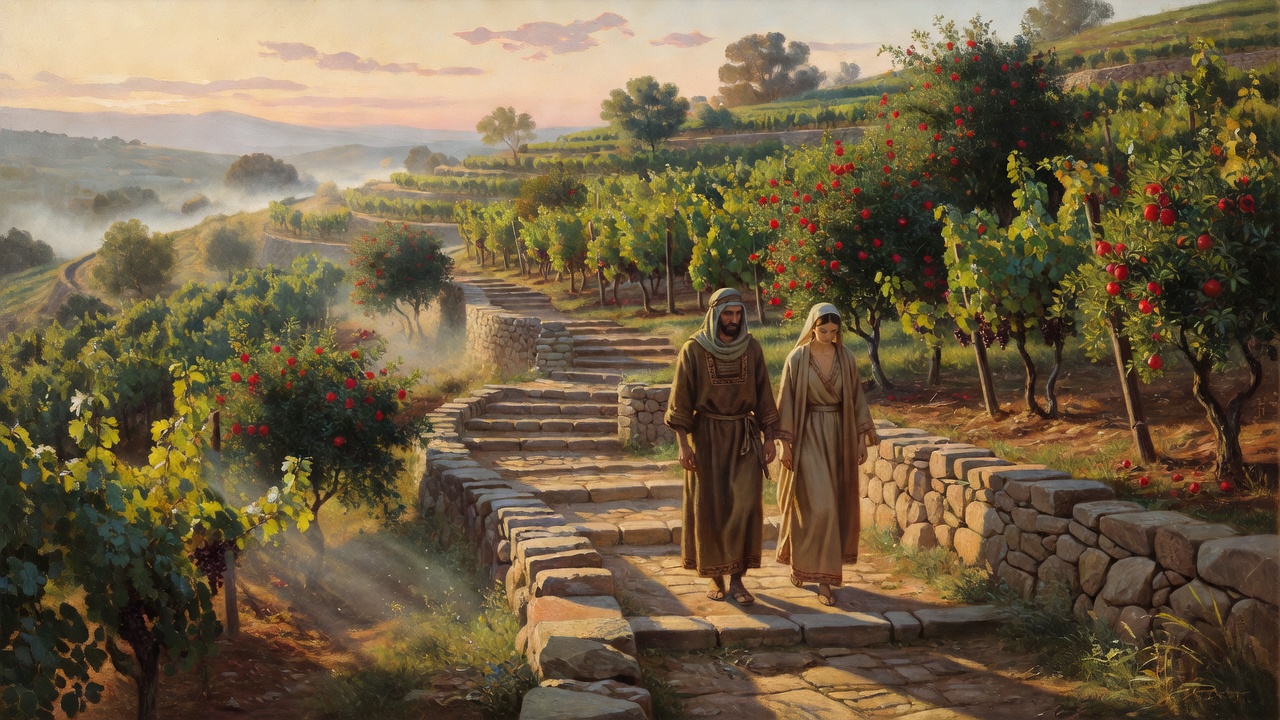
11I am my kinsman's, and his desire is toward me. 12Come, my kinsman, let us go forth into the field; let us lodge in the villages. 13Let us go early into the vineyards; let us see if the vine has flowered, if the blossoms have appeared, if the pomegranates have blossomed; there will I give thee my breasts. 14The mandrakes have given a smell, and at our doors are all kinds of choice fruits, new and old. O my kinsman, I have kept them for thee.
Did you know?
Poetry of Love and Landscape
- The poem describes the woman's beauty using prominent landmarks of the region. Her eyes are compared to the calm pools of Heshbon near the gate of Bath-rabbim east of the Jordan, while her profile is likened to a majestic tower in the mountain range of Lebanon overlooking Damascus.Sources: the Bible text itself · Heshbon · Bath-rabbim · Lebanon
- The chapter concludes with an invitation to the countryside during the renewal of spring. The lovers seek out budding grapevines, blooming pomegranates, and fragrant mandrakes, reflecting the close connection in ancient Hebrew poetry between romantic intimacy and the vitality of the natural world.Sources: the Bible text itself
Notes written with AI assistance from open sources (Theographic Bible Metadata, CC BY-SA 4.0; Easton’s Bible Dictionary, public domain) and reviewed before publishing.
Places in this chapter
- Bath-rabbim · Today: in Tell Hesban · 31.801, 35.809 · verse 4
- Damascus · 33.511, 36.306 · verse 4
- Lebanon · 33.540, 35.584 · verse 4
- Mount Carmel · 32.672, 35.023 · verse 5
Only places identified with high confidence are shown (90% or more according to the scholarly sources compiled by OpenBible). Period map: DARE (Digital Atlas of the Roman Empire), CC BY 4.0; modern map: © OpenStreetMap contributors; places: OpenBible.info (CC BY 4.0).
Credits and license for this translation
Translation of the Greek Septuagint into English by Sir Lancelot Charles Lee Brenton
Published in 1851, and now in the Public Domain.
If you find errors in the text, please report them so that we can correct them.
Section headings adapted from the Berean Standard Bible (public domain); they are not part of this translation’s text.
Source: http://ebible.org/eng-Brenton/ · eBible.org