Proverbs 27
Brenton Septuagint Translation · Tap a verse to see its cross-references.
Do Not Boast about Tomorrow
1Boast not of to-morrow; for thou knowest not what the next day shall bring forth. 2Let thy neighbour, and not thine own mouth, praise thee; a stranger, and not thine own lips. 3A stone is heavy, and sand cumbersome; but a fool's wrath is heavier than both. 4Wrath is merciless, and anger sharp: but envy can bear nothing. 5Open reproofs are better than secret love. 6The wounds of a friend are more to be trusted than the spontaneous kisses of an enemy.
7A full soul scorns honeycombs; but to a hungry soul even bitter things appear sweet. 8As when a bird flies down from its own nest, so a man is brought into bondage whenever he estranges himself from his own place. 9The heart delights in ointments and wines and perfumes: but the soul is broken by calamities.
10Thine own friend, and thy father's friend, forsake not; and when thou art in distress go not into thy brother's house: better is a friend that is near than a brother living far off. 11Son, be wise, that thy heart may rejoice; and remove thou from thyself reproachful words. 12A wise man, when evils are approaching, hides himself; but fools pass on, and will be punished. 13Take away the man's garment, (for a scorner has passed by) whoever lays waste another's goods. 14Whosoever shall bless a friend in the morning with a loud voice, shall seem to differ nothing from one who curses him.
15On a stormy day drops of rain drive a man out of his house; so also does a railing woman drive a man out of his own house. 16The north wind is sharp, but it is called by name propitious. 17Iron sharpens iron; and a man sharpens his friend's countenance. 18He that plants a fig-tree shall eat the fruits of it: so he that waits on his own master shall be honoured. 19As faces are not like other faces, so neither are the thoughts of men. 20Hell and destruction are not filled; so also are the eyes of men insatiable. 20[He that fixes his eye is an abomination to the Lord; and the uninstructed do not restrain their tongue.] 21Fire is the trial for silver and gold; and a man is tried by the mouth of them that praise him. 21The heart of the transgressor seeks after mischiefs; but an upright heart seeks knowledge. 22Though thou scourge a fool, disgracing him in the midst of the council, thou wilt still in no wise remove his folly from him.
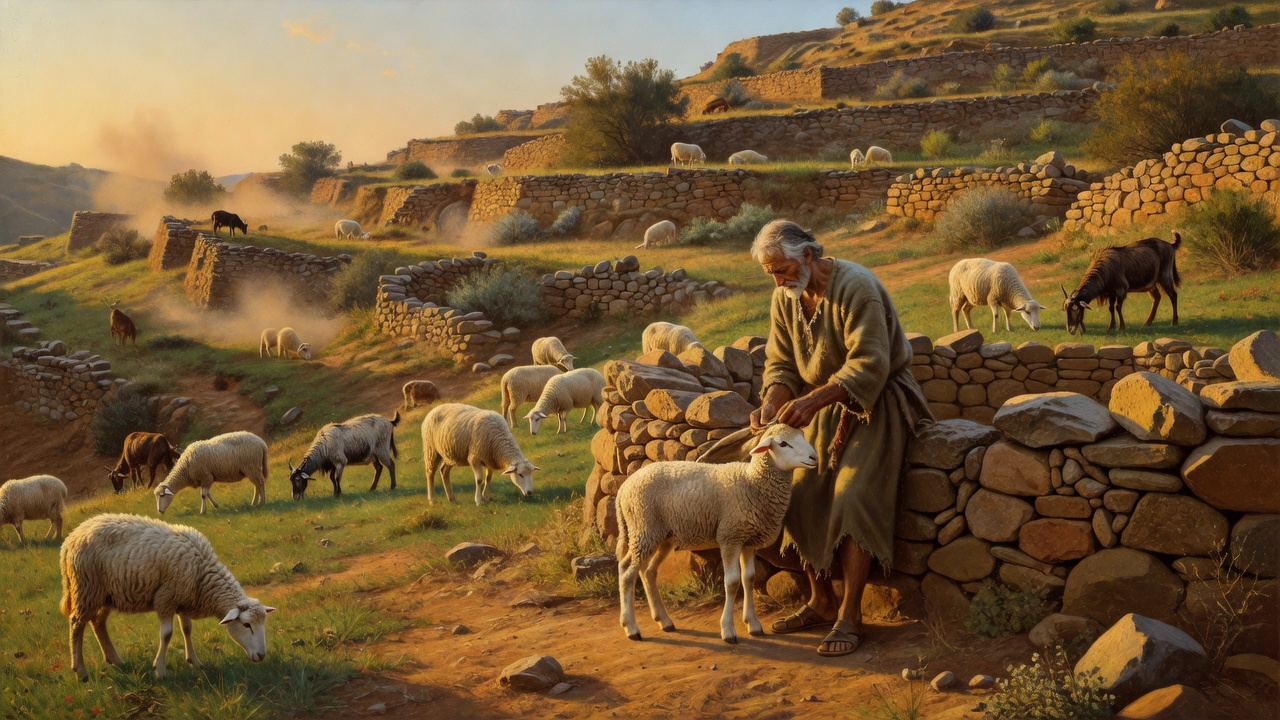
23Do thou thoroughly know the number of thy flock, and pay attention to thine herds. 24For a man has not strength and power for ever; neither does he transmit it from generation to generation. 25Take care of the herbage in the field, and thou shalt cut grass, and gather the mountain hay; 26that thou mayest have wool of sheep for clothing: pay attention to the land, that thou mayest have lambs. 27My son, thou hast from me words very useful for thy life, and for the life of thy servants.
Did you know?
Friendship, Prudence, and Daily Diligence
- Proverbs 27 places a strong emphasis on authentic relationships, contrasting the deceitful kisses of an enemy with the faithful wounds of a friend. It famously describes constructive interpersonal interaction with the metaphor of iron sharpening iron, while also advising reliance on a nearby neighbor over a distant relative in times of crisis.Sources: the Bible text itself
- The chapter draws on practical illustrations from ancient daily crafts and domestic life, such as refining silver and gold in a crucible and furnace, grinding grain with a mortar and pestle, and observing one's reflection in water.Sources: the Bible text itself
- The closing section outlines the seasonal realities of an agrarian and pastoral economy. It urges careful oversight of flocks and herds, noting that wealth and political crowns are fleeting, while diligent care of livestock and land reliably provides food, goat milk, and wool for the household.Sources: the Bible text itself
Notes written with AI assistance from open sources (Theographic Bible Metadata, CC BY-SA 4.0; Easton’s Bible Dictionary, public domain) and reviewed before publishing.
Credits and license for this translation
Translation of the Greek Septuagint into English by Sir Lancelot Charles Lee Brenton
Published in 1851, and now in the Public Domain.
If you find errors in the text, please report them so that we can correct them.
Section headings adapted from the Berean Standard Bible (public domain); they are not part of this translation’s text.
Source: http://ebible.org/eng-Brenton/ · eBible.org