Leviticus 6
Brenton Septuagint Translation · Tap a verse to see its cross-references.
Sins Requiring a Guilt Offering
1And the Lord spoke to Moses, saying, 2Charge Aaron and his sons, saying, This is the law of whole-burnt-offering; this is the whole-burnt-offering in its burning on the altar all the night till the morning; and the fire of the altar shall burn on it, it shall not be put out. 3And the priest shall put on the linen tunic, and he shall put the linen drawers on his body; and shall take away that which has been thoroughly burnt, which the fire shall have consumed, even the whole-burnt-offering from the altar, and he shall put it near the altar. 4And he shall put off his robe, and put on another robe, and he shall take forth the offering that has been burnt without the camp into a clean place. 5And the fire on the altar shall be kept burning on it, and shall not be extinguished; and the priest shall burn on it wood every morning, and shall heap on it the whole-burnt-offering, and shall lay on it the fat of the peace-offering. 6And the fire shall always burn on the altar; it shall not be extinguished. 7This is the law of the sacrifice, which the sons of Aaron shall bring near before the Lord, before the altar.
The Burnt Offering
8And he shall take from it a handful of the fine flour of the sacrifice with its oil, and with all its frankincense, which are upon the sacrifice; and he shall offer up on the altar a burnt-offering as a sweet-smelling savour, a memorial of it to the Lord. 9And Aaron and his sons shall eat that which is left of it: it shall be eaten without leaven in a holy place, they shall eat it in the court of the tabernacle of witness. 10It shall not be baked with leaven. I have given it as a portion to them of the burnt-offerings of the Lord: it is most holy, as the offering for sin, and as the offering for trespass. 11Every male of the priests shall eat it: it is a perpetual ordinance throughout your generations of the burnt-offerings of the Lord; whosoever shall touch them shall be hallowed.
12And the Lord spoke to Moses, saying, 13This is the gift of Aaron and of his sons, which they shall offer to the Lord in the day in which thou shalt anoint him; the tenth of an ephah of fine flour for a sacrifice continually, the half of it in the morning, and the half of it in the evening.
The Grain Offering
14It shall be made with oil in a frying-pan; he shall offer it kneaded and in rolls, an offering of fragments, an offering of a sweet savour unto the Lord. 15The anointed priest who is in his place, one of his sons, shall offer it: it is a perpetual statute, it shall all be consumed. 16And every sacrifice of a priest shall be thoroughly burnt, and shall not be eaten. 17And the Lord spoke to Moses, saying, 18Speak to Aaron and to his sons, saying, This is the law of the sin-offering;—in the place where they slay the whole-burnt-offering, they shall slay the sin-offerings before the Lord: they are most holy. 19The priest that offers it shall eat it: in a holy place it shall be eaten, in the court of the tabernacle of witness. 20Every one that touches the flesh of it shall be holy, and on whosesoever garment any of its blood shall have been sprinkled, whosoever shall have it sprinkled, shall be washed in the holy place. 21And the earthen vessel, in whichsoever it shall have been sodden, shall be broken; and if it shall have been sodden in a brazen vessel, he shall scour it and wash it with water. 22Every male among the priests shall eat it: it is most holy to the Lord. 23And no offerings for sin, of whose blood there shall be brought any into the tabernacle of witness to make atonement in the holy place, shall be eaten: they shall be burned with fire.
Did you know?
Priestly Duties and the Continuous Altar Fire
- For offenses involving robbery, extortion, or falsely swearing about lost property, the law required full restitution plus an additional fifth of the property's value paid to the rightful owner before the offender could present a ram for the guilt offering.Sources: the Bible text itself
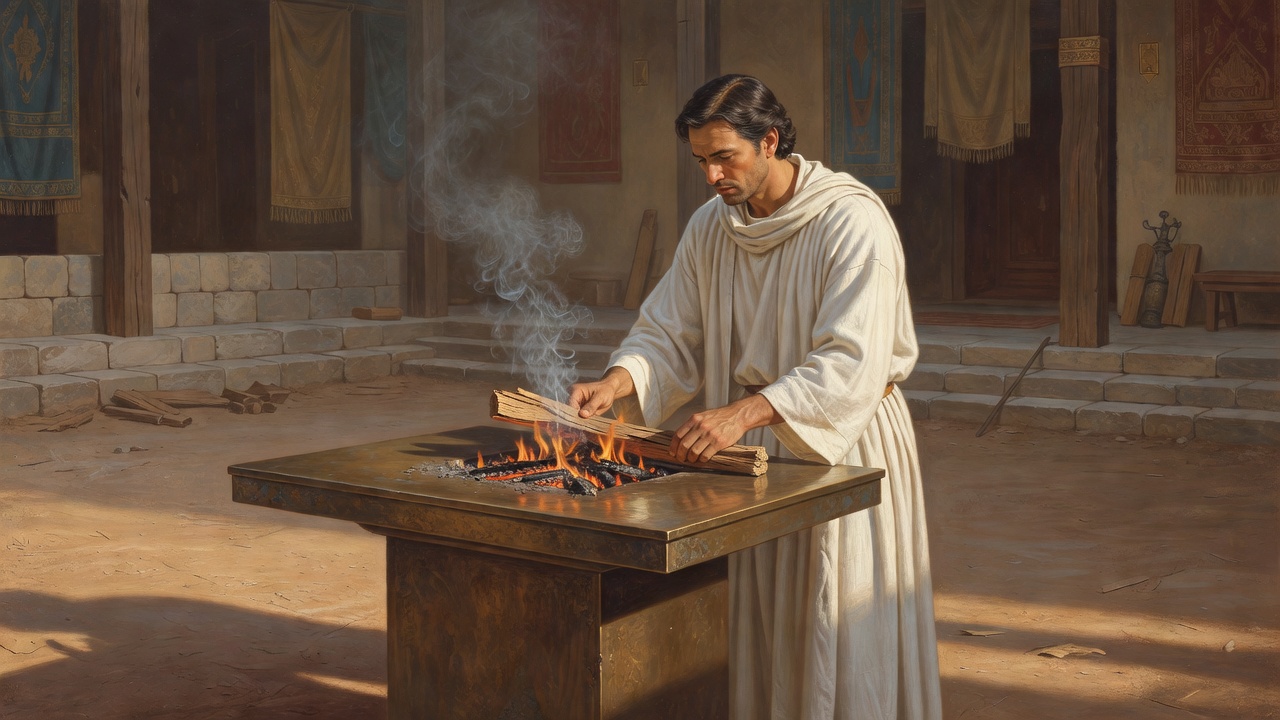
- The priests were commanded to keep the fire on the altar burning continually day and night without ever letting it go out. Each morning, a priest wearing linen garments arranged fresh wood on the altar and removed the ashes to carry them outside the camp.Sources: the Bible text itself
- Because the sin offering was considered most holy, strict regulations governed the vessels used to prepare it: clay pots used for boiling its meat had to be broken, whereas bronze vessels could be scoured and rinsed with water.Sources: the Bible text itself
Notes written with AI assistance from open sources (Theographic Bible Metadata, CC BY-SA 4.0; Easton’s Bible Dictionary, public domain) and reviewed before publishing.
Credits and license for this translation
Translation of the Greek Septuagint into English by Sir Lancelot Charles Lee Brenton
Published in 1851, and now in the Public Domain.
If you find errors in the text, please report them so that we can correct them.
Section headings adapted from the Berean Standard Bible (public domain); they are not part of this translation’s text.
Source: http://ebible.org/eng-Brenton/ · eBible.org